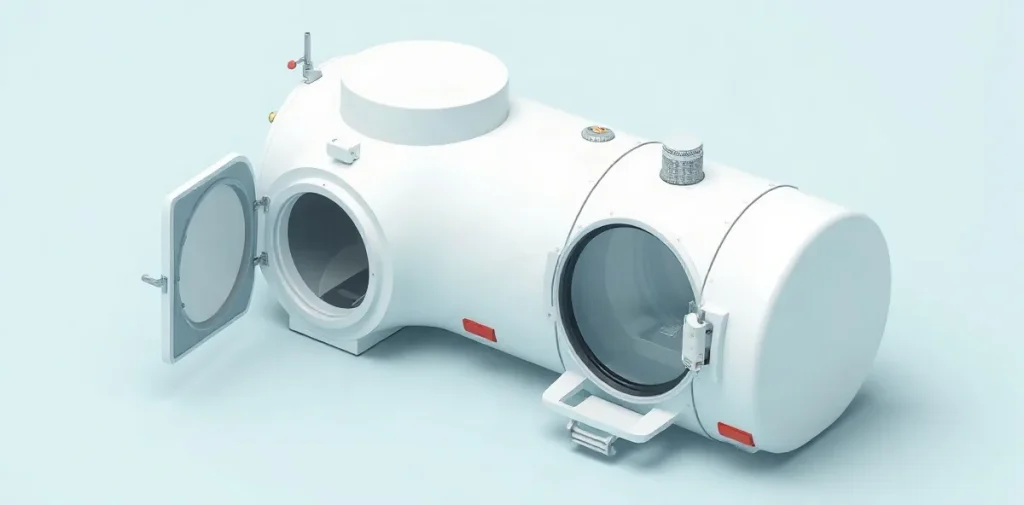
A hyperbaric chamber is an enclosed space in which pressure can be raised above the pressure of the surrounding air. In diving medicine, chambers are used to provide controlled pressure and oxygen exposure, most notably in the treatment of decompression illness; understanding their role also clarifies how pressure affects divers underwater.
What does a hyperbaric chamber do?
As a diver descends, increasing ambient pressure compresses gas in air spaces and increases the amount of inert gas that dissolves in body tissues. During ascent, pressure falls and dissolved gas returns towards the lungs for elimination. If this process is disrupted, bubbles may form in tissues or blood and cause decompression illness.
A treatment chamber lets clinicians control pressure and the breathing gas while observing the patient. Recompression can reduce bubble size and restore conditions that help inert gas leave the body; oxygen breathing can support oxygen delivery and promote inert-gas elimination. The exact treatment plan depends on the clinical presentation and the chamber protocol.
Why is pressure relevant to divers?
Pressure is not just an equipment setting. It changes gas volume, gas density and the partial pressures of gases in a diver’s breathing mix. These changes help explain familiar diving hazards, including barotrauma, nitrogen narcosis and decompression stress, while also shaping how a chamber is used in medical care.
The chamber therefore connects two parts of diving medicine: preventing injury during exposure and treating illness after it occurs. A diver’s depth, time underwater, ascent, breathing gas and symptoms all matter to clinical assessment. Symptoms that could indicate decompression illness warrant prompt evaluation by diving-medicine professionals rather than an attempt to diagnose the problem underwater.
What concepts help explain chamber treatment?
Several basic ideas recur in research and clinical discussions of hyperbaric exposure:
- Ambient pressure: the pressure around the body, which rises with depth underwater and can also be increased inside a chamber.
- Partial pressure: the share of total pressure contributed by an individual gas; it helps determine how gases behave in the lungs and tissues.
- Inert-gas uptake and elimination: the movement of gases such as nitrogen between breathing gas, blood and tissues as pressure changes.
- Recompression: a controlled increase in pressure used in chamber treatment, followed by a planned return to surface pressure.
- Oxygen exposure: breathing oxygen under pressure can be therapeutically useful, but exposure must be managed because oxygen itself can become toxic at elevated partial pressures.
These concepts do not make chamber treatment interchangeable with simply returning a diver to depth. Clinical recompression requires a controlled environment, trained personnel and a prescribed schedule. The choice of treatment also depends on the person’s condition and the risks of continuing pressure exposure.
How does chamber care differ from diving?
Both activities involve pressure, but their purposes and safeguards differ. A dive is an exposure in which the diver must manage buoyancy, gas supply, environmental hazards and a safe ascent. In a chamber, clinicians control the pressure profile and breathing gas while monitoring a patient and responding to changes in condition.
Chamber treatment also has limits and potential complications. Pressure changes can affect the ears and sinuses, and oxygen exposure requires careful control. A diving-medicine physician or hyperbaric clinician weighs those considerations against the need to treat the suspected injury; decisions should be based on clinical assessment, not on symptoms alone.
What questions does research address?
Research on hyperbaric medicine examines how pressure and breathing gases affect physiology, how treatment schedules can be applied safely, and how clinical signs relate to underwater exposure. It sits alongside work on decompression theory, gas toxicities, barotrauma and the recognition of diving-related illness.
For divers and clinicians, the practical value is a clearer framework for connecting an exposure history with a medical response. If a diver develops concerning symptoms after a dive, provide the treating team with the dive profile and breathing-gas details when available, and seek assessment from a diving-medicine physician.
Frequently asked questions
Is a hyperbaric chamber only used for diving injuries?
Does chamber recompression mean a diver should return underwater?
Who should assess possible decompression illness?
An original research-library explainer written by the Rubicon editors. It is not a summary of a specific publication.
Related reading on Rubicon
- The Diving Reflex: What Happens Underwater
- Scuba Diving Regulators: Balanced vs. Unbalanced
- Scuba Diving Buddy Checks: Catch Problems Early
- Scuba Diving: Why Immersion Can Dehydrate You
- Thesis Research in Diving and Hyperbaric Medicine
- Oxygen in Diving and Hyperbaric Medicine
- More on Dive Medicine
- Browse the Research Library