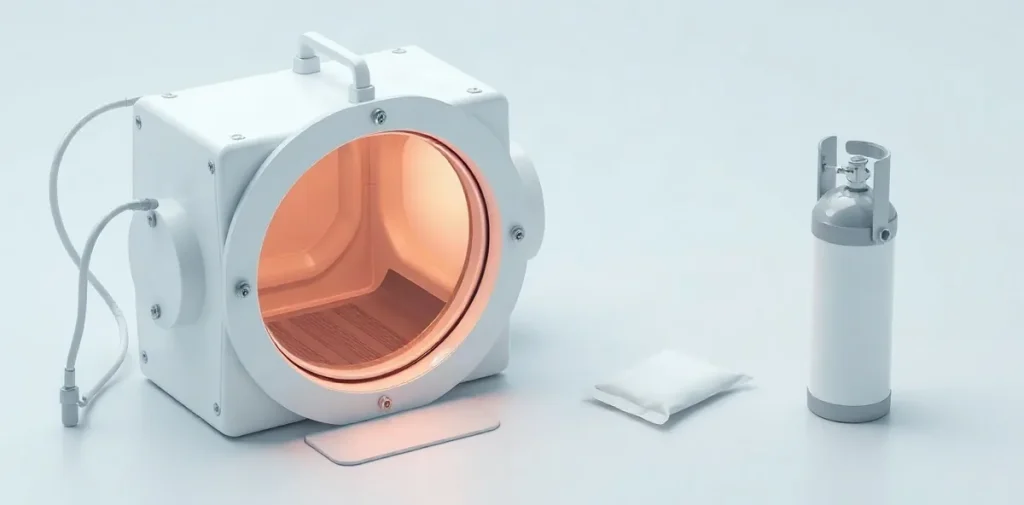
Research on hyperbaric oxygen and scopolamine sits at the intersection of pressure medicine, pharmacology and human performance. It asks how a medicine used against motion sickness may interact with oxygen delivered under increased pressure—a question relevant to treatment chambers and to understanding the effects of drugs in diving environments.
Why consider a motion-sickness drug under pressure?
Scopolamine acts on muscarinic acetylcholine receptors and can reduce nausea and motion sickness. It can also cause effects such as dry mouth, blurred vision, drowsiness or confusion. Those effects matter underwater, where clear vision, attention and coordinated action are safety-critical.
Hyperbaric oxygen is oxygen breathed at a pressure greater than surface pressure, commonly in a medical chamber. Pressure changes the conditions in which gases are breathed and can affect the body’s response to oxygen. Studying a drug alongside hyperbaric oxygen therefore raises questions about both therapeutic use and the recognition of adverse effects.
What physiological questions does this research raise?
One central issue is whether exposure to increased oxygen pressure changes the effects of a medicine, or whether the medicine alters how a person responds to the exposure. These are distinct possibilities: an observed change could involve the nervous system, oxygen-related effects, the medication, or their interaction.
Scopolamine’s action on the nervous system makes cognitive and sensory function relevant outcomes. In a controlled study, investigators may examine symptoms, alertness, visual or other sensory effects, and task performance, while controlling the exposure conditions and timing of medication. The exact measures depend on the question being tested.
Such work belongs to a broader effort to understand human responses to hyperbaric environments. The same setting is used to investigate oxygen exposure, treatment protocols and physiological responses, while diving medicine also considers how illness, medication and environmental stressors can complicate assessment.
How do studies of this kind examine the problem?
A useful design separates the effects of pressure, oxygen and medication rather than treating “the chamber” as a single variable. Depending on the research question, comparisons can include different exposure conditions, medication conditions, or both. Researchers also need to consider when the drug is taken relative to exposure and how long effects are assessed.
Common considerations include:
- Exposure: the breathing gas, pressure and duration determine the hyperbaric conditions being studied.
- Medication: dose and timing can affect both the presence and duration of drug effects.
- Assessment: symptoms and performance measures address different aspects of a person’s response.
- Interpretation: a change during exposure does not by itself identify whether oxygen, pressure or medication caused it.
Controlled chamber research can isolate variables more readily than open-water diving, but chamber findings do not automatically predict performance in water. Immersion, exertion, equipment, temperature and task demands can all change the practical significance of a symptom or medication effect.
What does this mean for divers and clinicians?
For divers, the key concern is functional: a medicine that reduces nausea may also affect alertness, vision or judgment. Underwater, even a familiar side effect can interfere with navigation, communication or responding to an unexpected problem. Whether a medication is appropriate depends on the person, the dive and the treatment context.
For hyperbaric clinicians, medication effects can complicate the distinction between a drug reaction and a response to oxygen exposure or another clinical problem. A careful medication history and attention to symptom timing help frame that assessment. Decisions about treatment or fitness to dive belong with a physician experienced in diving medicine, particularly when hyperbaric oxygen is involved.
How does the topic fit into diving research?
Diving medicine studies more than decompression and pressure injury. It also examines motion sickness, medication safety and the ways environmental conditions shape human performance. Research on scopolamine under hyperbaric conditions connects these themes: it treats the diver or patient as a person exposed to interacting physiological and pharmacological factors.
That perspective is useful even when a chamber study does not mirror a dive. It helps define which questions need testing under controlled conditions and which require further consideration in operational settings. For any individual decision, the relevant details are the medication, the exposure and the person’s medical circumstances.
Frequently asked questions
What is scopolamine used for?
Why study a medication in a hyperbaric chamber?
Can a diver decide independently whether to use scopolamine?
An original research-library explainer written by the Rubicon editors. It is not a summary of a specific publication.
Related reading on Rubicon
- The Physiology Behind Oxygen Toxicity in Deep Dives
- Understanding Oxygen Toxicity Risks and Prevention in Diving
- Myth Busting: Clarifying Oxygen Toxicity Limits in Diving
- The Diving Reflex: What Happens Underwater
- Oxygen in Diving and Hyperbaric Medicine
- Oxygen Toxicity in Diving and Hyperbaric Medicine
- More on Dive Medicine
- Browse the Research Library