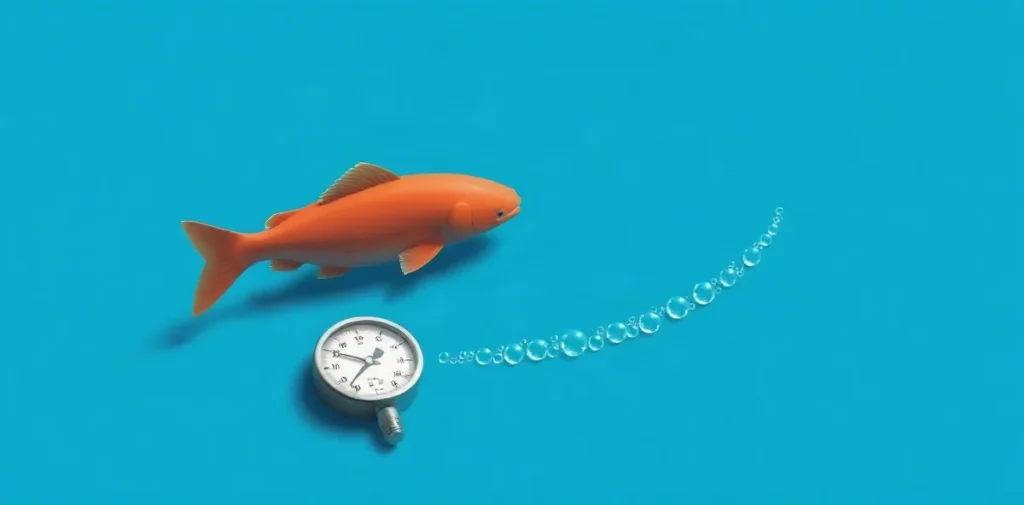
Decompression research asks how pressure exposure and the return to lower pressure affect the body, and which parts of that process drive injury. Studies using fish such as fingerling salmon offer a way to examine decompression biology in a living organism, with questions relevant to dive planning, medical care and the limits of translating animal research to human divers.
Why separate the parts of decompression?
During a dive, elevated ambient pressure increases the partial pressure of breathing gases. Inert gases such as nitrogen can dissolve into tissues; during ascent, falling pressure allows those gases to leave solution and be eliminated through the lungs. The rate and pattern of pressure change influence how this process unfolds.
Decompression sickness is associated with gas bubbles forming in tissues or blood, but risk is not captured by a single pressure reading. Exposure duration, depth, ascent profile, breathing gas and individual physiology interact. Research that isolates variables can help clarify which mechanisms matter and how one exposure condition changes the effect of another.
What can a fish model examine?
Salmon are vertebrates with circulatory and respiratory systems, making them useful subjects for questions about gas exchange and decompression effects. Research involving fingerling salmon can investigate how pressure exposure relates to bubble formation or physiological stress in a living animal, rather than relying only on a physical model or measurements made outside the body.
Animal models also have boundaries. Fish physiology, habitat and breathing differ from those of human divers, and an observed response in a fish cannot be treated as a direct prediction of human illness. The model is most useful for examining mechanisms and generating questions that can be tested against other experimental and clinical evidence.
Which variables shape decompression?
Decompression research often tries to distinguish the effects of exposure from those of ascent and recovery. That means considering both the pressure history and the biological response, while controlling the conditions that could otherwise obscure their relationship.
- Pressure exposure: depth and time determine the conditions under which inert gas enters tissues.
- Ascent profile: the rate and sequence of pressure reduction affect the gradient driving gas elimination and bubble formation.
- Gas and tissue exchange: gases move between lungs, blood and tissues at different rates.
- Biological response: bubbles and other physiological changes are relevant outcomes, but their presence alone does not establish the severity or clinical meaning of an effect.
Separating these factors is difficult because changing one part of a dive profile can alter several linked processes. Experimental design therefore matters: a useful comparison must distinguish the variable under study from changes in exposure, observation or recovery conditions.
How does this fit into diving medicine?
Decompression has long been a central problem in diving science because divers must return to surface pressure without causing unacceptable injury. The field connects physical models of gas dissolution and bubble formation with biological observations, human experience and practical decompression procedures.
Animal work is one strand of that wider effort. It can help investigate fundamental mechanisms that are hard to isolate in people, while human studies and clinical practice address how those mechanisms relate to symptoms, diagnosis and care. Findings from one strand need careful interpretation before they inform another.
What does the research mean for divers?
Decompression physiology provides the basis for understanding why ascent procedures matter and why risk can vary between dives that appear similar. It also helps clinicians frame questions about a diver’s exposure and symptoms. A research model, however, is not a personal risk calculator or a substitute for established dive procedures.
If symptoms occur after diving, seek prompt assessment from a diving-medicine physician or emergency service; do not use animal research to judge whether symptoms are harmless. Decisions about fitness to dive, treatment or return to diving should be made with an appropriately qualified clinician.
Frequently asked questions
Why study decompression in fish?
What is decompression sickness?
Can animal research set a safe ascent rate for divers?
An original research-library explainer written by the Rubicon editors. It is not a summary of a specific publication.
Related reading on Rubicon
- Safety Dive: Safety Stops vs Decompression Stops
- Decompression Sickness: Causes and Risk Reduction
- The Science of Diving SSI: Education and Physiology Insights
- Diving Science: Physiology and Tech Behind Safe Dives
- Decompression Bubbles, Salmon and Diver Physiology
- Bubble Formation and Decompression Sickness in Salmon
- More on Diving Science
- Browse the Research Library