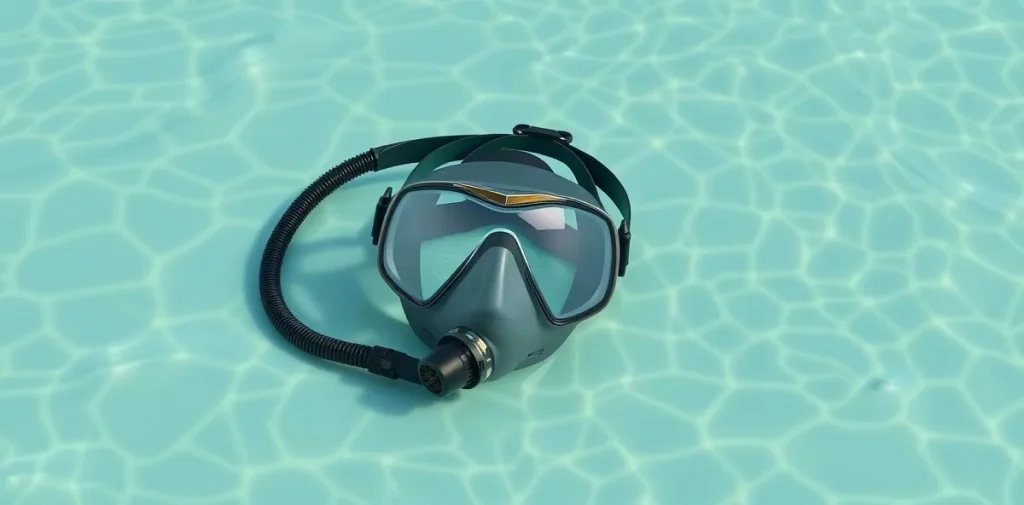
Full-face masks used with very shallow-water breathing apparatus bring two pieces of diving equipment into one working system: a face-covering interface and a means of supplying breathing gas near the surface. Their evaluation concerns whether the diver can breathe, see, communicate and work safely with the combination under its intended conditions.
What makes a full-face mask a system, not just a face covering?
A full-face mask encloses the eyes, nose and mouth, allowing the diver to breathe through a connected gas supply while keeping the face covered. Its seal, internal air space, valves and regulator interface all affect how it works. A poor fit or a leak can compromise the breathing system, not merely cause discomfort.
Very shallow-water apparatus is intended for operations close to the surface, where equipment configuration and the diver’s position relative to the water can shape gas delivery. Pairing such an apparatus with a full-face mask raises a compatibility question: components that work separately must also function together as a complete system.
Which performance questions matter underwater?
Equipment assessment examines breathing resistance, gas delivery and the mask’s behaviour during changes in posture or work rate. Resistance is the effort required to draw in and exhale gas. It can affect comfort and workload, especially when the diver is moving or performing a task rather than resting.
Fit and stability matter because movement, head position and facial variation can affect the seal. A mask must also provide a useful field of view and remain manageable during normal tasks. Evaluation may therefore consider the diver’s ability to orient, use equipment and respond to a problem while wearing the complete setup.
- Breathing performance: whether gas delivery and breathing effort remain workable across the intended use.
- Fit and sealing: whether the mask stays secure and limits water entry.
- Operational usability: whether vision, movement and task performance are practical.
- System compatibility: whether the mask and breathing apparatus function together as configured.
How are equipment questions assessed?
Studies of breathing equipment commonly combine inspection of the design with controlled testing and diver use. Instrumented tests can examine gas flow and breathing effort; supervised in-water evaluation can reveal fit, visibility, handling and task-related issues that a bench test cannot reproduce on its own.
Conditions matter. Results from one configuration, depth range or activity cannot automatically be transferred to another, and performance with a stationary diver may not represent work in motion. A sound evaluation describes the setup and conditions clearly enough for users to judge whether they match their intended operation.
Why does this matter for divers and clinicians?
A breathing system affects more than comfort. Increased breathing effort can add to a diver’s workload, while water entering the mask or difficulty managing the equipment can distract from the task. For scientific and occupational divers, these issues may affect the quality and continuity of work; for dive teams, they shape training and emergency planning.
Full-face masks also change how the diver interacts with the environment and other people. Communication may be possible with some configurations, but it depends on the equipment and operating procedure. Any evaluation should distinguish a feature that exists from one that has been assessed in the conditions where it will be used.
What should a diver check before relying on the setup?
Use the equipment only within its intended operating conditions and follow the manufacturer’s instructions and the relevant training procedures. Check fit, seals, valves, connections and gas supply before entering the water. Familiarisation should include the tasks the diver will actually perform, not only breathing while stationary.
Equipment choice does not replace a plan for loss of gas, leakage or other failures. Divers should know the applicable procedures and have a team response suited to the operation. Questions about medical fitness, symptoms or a return to diving belong with a diving-medicine physician.
Frequently asked questions
What is a very shallow-water breathing apparatus?
Does a full-face mask prevent water from entering?
Can results from one equipment setup apply to another?
An original research-library explainer written by the Rubicon editors. It is not a summary of a specific publication.
Related reading on Rubicon
- Full-Face vs Traditional Dive Masks: Usability and Safety
- Risks and Prevention of Shallow Water Blackout
- Scuba Equipment: Stop Your Mask Fogging
- Diving Safety: Training, Gear, Sites, Risk
- Diver Breathing: Mouthpiece vs Full-Face Mask
- PAO2 and PACO2 During Breath-Hold
- More on Equipment
- Browse the Research Library