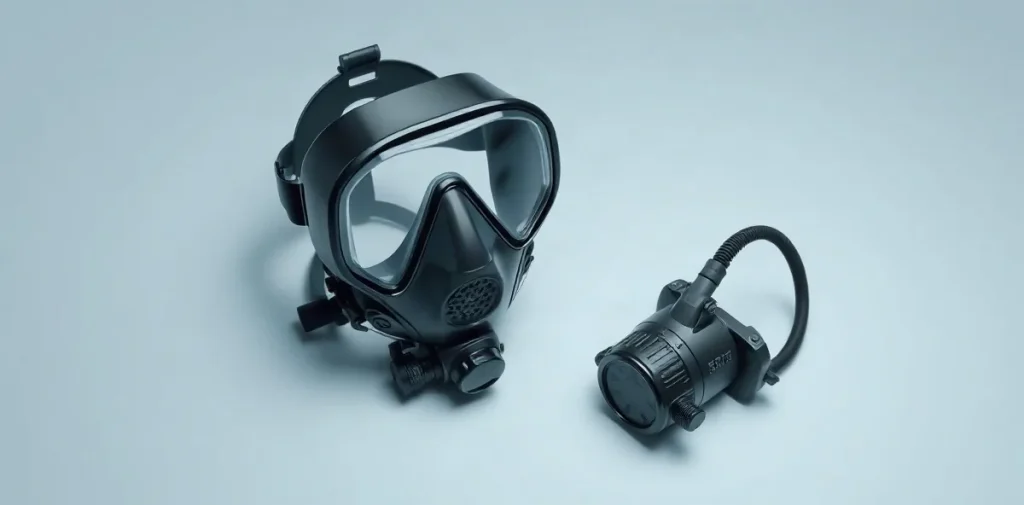
Evaluation of the KMS 48 Full Face Mask with the Viper Very Shallow Water Underwater Breathing Apparatus is a 2003 publication by Stanek and Hedricks in the US Naval Experimental Diving Unit Technical Report NEDU-TR-03-06. Its subject is a full-face mask used with a very shallow-water breathing apparatus—a pairing whose fit, breathing performance and operational demands matter to divers and equipment evaluators.
What equipment does the report address?
The title identifies two components: the KMS 48 Full Face Mask and the Viper Very Shallow Water Underwater Breathing Apparatus. A full-face mask encloses the eyes, nose and mouth, unlike a conventional diving mask, which covers the eyes and nose while the diver breathes through a separate mouthpiece.
That arrangement makes the interface between mask and breathing apparatus central. The mask must maintain a seal while allowing the diver to breathe and see; the apparatus must deliver breathing gas in a way that works with the mask’s internal space and the diver’s position in the water.
The report’s naval experimental-diving setting places the subject within applied equipment evaluation. Such work concerns how a specific combination functions in its intended operating context, rather than treating a mask or breathing unit as an isolated object.
Why does a full-face mask change the equipment question?
A full-face mask covers more of the face and creates a breathing space around the nose and mouth. Its seal, internal volume, visibility, comfort and ability to manage water entering the mask are all relevant to practical use. These features can affect how a diver interacts with the apparatus, especially if the mask must remain in place throughout a task.
Breathing performance is not determined by the gas supply alone. Pressure losses through the breathing circuit, the position of the demand mechanism, water pressure and the diver’s depth can influence the effort required to inhale and exhale. A system intended for very shallow water still has to be assessed as a complete configuration under the conditions for which it is designed.
Mask and apparatus compatibility also has a human-factors dimension. A diver must be able to see, communicate when required, clear or manage water, and respond to a problem without compromising the seal or gas supply. Those operational demands make the combination relevant to equipment specialists as well as to divers.
What do equipment evaluations of this kind examine?
Evaluation of a breathing system commonly considers the interface between its parts and how that interface behaves during use. The precise test plan depends on the device and intended operation; broad areas of interest include:
- Breathing resistance: the effort needed to move gas through the system during inhalation and exhalation.
- Fit and sealing: whether the mask remains secure and limits unwanted water entry.
- Visibility and handling: whether the diver can see and operate the equipment effectively.
- Water management: how the configuration accommodates water inside the mask or breathing space.
- Integrated operation: whether the mask and breathing apparatus function together in the intended shallow-water setting.
These considerations are connected. A change in mask fit can affect comfort and water intrusion, while the breathing circuit and the diver’s posture can influence breathing effort. An equipment assessment therefore asks how the whole arrangement works, not simply whether each component can function on its own.
How does this subject connect to diving medicine?
Breathing effort, gas delivery and equipment reliability are physiological concerns as well as engineering ones. Increased respiratory effort can add to a diver’s workload; if a diver is already exerting themselves, managing a task or coping with cold, that extra demand may matter. Equipment that complicates breathing or vision can also affect a diver’s ability to respond calmly to changing conditions.
For diving physicians and hyperbaric clinicians, equipment configuration is useful context when assessing a breathing-related problem. The question is not only what gas was available, but how the diver breathed it, what equipment was worn and what demands the task imposed. Individual symptoms or fitness-to-dive concerns require assessment by a diving-medicine physician.
In the wider field, this publication sits at the meeting point of diving equipment engineering, human factors and respiratory physiology. Very shallow-water systems still require careful evaluation: operating depth changes the pressure environment, but does not remove the need to assess the breathing apparatus, mask and diver as a working system.
What should readers keep in view?
The title defines the central subject: the KMS 48 full-face mask used with the Viper very shallow-water underwater breathing apparatus. The venue identifies the work as a US Naval Experimental Diving Unit technical report, a form suited to applied questions about equipment and its use.
Readers should distinguish the broad questions raised by this equipment pairing from conclusions about any particular test. In practical evaluation, the intended depth and task, breathing performance, fit, visibility and water management all shape what the system is suitable for; equipment documentation and current operational procedures remain important when assessing a specific use.
Frequently asked questions
What equipment is the publication about?
What does a full-face mask cover?
Why assess the mask and breathing apparatus together?
Citation details
- Title: Evaluation of the KMS 48 Full Face Mask with the Viper Very Shallow Water Underwater Breathing Apparatus
- Authors: Stanek, SJ and Hedricks, CS
- Year: 2003
- Published in: US Naval Experimental Diving Unit Technical Report NEDU-TR-03-06
- Record type: Journal article
- Repository record: Rubicon Research Repository, handle 123456789/3541
This page is an original summary written by the Rubicon editors from the publication’s bibliographic record. It does not reproduce the paper, its abstract or its data; consult the publication itself for its methods and findings.
Related reading on Rubicon
- Full-Face vs Traditional Dive Masks: Usability and Safety
- Risks and Prevention of Shallow Water Blackout
- The Diving Reflex: What Happens Underwater
- Scuba Equipment: Stop Your Mask Fogging
- Full-Face Masks and Very Shallow-Water Breathing Gear
- Drag and Human Locomotion in Water: Research Summary
- More on Equipment
- Browse the Research Library