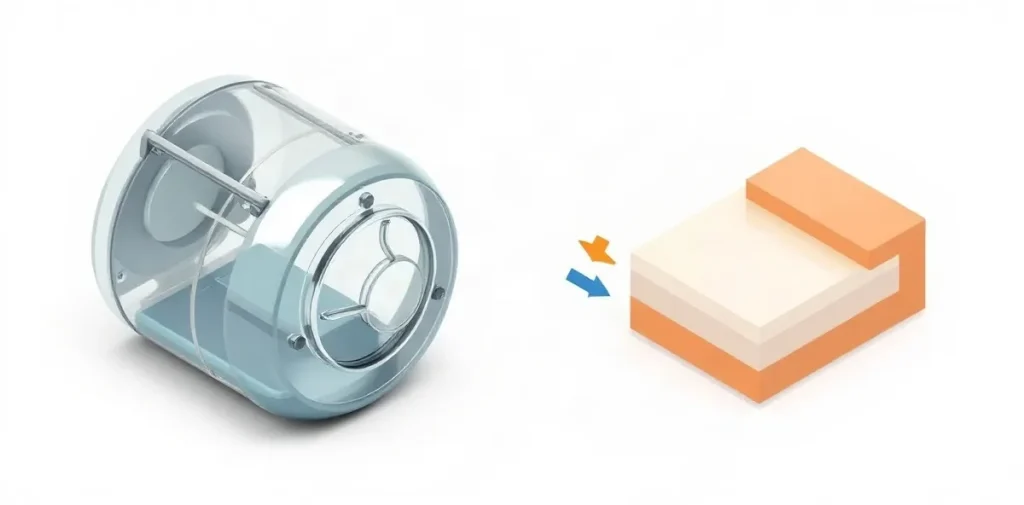
Hyperbaric Oxygen Therapy in the Management of Cochlear Implant Flap Necrosis is a 1990 journal article by Schweitzer VG and Burtka MJ, published in J. Hyperbaric Med 5(2). It addresses hyperbaric oxygen therapy in the context of tissue necrosis affecting a cochlear implant flap—a subject linking wound care, implanted devices and oxygen-based treatment.
What does flap necrosis mean around a cochlear implant?
A cochlear implant is an electronic medical device used to provide sound perception through electrical stimulation of the auditory pathway. Its implanted components sit beneath the skin, while the overlying tissue forms a protective covering. A flap is a section of tissue moved or shaped during surgery to cover or reconstruct an area.
Necrosis means that tissue has died. When it affects tissue covering an implant, the concern is not only the wound itself: inadequate coverage can expose the device, complicate healing and increase the risk of infection. The title therefore identifies a problem at the intersection of surgical wound viability and implanted-device protection.
Why might clinicians consider hyperbaric oxygen?
Hyperbaric oxygen therapy (HBOT) involves breathing oxygen in a pressurised chamber. Increased pressure raises the amount of oxygen dissolved in blood plasma, which can increase oxygen delivery to tissues. Oxygen is required for cellular energy production and contributes to processes involved in wound repair, including collagen formation and the activity of some immune cells.
Those mechanisms make oxygen availability relevant when tissue is compromised. But biological plausibility is not the same as proof that a treatment will help a particular wound. Whether HBOT is appropriate depends on the cause and extent of tissue injury, the condition of the implant and the broader clinical picture.
What clinical questions does this subject raise?
Work on HBOT and flap necrosis sits within a wider clinical question: can changing oxygen delivery support tissue that is threatened but still capable of recovery? Clinicians must distinguish potentially salvageable tissue from tissue that is already non-viable, while also addressing the underlying cause of impaired healing.
For wounds near implanted hardware, treatment planning has additional demands. The team must consider the integrity of the skin and deeper tissues, the possibility of infection, the need for surgical assessment and the role of the device in the patient’s care. HBOT is one possible element of management, not a substitute for evaluating those factors.
- Tissue viability: whether the flap has enough circulation and oxygen delivery to remain healthy.
- Wound healing: repair depends on viable cells, adequate blood supply and control of infection.
- Implant protection: tissue breakdown can threaten coverage of the device and make wound management more complex.
- Pressure exposure: chamber treatment requires assessment of the patient’s ability to tolerate pressure changes and oxygen exposure.
Why does this matter to diving and hyperbaric medicine?
HBOT is a medical use of pressure and oxygen, distinct from recreational or occupational diving. Its study nevertheless belongs in a diving and hyperbaric medicine library because it engages the same core variables: ambient pressure, gas exposure, oxygen delivery and the body’s response to a pressurised environment.
The clinical setting also highlights an important distinction. A diver’s exposure to pressure is not equivalent to a prescribed chamber treatment, and the fact that HBOT is considered for a wound does not establish that diving is safe during healing. People with a cochlear implant, a recent operation or an active wound should discuss diving with a physician experienced in diving medicine; pressure-related risks depend on the individual and the device.
What should readers keep in view?
The article’s subject is a specific clinical problem: using hyperbaric oxygen therapy in the management of necrosis involving a cochlear implant flap. Its place in the literature reflects broader interest in whether oxygen-based chamber treatment can support compromised tissue, alongside surgical and wound-care decisions.
For clinical use, the central issues are diagnosis, tissue viability, implant status and the risks and burdens of chamber treatment. A hyperbaric clinician and the treating surgical team should assess those factors together; a general account of HBOT cannot determine an individual treatment plan.
Frequently asked questions
What is a cochlear implant flap?
What does hyperbaric oxygen therapy involve?
Can someone dive with a cochlear implant or healing wound?
Citation details
- Title: Hyperbaric Oxygen Therapy in the Management of Cochlear Implant Flap Necrosis
- Authors: Schweitzer VG, Burtka MJ
- Year: 1990
- Published in: J. Hyperbaric Med 5(2)
- Record type: Journal article
- Repository record: Rubicon Research Repository, handle 123456789/4424
This page is an original summary written by the Rubicon editors from the publication’s bibliographic record. It does not reproduce the paper, its abstract or its data; consult the publication itself for its methods and findings.
Related reading on Rubicon
- The Physiology Behind Oxygen Toxicity in Deep Dives
- Understanding Oxygen Toxicity Risks and Prevention in Diving
- Oxygen Partial Pressure: Key to Dive Safety and Performance
- Myth Busting: Clarifying Oxygen Toxicity Limits in Diving
- Hyperbaric Oxygen Therapy for Lyme Disease
- CNS Oxygen Toxicity in Hyperbaric Therapy
- More on Dive Medicine
- Browse the Research Library