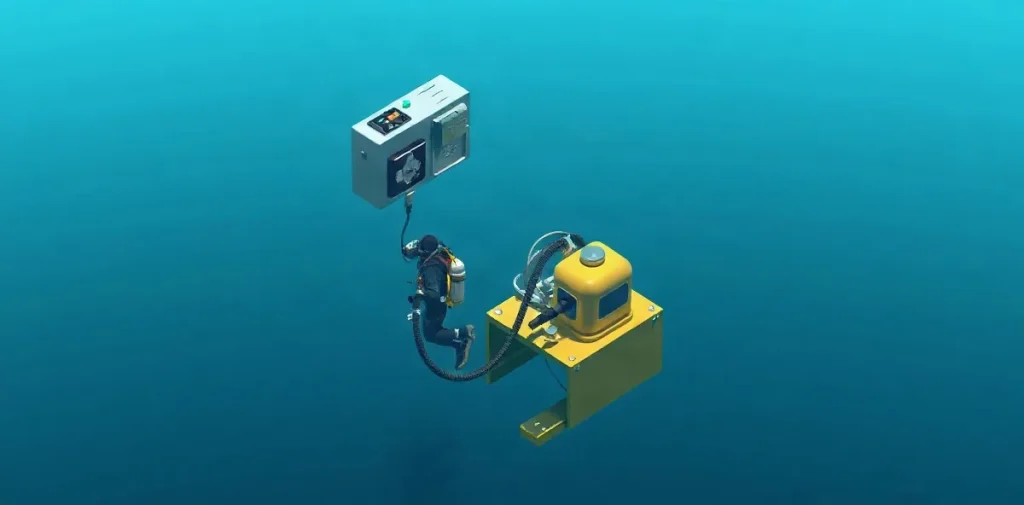
Comparing surface-supplied diving systems means examining how equipment, gas delivery, communications and emergency arrangements work together during a dive. For scientific divers, the choice affects more than comfort: it shapes how a team manages a diver’s connection to the surface, responds to interruptions and conducts work underwater.
What makes a diving system surface-supplied?
In surface-supplied diving, breathing gas reaches the diver from the surface through a hose, commonly called an umbilical. The diver may also be connected to the surface by communications and other lines. This arrangement differs from scuba, where the diver carries the breathing-gas supply on their back.
The system is a coordinated set of components, not simply a gas hose. Its design and operation involve the diver, the surface team, gas supply, communications, the umbilical and the equipment used underwater. Scientific work can make these connections particularly relevant: the diver may need to remain in contact with the team while carrying out a task.
What should a comparison examine?
A useful comparison asks how well each system supports the intended dive, rather than treating one feature as decisive. Operational demands, the diver’s mobility, the worksite and the team’s ability to monitor and support the diver all affect what matters.
- Breathing-gas delivery: how gas reaches the diver and how the supply is managed.
- Communications: how the diver and surface team exchange information during the operation.
- Umbilical management: how the connection is handled as the diver moves and works.
- Emergency arrangements: how the team plans for a disrupted supply, communications problem or other equipment difficulty.
- Task fit: whether the system suits the scientific work, site and operating procedures.
These considerations are interdependent. A configuration that supports close surface coordination may impose different demands on movement and line management than one selected for another kind of work. Comparison therefore requires attention to the complete operating setup and the conditions in which it is used.
Why does the surface connection matter to divers?
A surface supply can support sustained coordination between the diver and the team, but it also creates reliance on equipment and procedures that extend from the surface to the diver. The umbilical must be managed, the gas supply monitored and communication maintained in ways appropriate to the operation.
Any breathing-gas interruption is a safety concern, whatever the diving mode. Surface-supplied operations therefore depend on planning for equipment problems and on a team that understands its roles. The relevant question is not whether a system removes risk, but how its design and procedures address the hazards of the planned dive.
How does this fit into diving research?
Research on surface-supplied systems sits at the intersection of equipment design, operational practice and diver safety. It complements work on scientific-diving standards, mixed-gas operations and the medical effects of diving. Those are connected areas, but they ask different questions: a system comparison is concerned with how equipment configurations support an operation.
For diving medicine and hyperbaric care, equipment context can help explain what happened during an incident and what exposures or operational stresses may be relevant. It does not replace clinical assessment. Divers with symptoms or concerns after a dive should seek evaluation by a diving-medicine physician.
What should teams consider when choosing a system?
Selection begins with the planned work and the conditions at the site. A team needs to consider diver mobility, the required surface support, communications, gas management and emergency procedures together. Training and operating practices must match the equipment actually in use.
System comparisons are most useful when they make those trade-offs explicit. For a scientific team, the practical test is whether the configuration supports the task while allowing the diver and surface crew to manage foreseeable problems under their operating procedures.
Frequently asked questions
How is surface-supplied diving different from scuba?
Why compare complete systems rather than individual components?
Does surface supply eliminate diving risk?
An original research-library explainer written by the Rubicon editors. It is not a summary of a specific publication.
Related reading on Rubicon
- The Diving Reflex: What Happens Underwater
- Scuba Diving Regulators: Balanced vs. Unbalanced
- Scuba Diving Buddy Checks: Catch Problems Early
- Scuba Diving: Why Immersion Can Dehydrate You
- Surface-Supplied Mixed-Gas Diving to 300 FSW
- Surface-Supplied and Saturation Diving to 300 FSW
- More on Equipment
- Browse the Research Library