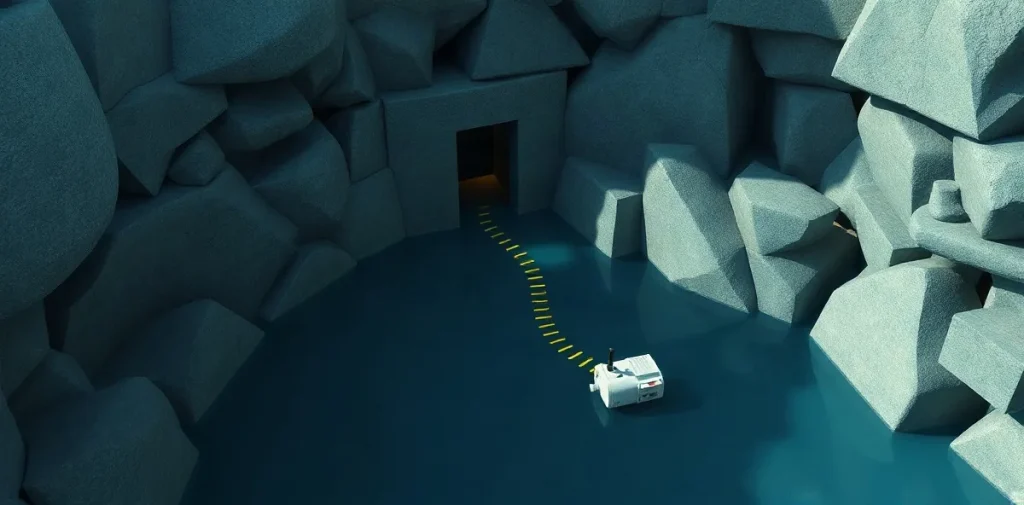
Scientific diving in caves and caverns combines underwater research with the demands of an overhead environment, where a direct ascent to the surface is impossible. Its central challenge is to plan reliable access, work and return while protecting divers, research equipment and the integrity of observations.
What makes cave and cavern research different?
In open water, a diver can usually ascend directly if a problem develops. In a cave or cavern, rock overhead blocks that route. The diver must navigate back through the entrance, often along a fixed guideline, while managing breathing gas, visibility and the task at hand.
The distinction between a cavern and a cave generally reflects how far a diver travels into an overhead environment and whether natural light remains available. Operational definitions vary, so the precise limits depend on the applicable diving standards and project rules.
Scientific work adds another layer: the dive has a research purpose, and the team must collect useful observations without allowing the task to compromise safe movement or the planned exit. A sampling method, instrument or recording requirement can affect time, buoyancy and the diver’s ability to monitor the environment.
How do teams balance research and safe return?
Planning begins with the environment and the research question. Teams consider the route, depth, expected conditions, gas supply, equipment configuration, communications and the steps needed to return. The plan must account for the fact that an exit may require retracing a route rather than ascending.
Gas management is central because the diver needs enough breathing gas not only to complete the work but also to navigate out and respond to foreseeable problems. The suitable configuration depends on the dive, the environment, the team and the governing procedures; a plan that works in one cave is not automatically suitable in another.
- Guidelines and navigation: a continuous route marker can help divers find the exit, especially when visibility deteriorates.
- Task loading: instruments, sampling and recording can draw attention away from navigation and gas monitoring.
- Equipment reliability: breathing systems, lights and research tools must be considered as part of the complete dive plan.
- Team procedures: roles, communication and responses to equipment or visibility problems need to be established before entering.
These considerations are connected. For example, a change in the research task may increase time underwater, while reduced visibility can make navigation and team coordination more demanding.
What physiological and medical issues matter?
Depth and duration affect gas use and inert-gas uptake, while exertion and stress can increase breathing demand. Decompression planning therefore remains relevant, even when the scientific objective is close to an entrance or at a relatively modest depth. The overhead environment also makes a safe exit an essential part of any response to distress.
Cold, workload, restricted movement and the mental effort of navigation can influence a diver’s performance. These factors do not operate in isolation: a diver concentrating on a sample or instrument may have less attention available for monitoring gas, buoyancy and the team.
Diving medicine provides context for assessing fitness, recognizing symptoms and planning an appropriate response, but it cannot replace operational controls. Questions about an individual’s fitness to dive, decompression illness or post-dive symptoms should be discussed with a diving-medicine physician.
How does this work fit into diving research?
Cave and cavern scientific diving sits at the intersection of research diving, overhead-environment procedures, equipment use and dive medicine. Its methods address a practical question shared across those fields: how can a team obtain reliable observations while preserving a controlled route out?
That question also connects to other forms of technical and occupational diving. Surface-supplied mixed-gas and saturation operations involve different equipment and operating environments, but they likewise require teams to coordinate gas supply, depth, exposure and emergency procedures. Comparing these settings helps clarify which controls are specific to caves and which reflect broader principles of diving risk management.
For scientific divers, the value of a method depends on both the quality of the observation and the discipline of the operation. Research design, training, equipment checks and clear limits all shape what can be done safely in an overhead environment.
What should a scientific diver check before a project?
Start with the standards and procedures that govern the particular project, then confirm that the team’s training and equipment match the planned environment and tasks. A general description of cave or cavern diving cannot establish the rules for every institution, site or research programme.
Before entering, make sure the route, gas plan, task sequence, communication arrangements and response procedures are understood by the team. If a research requirement conflicts with the planned limits or distracts from navigation and gas monitoring, the project needs to be adjusted before the dive.
Frequently asked questions
Why does an overhead environment change dive planning?
How does scientific work affect a cave dive?
Who should advise on medical fitness for scientific diving?
An original research-library explainer written by the Rubicon editors. It is not a summary of a specific publication.
Related reading on Rubicon
- Scientific Diving Course: Curriculum, Skills, Certification
- The Diving Reflex: What Happens Underwater
- Scuba Diving Regulators: Balanced vs. Unbalanced
- Scientific Diving Standards for Caves and Caverns
- Scientific Diving and Underwater Research: Research Summary
- More on Safety
- Browse the Research Library