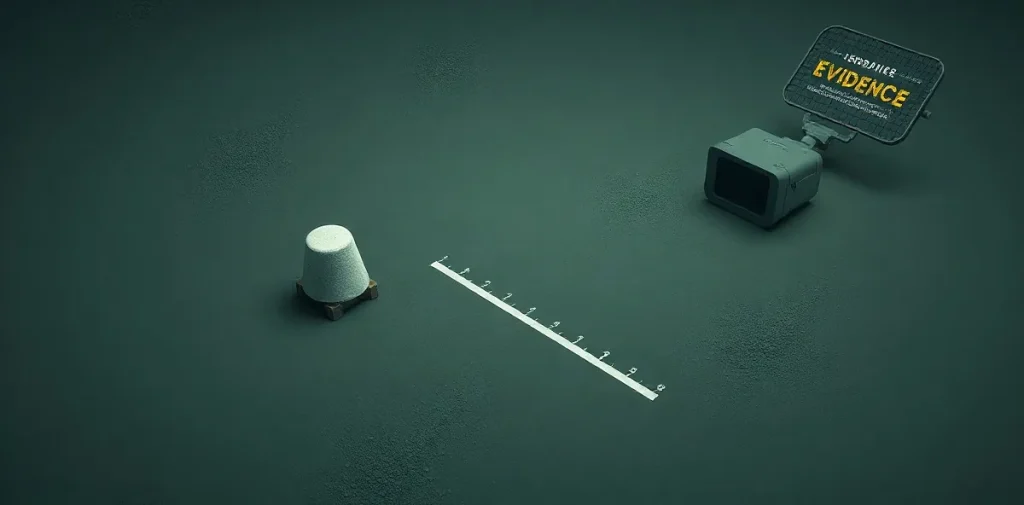
Underwater crime scene investigation applies search, documentation and evidence-handling methods to scenes beneath the surface. It matters because currents, poor visibility, depth and diver activity can alter or obscure evidence, while the work itself exposes divers to operational and physiological hazards.
What makes an underwater scene different?
Water changes how a scene can be searched and recorded. Visibility may be limited, objects can be displaced by currents or contact, and the seabed can conceal evidence under sediment or among vegetation. A search plan must account for these conditions before divers enter the water.
The scene is also a working dive environment. Bottom time, depth, gas supply, thermal stress, workload and access to the surface all affect what a team can safely do. The need to preserve evidence does not remove the need to manage those risks.
What questions guide the investigation?
Investigators need to locate relevant objects, record their positions and condition, and maintain a reliable account of how they were found and handled. They may also need to distinguish evidence altered by the event from changes caused by water movement, environmental exposure or the search itself.
Those questions make documentation central. A useful record can include site layout, search coverage, object location, depth and environmental conditions, alongside notes about any contact or movement during recovery. The exact method depends on the scene and the evidence being sought.
How do divers search and document a site?
Underwater searches use planned patterns rather than relying on memory or chance. Depending on visibility, terrain and the size of the search area, a team may use lines, measured sectors or other repeatable approaches. Clear roles help coordinate the search and reduce unnecessary disturbance.
Recording tools can include underwater writing, measurements, photography or video, and reference points that connect observations to the site. These methods have practical limits: poor visibility affects imaging, while gloves, equipment and water movement can make fine work difficult. Teams need a plan for recording before evidence is moved.
- Search coverage: whether the planned area has been examined systematically.
- Position: where an item lies in relation to stable site features or recorded measurements.
- Condition: visible damage, sediment, entanglement or other relevant features before handling.
- Handling: who touched or moved an item, and when it was recovered.
- Dive conditions: visibility, current, depth and other factors affecting the work.
Why does evidence handling matter?
Evidence can lose context when it is moved, cleaned or separated from its surroundings. Recording an object in place before recovery helps preserve information about its position and relationship to other features. Careful packaging and a documented transfer process help maintain continuity after the dive.
Underwater conditions complicate that process. Water, sediment and biological growth may affect an object, and recovery can introduce further changes. Investigators must avoid treating every observed mark or displacement as proof of a particular event; interpretation depends on the full scene and subsequent examination.
What does this mean for dive teams?
Crime-scene work combines scientific observation with a task-focused dive. It can demand sustained attention, careful buoyancy control and close coordination, often in conditions that make communication and orientation harder. A diver’s ability to continue safely remains more important than completing a search at any cost.
Training and planning should address both evidence procedures and dive hazards. The relevant considerations include the team’s competence, equipment, environmental conditions, exposure limits and arrangements for assistance. Questions about an individual’s fitness to participate in this kind of diving belong with a diving-medicine physician.
Frequently asked questions
Is underwater crime scene investigation a type of scientific diving?
Why record an object before recovering it?
What is the main safety concern for divers doing this work?
An original research-library explainer written by the Rubicon editors. It is not a summary of a specific publication.
Related reading on Rubicon
- Why Divers Get Cold Faster Underwater
- Glossary of Essential Underwater Physiology Terms for Divers
- The Diving Reflex: What Happens Underwater
- Diving Safety: Key Insights into Underwater Exploration
- Underwater Crime Scene Investigations: Research Summary
- Divers and Underwater Sound at 800–2250 Hz
- More on Diving Science
- Browse the Research Library