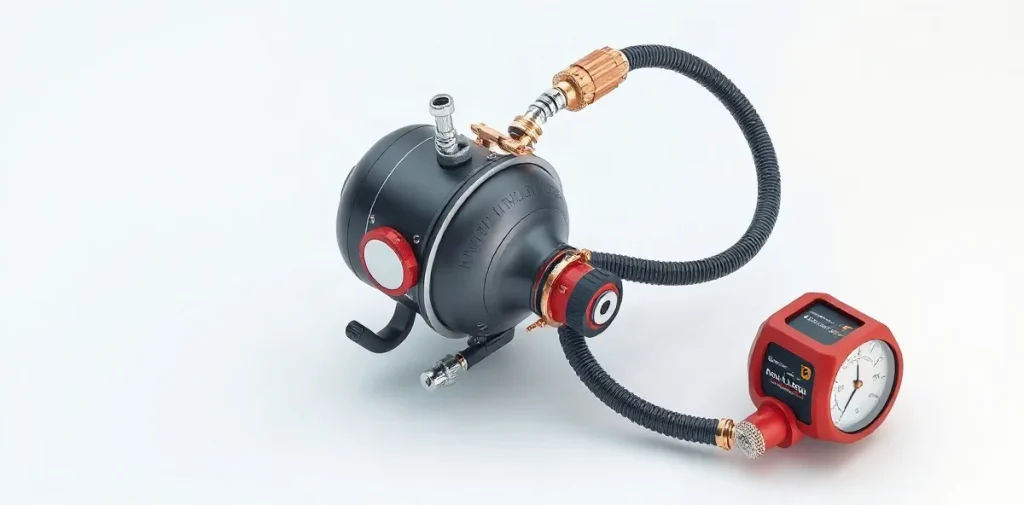
Development of a Decompression Algorithm for Constant Oxygen Partial Pressure in Helium Diving is a 1985 research report by Thalmann, published in Navy Exp. Diving Unit Res. Report 1–85. It addresses how to design decompression procedures for helium dives while maintaining a constant oxygen partial pressure—a problem linking breathing-gas control, inert-gas exchange and ascent planning.
What does constant oxygen partial pressure mean underwater?
Oxygen partial pressure is the share of the total breathing-gas pressure contributed by oxygen. It changes with both the oxygen fraction in a breathing mix and the surrounding pressure. A diver can therefore breathe a changing mixture during a dive while a control system aims to keep oxygen partial pressure steady.
This approach is associated with mixed-gas and rebreather diving, where gas composition can be adjusted as depth changes. Helium replaces some nitrogen in the breathing mix, but it does not remove the need to manage oxygen exposure or decompression. Those are related but distinct parts of dive planning.
Why does helium make decompression planning distinctive?
During a dive, inert gases in the breathing mixture enter body tissues under pressure. During ascent, pressure falls and those gases leave the tissues; if the pressure change is too rapid for the body’s capacity to eliminate gas, bubbles can form and cause decompression illness. A decompression algorithm is a mathematical method for turning a model of this process into an ascent schedule.
Helium and nitrogen differ in their physical properties and in how they move through tissues. As a result, a decompression method developed for one gas mixture cannot simply be assumed to apply unchanged to another. Helium diving makes the choice of gas assumptions, tissue models and ascent constraints a central technical question.
What does an algorithm have to balance?
A decompression algorithm must represent changing pressure and inert-gas loading over time, then determine how ascent can proceed within the model’s limits. With constant oxygen partial pressure as a design condition, the breathing mix and the inert-gas fractions can vary as depth changes. The algorithm must account for those changes rather than treating the gas mixture as fixed throughout the dive.
- Oxygen control: maintaining a target oxygen partial pressure as ambient pressure changes.
- Inert-gas uptake and release: modelling how helium and any other inert gas move between breathing gas and tissues.
- Ascent constraints: translating the model into allowable pressure changes and decompression stops.
- Operational use: considering how a calculated schedule can be followed with the equipment and gas changes used on a dive.
These elements are coupled. A change in depth affects ambient pressure; that affects oxygen partial pressure and the gas gradients driving inert-gas exchange. A schedule is useful only when its assumptions correspond to the breathing system and dive profile being considered.
Why does this matter to divers and clinicians?
For divers, decompression schedules set limits on ascent and time at depth. For diving physicians and hyperbaric clinicians, understanding how a schedule is constructed helps explain why decompression risk depends on the full exposure, not on a single depth or gas label. A calculated schedule is a planning tool, not a guarantee against decompression illness.
The subject also sits within a wider research effort to make decompression models fit real diving conditions: changing mixtures, different inert gases and varied pressure histories. Historical work on algorithm design provides context for how these problems have been formalised. Current procedures and equipment require their own validation and operational guidance; a report from 1985 should not be treated as a present-day dive protocol.
What should readers keep in mind?
Constant oxygen partial pressure describes an oxygen-control objective; it does not mean constant total pressure, constant gas composition or an absence of decompression obligations. Likewise, an algorithm’s output depends on its model and the conditions entered into it. Practical diving decisions must account for the actual breathing system, profile, training and applicable procedures.
This publication is relevant to readers studying the history and engineering of decompression calculation for helium diving. It is not individual medical advice. For a personal fitness-to-dive question or a suspected decompression illness, consult a diving-medicine physician or seek urgent medical care as appropriate.
Frequently asked questions
What is a decompression algorithm?
Does constant oxygen partial pressure mean the gas mix stays the same?
Can a historical report be used as a current dive procedure?
Citation details
- Title: Development of a Decompression Algorithm for Constant Oxygen Partial Pressure in Helium Diving
- Authors: Thalmann, E. D
- Year: 1985
- Published in: Navy Exp. Diving Unit Res. Report 1–85
- Record type: Journal article
- Repository record: Rubicon Research Repository, handle 123456789/4816
This page is an original summary written by the Rubicon editors from the publication’s bibliographic record. It does not reproduce the paper, its abstract or its data; consult the publication itself for its methods and findings.
Related reading on Rubicon
- Oxygen Partial Pressure: Key to Dive Safety and Performance
- Diving Physics: Gas Laws, Pressure Effects, and Safety
- The Physiology Behind Oxygen Toxicity in Deep Dives
- Understanding Oxygen Toxicity Risks and Prevention in Diving
- Constant Oxygen Partial Pressure in Helium Diving
- Decompression Sickness and Oxygen Toxicity in He-O2 Diving
- More on Diving Science
- Browse the Research Library