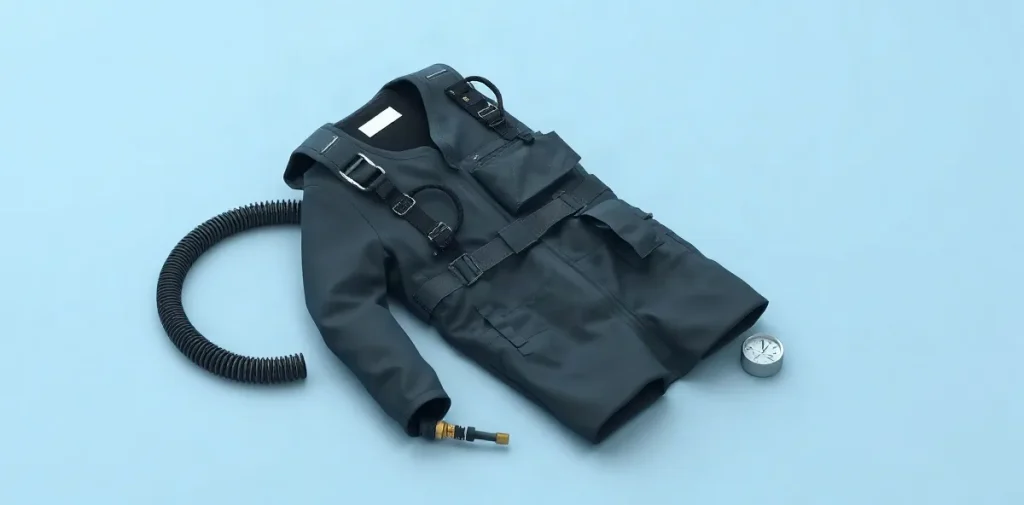
Market Survey of Commercially Available Dry Suits is a 1988 journal article by Brewster and Sterba, published in NEDU. Its subject is the commercial dry-suit market: equipment designed to keep water away from a diver’s body. Suit design matters because insulation, fit, seals and buoyancy interact with exposure, workload and underwater control.
Why does a dry suit matter underwater?
Water conducts heat away from the body more effectively than still air. A dry suit limits water exchange around the diver, while undergarments provide much of the insulation. The suit is therefore part of a thermal-protection system, not a stand-alone guarantee against cooling.
As a diver descends, increasing pressure compresses gas in the suit and its insulating layers. The diver may add gas to reduce squeeze and maintain a usable fit; during ascent, expanding gas must be managed. These changes make suit operation part of buoyancy control as well as thermal protection.
What does a market survey of dry suits examine?
A survey of commercially available equipment addresses a practical question: what kinds of dry suits are offered, and how can their designs be compared? A technical assessment may consider construction, closures, seals, materials, fit, insulation compatibility, gas management and intended use. Each feature affects how a suit works as a system.
These comparisons also help frame equipment testing. A product description is not the same as a performance test: construction details can suggest how a suit is meant to function, while controlled evaluation is needed to assess performance under defined conditions. For divers, the distinction matters when choosing between features and demonstrated suitability.
- Thermal protection: suit materials and undergarments influence heat loss, alongside water temperature, exposure time and activity.
- Fit and seals: these affect water exclusion, comfort and freedom of movement.
- Buoyancy management: gas added to or released from the suit changes its volume and can affect control.
- Use conditions: depth, workload, environment and the diver’s configuration shape equipment demands.
How do dry suits affect physiology and dive medicine?
Thermal stress is not simply a question of whether a diver feels cold. Cooling can affect comfort, dexterity and the ability to perform tasks; the rate and extent of heat loss depend on the person and the dive conditions. A dry suit reduces exposure to water but cannot remove the need to consider insulation, duration and workload.
Suit-related gas also has physiological and operational importance. Gas trapped in a suit or its undergarments can shift as the diver changes position, while changes in volume with depth affect buoyancy. Training and configuration are important because a loss of control can turn an equipment-management problem into a more serious dive hazard.
Where does equipment comparison fit in diving research?
Dry-suit research sits at the intersection of equipment engineering, thermal physiology and operational safety. The same suit can be judged differently depending on whether the question concerns heat retention, mobility, durability, buoyancy handling or suitability for a particular task. A market survey maps the equipment landscape; physiological and field evaluations address how systems perform in use.
This perspective is relevant to recreational divers, scientific divers and clinical teams considering exposure during underwater work. Suit selection should account for the whole configuration, including undergarments and buoyancy equipment, rather than relying on a product category alone. For medical concerns related to cold exposure or diving fitness, consult a diving-medicine physician.
What should a diver consider when comparing suits?
Start with the environment and task. Water temperature, planned exposure, depth, activity level and the need for precise movement all affect what protection and mobility are required. A suit that fits poorly or restricts movement can create problems even if its materials appear suitable.
Then consider how the suit integrates with the rest of the equipment and with the diver’s training. Seal design, undergarment volume, inflation and exhaust arrangements, and compatibility with other gear are practical points to check. Follow the manufacturer’s instructions and use appropriate training to practise buoyancy control in the complete configuration.
Frequently asked questions
How is a dry suit different from a wetsuit?
Does a dry suit provide all the insulation a diver needs?
Why does dry-suit gas management matter?
Citation details
- Title: Market Survey of Commercially Available Dry Suits
- Authors: Brewster, D. F; Sterba, J. A
- Year: 1988
- Published in: NEDU
- Record type: Journal article
- Repository record: Rubicon Research Repository, handle 123456789/4868
This page is an original summary written by the Rubicon editors from the publication’s bibliographic record. It does not reproduce the paper, its abstract or its data; consult the publication itself for its methods and findings.
Related reading on Rubicon
- Choosing the Right Exposure Suit: Balancing Thermal
- Comparing Dive Suit Materials: Thermal Protection &
- Open-Circuit vs Closed-Circuit Rebreathers: Which Suits You?
- In-Suit Exercise Before Spacewalks: Research Summary
- Atmospheric Diving Suits: Research Summary
- More on Equipment
- Browse the Research Library