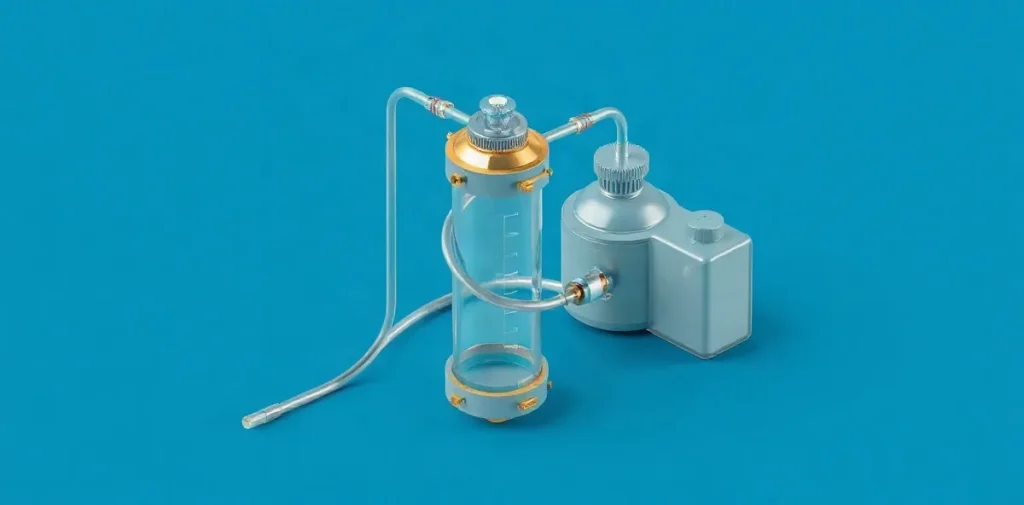
Closed-circuit oxygen diving uses an apparatus that recycles a diver’s exhaled gas rather than releasing each breath into the water. Its history belongs to a wider engineering and physiological question: how can a breathing system conserve gas while keeping oxygen exposure within safe limits?
How does a closed circuit recycle breathing gas?
A diver exhales into a loop instead of sending the breath directly to the surrounding water. A carbon dioxide absorbent removes CO₂ from that gas; oxygen is added to replace what the body has used, and the resulting mixture is breathed again.
This arrangement differs from open-circuit scuba, where exhaled gas leaves as bubbles and fresh gas is supplied from the cylinder for each breath. Recycling can reduce gas loss and visible bubbles, but it makes the breathing loop a life-support system whose components must work together.
- Breathing loop: the pathway through which gas moves between the diver and the apparatus.
- CO₂ absorbent: material that removes carbon dioxide from exhaled gas.
- Oxygen supply: gas added to replace oxygen consumed by metabolism.
- Oxygen exposure: the balance between the oxygen pressure in the breathing gas and the time spent breathing it.
Why is oxygen both essential and hazardous underwater?
Oxygen supports aerobic metabolism, but breathing it at elevated partial pressure can cause oxygen toxicity. Partial pressure is the share of the total gas pressure contributed by oxygen; underwater, increasing ambient pressure raises the partial pressure of a fixed gas mixture.
Central nervous system oxygen toxicity can cause convulsions, which are especially dangerous underwater because a diver may lose control of the breathing apparatus. Pulmonary effects are associated with prolonged exposure. The practical issue is therefore not simply whether oxygen is present, but the pressure and duration of exposure.
Depth, breathing-gas composition and time all affect the risk. Closed-circuit oxygen systems require particular attention because their breathing gas is not continually discarded and replaced as it is in open circuit; safe use depends on controlling exposure as well as maintaining the equipment.
What questions shape the study of early apparatus?
Historical work on breathing apparatus can examine how designers addressed gas recycling, oxygen delivery, carbon dioxide removal and the practical demands of underwater use. It also places technical choices in context: a system is not just a circuit diagram, but equipment that must be carried, operated and checked by a diver.
Across the field, researchers and clinicians consider how equipment function interacts with human physiology. Questions include whether the breathing loop can clear CO₂ effectively, whether oxygen delivery remains appropriate, and how a diver might recognise a malfunction before it becomes an emergency.
History matters because design problems recur in new forms. Understanding the principles behind earlier equipment helps readers distinguish enduring constraints—such as oxygen toxicity and CO₂ retention—from changes in materials, controls and operating practice.
How do CO₂ removal and equipment failures affect divers?
Carbon dioxide is a normal product of metabolism. If a scrubber is exhausted, incorrectly assembled or otherwise fails to remove enough CO₂, the diver may rebreathe it. CO₂ retention can cause distress and impair performance; in severe circumstances, it can become a medical emergency.
Water intrusion, leaks, breathing resistance and faults in oxygen supply are among the general hazards considered in closed-circuit equipment design and operation. The exact failure modes depend on the apparatus. Checks, training and maintenance address different parts of the risk, and none makes an oxygen-rebreathing system suitable for casual or untrained use.
For divers, the central lesson is that gas conservation comes with added system complexity. A problem in a closed loop may not announce itself with the steady stream of bubbles familiar from open circuit, so equipment monitoring and correct procedures matter.
Where does this subject fit in diving medicine?
Closed-circuit oxygen apparatus connects equipment history with respiratory physiology, toxicology and human factors. It sits alongside research on breathing-gas management, CO₂ scrubbers, oxygen exposure and the medical demands placed on divers working underwater or in hyperbaric settings.
That connection matters to diving physicians and hyperbaric clinicians because symptoms during a dive can involve both the person and the life-support system. Assessment may need to consider the exposure, the equipment and the circumstances together; anyone with a health concern related to diving should consult a diving-medicine physician.
Frequently asked questions
What makes an oxygen rebreather a closed-circuit system?
Why does depth matter when breathing oxygen?
Why is carbon dioxide removal critical?
An original research-library explainer written by the Rubicon editors. It is not a summary of a specific publication.
Related reading on Rubicon
- Safety Guide to Diving: Key Principles and Precautions
- The Physiology Behind Oxygen Toxicity in Deep Dives
- Understanding Oxygen Toxicity Risks and Prevention in Diving
- Myth Busting: Clarifying Oxygen Toxicity Limits in Diving
- History of Closed-Circuit Oxygen Diving Apparatus
- CNS Oxygen Toxicity in Closed-Circuit Diving
- More on Equipment
- Browse the Research Library