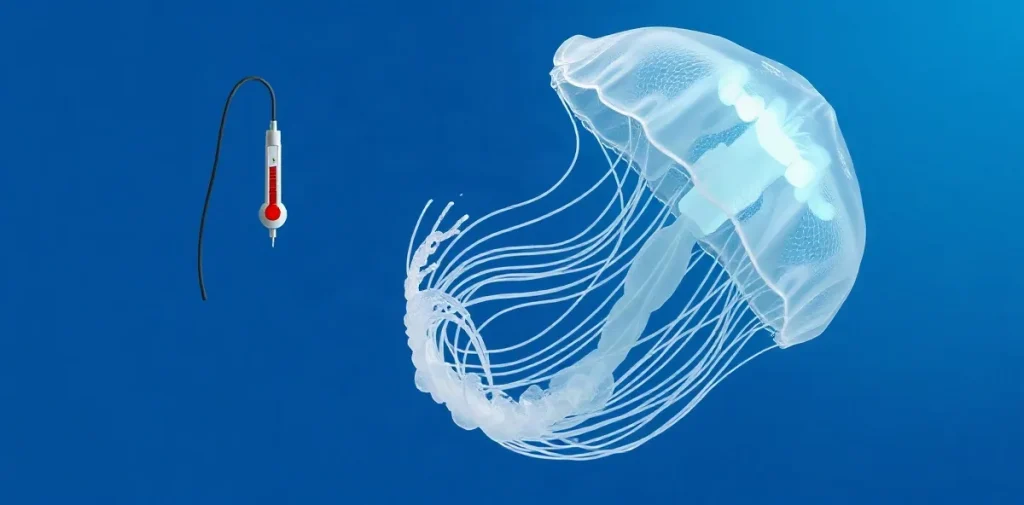
Are some jellyfish toxins heat labile? is a 2000 journal article by Taylor in the South Pacific Underwater Medicine Society journal. Its title raises a practical question: can heat alter toxins delivered by jellyfish stings? The answer matters to divers because first-aid choices after a marine sting depend on the organism, the toxin and the injury.
What does “heat labile” mean for a jellyfish sting?
A substance is heat labile when heating can change or reduce its biological activity. Applied to jellyfish toxins, the phrase poses a question about how temperature affects venom components, not a general claim that heat neutralises every sting.
Jellyfish venom is a mixture of biologically active substances delivered through specialized stinging cells. The effects can include local pain and skin inflammation; some species can cause more serious systemic illness. The precise response depends on the animal, the exposure and the person affected.
Why does temperature matter in marine-sting care?
Temperature can affect both venom activity and the injured tissue. Heat may also change pain perception, so symptom relief alone does not establish that a toxin has been inactivated. These are related but distinct questions in evaluating a treatment.
For divers, a sting may occur at a remote site where identification and medical support are limited. A simple first-aid measure can be attractive, but applying heat without considering the species and local guidance may be unsuitable. Suspected serious reactions need urgent medical assessment.
What questions do studies of toxin stability examine?
Research on heat sensitivity needs to distinguish the effect of temperature on a toxin from the effect of a treatment on pain or skin injury. It also needs to consider how the venom is prepared, how heating is applied and what biological response is measured. Those details determine what a laboratory result can mean for care in the water or on shore.
- Toxin activity: whether heating changes a biological effect, rather than merely changing the appearance of a sample.
- Exposure conditions: the temperature, duration and handling used to test heat sensitivity.
- Clinical relevance: whether a laboratory observation supports a safe, practical response to an actual sting.
- Species differences: whether an observation applies to one jellyfish or can reasonably be extended to others.
These distinctions connect marine envenomation research with broader dive-medicine concerns: identifying the cause of an injury, limiting further harm and choosing treatment that matches the hazard.
How does this subject fit into diving medicine?
Diving medicine addresses more than pressure-related illness. Scientific and recreational divers also encounter environmental injuries, including contact with marine organisms. Understanding venom and tissue responses helps clinicians assess symptoms and helps diving teams plan for first aid and evacuation.
The question of heat sensitivity sits at the boundary between basic toxicology and practical treatment. A mechanistic finding can guide further investigation, but a useful field protocol also has to account for species identification, the injured area, symptom severity and the conditions in which care is delivered.
What should divers keep in mind after a sting?
Do not assume that one treatment fits every jellyfish sting. Follow local emergency guidance, avoid handling tentacles with bare skin and seek urgent help for severe pain, breathing difficulty, collapse or other rapidly worsening symptoms. A diving-medicine physician should be consulted when symptoms are significant or the appropriate care is uncertain.
For planned operations, divers and supervisors should check current local advice on marine stings and emergency arrangements before entering the water. The organism and the setting matter as much as the general question of whether heat can affect a toxin.
Frequently asked questions
What does “heat labile” mean?
Does heat treat every jellyfish sting?
Why is this question relevant to divers?
Citation details
- Title: Are some jellyfish toxins heat labile?
- Authors: Taylor, G
- Year: 2000
- Published in: South Pacific Underwater Medicine Society journal 30(2)
- Record type: Journal article
- Repository record: Rubicon Research Repository, handle 123456789/5843
This page is an original summary written by the Rubicon editors from the publication’s bibliographic record. It does not reproduce the paper, its abstract or its data; consult the publication itself for its methods and findings.