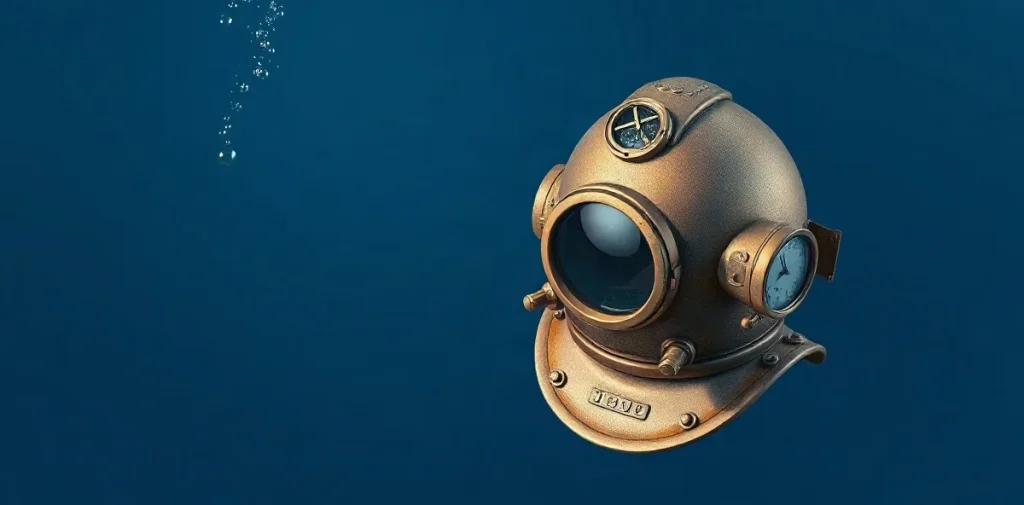
The history of diving is a way to study how people learned to work underwater and how those experiences shaped knowledge of pressure, breathing, decompression and illness. For divers and clinicians, it shows why modern procedures rest on accumulated observation, changing technology and continuing questions about human limits.
What can the history of diving explain?
Diving history is more than a timeline of equipment. It connects the practical demands of staying underwater with the development of methods for supplying air, controlling exposure and responding to injury.
As diving moved from breath-hold activity to work supported by surface air and later self-contained equipment, the conditions people faced changed. Each shift created new questions about pressure, gas exchange, time underwater and safe return to the surface.
Historical research asks how those questions were framed, what observations were possible, and how technical practice and physiological understanding influenced one another. It helps readers distinguish concepts that developed through repeated experience from those that depend on later measurement and medical interpretation.
Why does pressure change the problem?
Water pressure increases with depth. The pressure surrounding a diver affects gas volumes and the amount of gas dissolved in body tissues, so the consequences of a dive depend on both depth and time.
During ascent, pressure falls. Dissolved inert gas must leave the body; if the change is too rapid for the tissues and circulation to manage, bubbles can form and contribute to decompression illness. This makes the return to the surface part of the exposure, not merely the end of it.
These principles help explain why diving history and dive medicine belong together. Earlier approaches to underwater work raised practical problems that remain central: how to supply breathable gas, limit exposure and allow a controlled ascent.
How do researchers study the development of diving?
Historical work can examine equipment, technical records, medical observations and accounts of diving practice. The aim is to place each development in context: what problem it addressed, what users could observe and what assumptions shaped the response.
It also requires care with changing terminology. A historical description of a diving illness or procedure may not map neatly onto current clinical categories. Comparing records across periods means asking what was measured, how conditions were described and whether the same terms had the same meaning.
- Technology: how breathing-gas supply and underwater access changed the diver’s exposure.
- Physiology: how pressure, gas exchange and decompression became central to understanding risk.
- Medical observation: how symptoms and injuries informed recognition of diving-related illness.
- Practice: how procedures evolved in response to the demands and hazards of underwater work.
Reading history alongside present-day physiology can clarify why a procedure exists without treating past practice as current guidance. For clinical decisions, divers and clinicians should use current standards and consult a diving-medicine physician where appropriate.
What does this history mean for divers and clinicians?
For divers, historical context can make familiar safety concepts easier to understand. Decompression is not an arbitrary pause in a dive plan: it reflects the changing movement of gas into and out of the body as pressure changes.
For diving physicians and hyperbaric clinicians, history gives context to how symptoms, hazards and treatment questions came to be recognised. It can also sharpen questions about evidence: which observations apply to present equipment and practice, and which belong to a different technical setting?
Scientific divers face the same physiology while pursuing research underwater. Their work depends on separating the demands of the scientific task from the diver’s exposure, including the effects of depth, breathing gas and time in the water.
Frequently asked questions
Why study the history of diving?
How is diving history relevant to decompression?
Can historical diving practice guide a dive today?
An original research-library explainer written by the Rubicon editors. It is not a summary of a specific publication.
Related reading on Rubicon
- Liveaboard Diving: Plan, Pack, Dive
- Evaluating Dive Light Options for Night and Cave Diving
- Dive Medicine Primer: Essential Physiology Every Diver Knows
- The Diving Reflex: What Happens Underwater
- Thesis Research in Diving and Hyperbaric Medicine
- Oxygen in Diving and Hyperbaric Medicine
- More on Diving Science
- Browse the Research Library