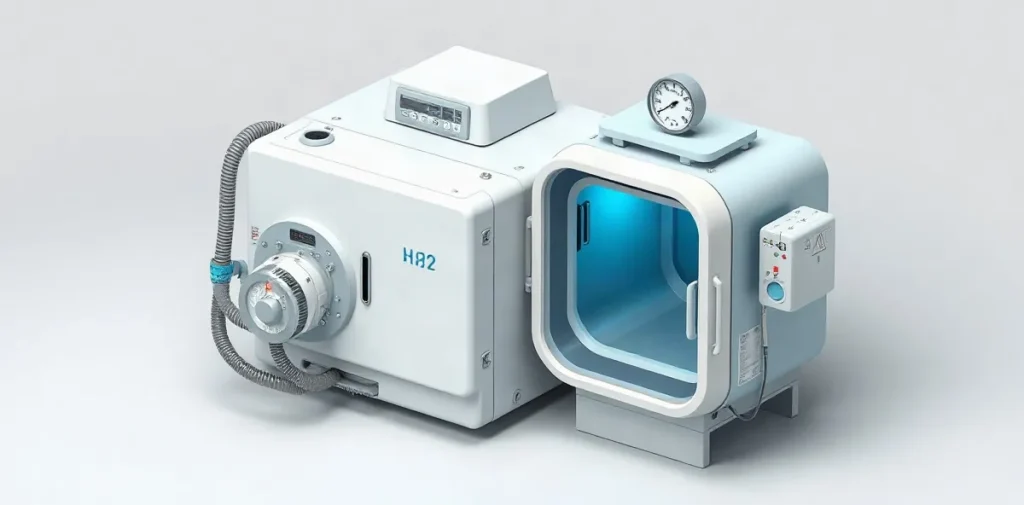
“Ventilator function under hyperbaric conditions” is a 1998 journal article by Skinner, published in South Pacific Underwater Medicine Society Journal 28(2). Its subject is how ventilators operate in the elevated ambient pressure of a hyperbaric environment—a technical question with direct importance for treating patients who need respiratory support while receiving hyperbaric care.
Why does ventilator performance matter under pressure?
A ventilator moves gas into and out of the lungs to support or replace breathing. Its operation depends on pressure differences, gas flow, and the mechanical properties of the breathing circuit and lungs. In a hyperbaric chamber, ambient pressure rises, changing the conditions in which the equipment delivers and measures gas.
That matters when a patient needs ventilation during a hyperbaric treatment. Clinical care must account for both the patient’s respiratory needs and the environment in which the device is operating. A ventilator that behaves differently under pressure can affect delivered ventilation, monitoring, and the clinician’s ability to assess the patient.
The topic also belongs to the wider safety problem of using medical equipment in an environment unlike an ordinary hospital room. Devices, their gas supplies, and their interfaces with patients have to be considered as a system, rather than judged only by how they work at surface pressure.
What changes when ambient pressure rises?
Pressure is central to both breathing and mechanical ventilation. A ventilator creates a pressure gradient that moves gas through a circuit and into the lungs. When ambient pressure changes, the relationship between the device’s internal pressures and the surrounding pressure can change too; the exact effect depends on the ventilator’s design and how it senses or regulates flow and pressure.
Gas behaviour is another consideration. At elevated pressure, the density of a gas increases, which can influence flow through narrow passages and the resistance encountered in a breathing circuit. The effects depend on the gas, the equipment, and the operating conditions, so a device’s performance cannot be assumed from its surface-pressure behaviour alone.
- Ambient pressure: the surrounding pressure against which equipment operates.
- Pressure gradient: the difference that drives gas through a ventilator circuit and into the lungs.
- Gas density and flow: pressure-related factors that can affect movement of gas through equipment.
- Measurement and control: the way a ventilator senses, displays, and adjusts respiratory support.
- System compatibility: the interaction among the ventilator, circuit, gas supply, chamber, and patient.
These concepts help frame the question raised by Skinner’s article: how ventilator function should be considered in a hyperbaric setting, where familiar equipment operates under altered physical conditions.
What does ventilator function include?
“Function” is broader than whether a machine switches on. It includes the gas volume and pressure delivered to the patient, the timing of breaths, the response to changes in respiratory demand, and the accuracy of monitoring. It also includes alarms and controls that help clinicians recognise when support is not being delivered as intended.
In hyperbaric medicine, clinicians and equipment specialists must consider whether those functions remain appropriate in the chamber environment. A ventilator and its accessories may respond differently to pressure, while the clinical team must still interpret the patient’s condition and the device’s readings. Testing under relevant conditions is therefore important to safe use.
The same reasoning applies to the complete breathing arrangement. Tubing, connectors, valves, sensors, and the gas source can contribute to resistance, leaks, or measurement differences. A device’s performance in isolation does not necessarily describe how a complete setup behaves.
How does this subject fit into diving medicine?
Hyperbaric medicine and diving medicine share a focus on pressure, gas, and their effects on the human body, but they are not identical clinical settings. Diving research often examines how pressure changes affect breathing, gas exchange, and equipment used underwater. Hyperbaric treatment adds the practical need to provide medical care inside a pressurised environment.
Ventilator performance is one part of that broader technical field. Other recurring concerns include reliable gas delivery, accurate monitoring, equipment compatibility, and the limits of transferring assumptions from surface use to pressurised use. The subject connects physiology with engineering: effective respiratory support depends on both the patient’s needs and the behaviour of the equipment.
For divers, physicians, and hyperbaric clinicians, this work’s topic is relevant wherever respiratory support and elevated pressure meet. Decisions about equipment use belong within clinical and technical procedures suited to the chamber and the patient; a diving-medicine physician should be involved when patient care raises diving-related questions.
Frequently asked questions
What is Skinner’s 1998 article about?
Why can pressure affect a ventilator?
Why is this relevant to hyperbaric care?
Citation details
- Title: Ventilator function under hyperbaric conditions
- Authors: Skinner, M
- Year: 1998
- Published in: South Pacific Underwater Medicine Society Journal 28(2)
- Record type: Journal article
- Repository record: Rubicon Research Repository, handle 123456789/5927
This page is an original summary written by the Rubicon editors from the publication’s bibliographic record. It does not reproduce the paper, its abstract or its data; consult the publication itself for its methods and findings.