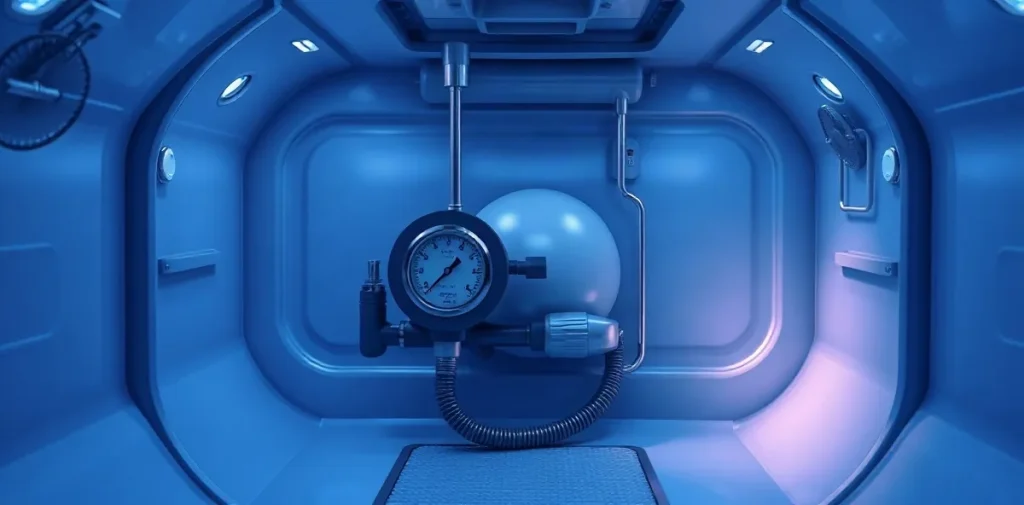
Ventilation under hyperbaric conditions is the study of how breathing and ventilator performance change when ambient pressure rises, as it does during a dive or inside a pressure chamber. Understanding these effects matters because gas density, respiratory mechanics and equipment behaviour can all influence how effectively a person breathes at depth or receives assisted ventilation.
What changes when pressure increases?
As a diver descends, the surrounding pressure increases and the gas breathed at depth becomes denser. The lungs still exchange oxygen and carbon dioxide, but moving gas through the airways can require more effort, particularly during rapid or forceful breathing.
Ventilation means moving air or breathing gas into and out of the lungs. Its effectiveness depends on more than the volume delivered: the pattern of breathing, airway resistance, lung mechanics and the removal of carbon dioxide all matter. These factors make pressure effects relevant both to divers breathing independently and to patients whose breathing is supported by a ventilator in a hyperbaric environment.
Why examine ventilators in a hyperbaric environment?
A ventilator is designed to deliver breathing gas according to settings such as pressure, volume or flow. Increased ambient pressure can affect gas behaviour and the operation or interpretation of equipment, so performance observed at ordinary surface pressure cannot automatically be assumed to apply inside a chamber.
Research in this area asks whether a device delivers and measures gas as intended under pressure, and whether its operation remains suitable across the conditions in which it may be used. The question is practical: in hyperbaric treatment, clinicians need to assess both the patient’s respiratory state and the reliability of the equipment supporting ventilation.
What do studies of ventilation under pressure examine?
Studies may test ventilators in pressure chambers, compare their performance at different ambient pressures, and examine how settings relate to delivered gas. Investigators can also consider breathing resistance, gas flow, airway pressures and carbon-dioxide clearance. The exact measurements depend on the device and the research question.
Interpreting such tests requires attention to the whole system: ventilator, breathing circuit, gas supply and patient. A change in a displayed value may reflect the instrument, the gas conditions, or a genuine change in respiratory mechanics. Bench testing can isolate equipment behaviour; clinical assessment must also account for the person receiving ventilation.
- Ambient pressure: the pressure surrounding the diver or equipment.
- Gas density: a factor that can increase the work of moving gas through the airways.
- Delivered ventilation: the gas reaching the patient, not only the value selected on a control.
- Measurement: whether sensors and displays remain meaningful under the conditions of use.
- Carbon-dioxide clearance: a central outcome of effective ventilation.
How does this connect to diving medicine?
Breathing physiology under pressure connects equipment research with the wider science of diving. Work on gas density and respiratory effort helps explain why breathing at depth is not simply the same as breathing at the surface. Hyperbaric medicine adds a related clinical setting: a patient may need respiratory support while exposed to increased ambient pressure.
For diving physicians and hyperbaric clinicians, the key issue is how physiological changes and device performance interact. A ventilator can be technically functional yet still require careful interpretation in context; patient condition, treatment environment and equipment suitability all matter. Decisions about an individual patient belong with clinicians experienced in diving and hyperbaric medicine.
What should clinicians and equipment teams keep in view?
Evaluation should distinguish a ventilator’s nominal settings from the gas actually delivered under pressure. It should also consider how pressure affects monitoring and whether a device is intended for the specific hyperbaric environment. Those questions are important before equipment is relied upon in treatment or research.
For divers, this research area offers a broader lesson: breathing gas, respiratory workload and equipment cannot be considered separately from depth. If a medical condition or respiratory support could affect fitness to dive, seek advice from a diving-medicine physician rather than applying general equipment findings to an individual case.
Frequently asked questions
Does increased pressure change the gas a diver breathes?
Why might a ventilator behave differently in a pressure chamber?
Can general research determine whether a person is fit to dive?
An original research-library explainer written by the Rubicon editors. It is not a summary of a specific publication.
Related reading on Rubicon
- Diving Physics: Gas Laws, Pressure Effects, and Safety
- Understanding the Physiology of Breath-Hold Diving
- How Pressure Amplifies Nitrogen Narcosis Effects on Divers
- Oxygen Partial Pressure: Key to Dive Safety and Performance
- Thesis Research in Diving and Hyperbaric Medicine
- The Nursing Role in Hyperbaric Medicine
- More on Diving Science
- Browse the Research Library