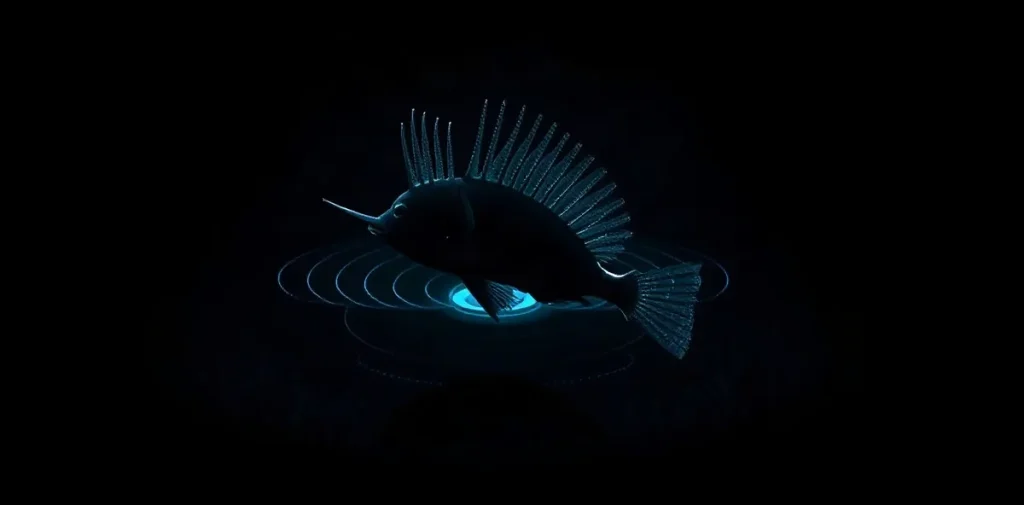
Behavior and Sound Production by Longspine Squirrelfish Holocentrus rufus During Playback of Predator and Conspecific Sounds is a 2007 publication by Luczkovich and Keusenkothen in the proceedings of the American Academy of Underwater Sciences’ twenty-sixth annual Scientific Diving Symposium. Its subject is how longspine squirrelfish behave and produce sounds during playback of predator and same-species sounds, a question linking animal communication with underwater observation.
What does sound playback help researchers examine?
Playback lets researchers present an animal with an acoustic stimulus under controlled conditions and observe its response. In this case, the title identifies two kinds of sound: predator sounds and conspecific sounds, meaning sounds associated with members of the same species. The research subject therefore brings together sound perception, behaviour and sound production.
Sound underwater travels through a medium that differs acoustically from air. Animals may use sound to communicate or respond to their surroundings, while researchers must consider how a playback signal reaches an animal and how an animal’s own sounds are detected. Behavioural observation and acoustic recording answer related but distinct questions.
The title also points to a useful distinction: a response to a sound and the production of sound are not the same measurement. A study of this kind can examine both, while keeping the stimulus and the observed response conceptually separate.
Why are these questions relevant to scientific diving?
Scientific diving provides a way to observe underwater organisms in their environment and to conduct work that depends on direct access to a study site. Research involving sound playback adds an experimental component: investigators need to place or operate sound-producing and recording equipment while also observing animal behaviour.
That combination makes the work relevant to diving science even though its central subject is not human decompression or treatment in a hyperbaric chamber. It sits within the broader practice of underwater research, where diver safety, reliable observation and the limits imposed by the aquatic environment shape how a study can be designed and carried out.
For divers and diving physicians, the connection is mainly methodological. Scientific dives can involve tasks that differ from recreational diving, and the activity must be planned around the work, the environment and the diver. The particular procedures used for this publication are not necessary to understand why underwater acoustics is a scientific-diving subject.
Which concepts are useful when reading this subject?
Several terms clarify what a playback study is asking. They describe the framework of the research, not any particular outcome:
- Playback: presentation of a sound stimulus so that behaviour can be observed.
- Conspecific: an individual belonging to the same species.
- Predator cue: a signal associated with a potential predator; its meaning depends on the animal and context.
- Sound production: the sounds an animal emits, which can be studied alongside its response to external sounds.
- Underwater acoustics: the study of sound transmission and detection in water.
These distinctions matter because acoustic studies depend on both the stimulus and the measurement. A playback signal is not automatically equivalent to a natural encounter, and a recorded sound does not by itself explain the behaviour associated with it. Interpretation depends on experimental design and the conditions under which observations are made.
How does the topic fit into diving research?
Diving research includes human physiology, decompression, equipment and safety, but it also includes scientific work conducted underwater. The symposium venue places this publication in that wider setting: scientific diving is a means of carrying out research, as well as a field with its own operational and physiological considerations.
Animal sound and behavioural research also belongs to a larger effort to understand how organisms interact with their environment. For divers, underwater sound is part of the setting in which observations occur; for researchers, it can also be the experimental variable. Separating those roles is important when interpreting observations made in a complex natural environment.
The publication is a journal article in the proceedings titled Diving for Science…2007, edited by NW Pollock and JM Godfrey. Its bibliographic context places the work among scientific-diving research, while its title identifies the biological and acoustic question it addresses.
Frequently asked questions
What animal is the subject?
What sounds are named in the title?
Why is the publication relevant to diving science?
Citation details
- Title: Behavior and Sound Production by Longspine Squirrelfish Holocentrus rufus During Playback of Predator and Conspecific Sounds
- Authors: Luczkovich, JJ and Keusenkothen, M
- Year: 2007
- Published in: In: NW Pollock and JM Godfrey (Eds.) the Diving for Science…2007 Proceedings of the American Academy of Underwater Sciences(Twenty–sixth annual Scientific Diving Symposium)
- Record type: Journal article
- Repository record: Rubicon Research Repository, handle 123456789/7000
This page is an original summary written by the Rubicon editors from the publication’s bibliographic record. It does not reproduce the paper, its abstract or its data; consult the publication itself for its methods and findings.