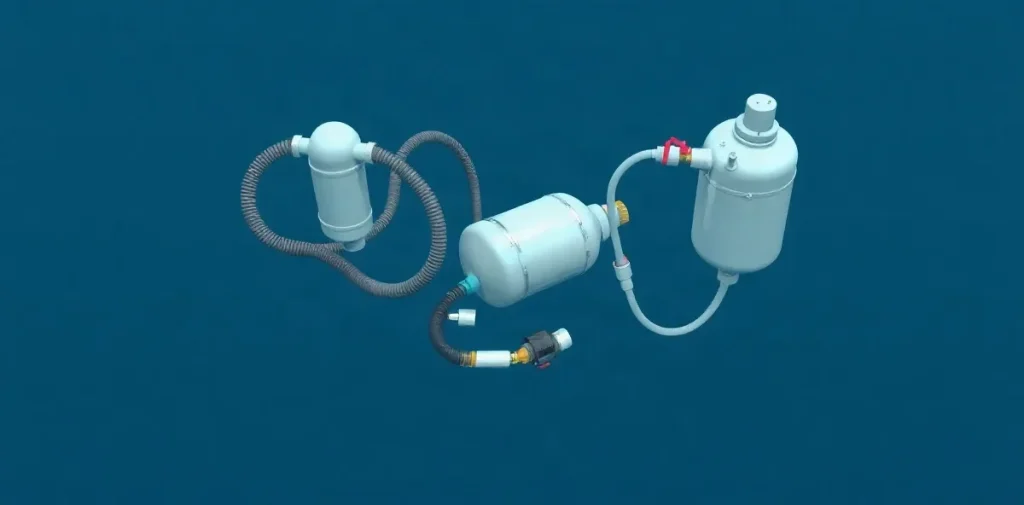
Rebreather research examines how closed- and semi-closed-circuit systems deliver breathing gas while removing carbon dioxide and managing oxygen. Its central concern is how equipment, physiology and operating conditions interact: a system must support breathing underwater without allowing a fault or changing gas mixture to become dangerous.
What makes a rebreather different from open-circuit scuba?
An open-circuit diver exhales gas into the water; a rebreather routes exhaled gas back through a breathing loop. A scrubber removes carbon dioxide, while oxygen is replenished to maintain a breathable mixture. Depending on the design, the unit may also add diluent gas to control loop volume and composition.
That recycling changes the engineering problem. The diver depends on sensors, valves, absorbent material, hoses and a breathing bag as well as on the gas supply. Research therefore considers the complete system, not just a single component: equipment behaviour affects the gas reaching the lungs, and the diver’s breathing affects the equipment in turn.
Which gas and breathing hazards need measuring?
Carbon-dioxide retention is a central concern. If the scrubber is exhausted, incorrectly assembled, flooded or otherwise impaired, carbon dioxide can accumulate in the breathing loop. Elevated carbon dioxide can cause distress and impair judgement; underwater, that can make a developing equipment problem harder to manage.
Oxygen control poses a different challenge. The partial pressure of oxygen—the pressure contributed by oxygen in the breathing mixture—changes with depth and loop composition. Too little oxygen can cause loss of consciousness, while excessive exposure can produce oxygen toxicity. Research examines how reliably a system measures and controls oxygen under changing operating conditions.
- Scrubber performance: how effectively and consistently carbon dioxide is removed.
- Oxygen monitoring: sensor response, control and the implications of incorrect readings.
- Breathing resistance: the effort needed to move gas through the loop at different depths and orientations.
- Gas management: how loop volume and composition change during a dive.
- Failure response: whether a developing fault can be detected and managed in time.
How is rebreather performance studied?
Different methods answer different questions. Bench testing can examine components and system behaviour under controlled conditions, while human testing can assess breathing effort, physiological responses and the practical use of monitoring and controls. Field evaluation adds the realities of depth, workload, temperature and task demands.
These approaches are complementary rather than interchangeable. A component that performs as intended in a test does not by itself establish how the whole unit behaves during a dive. Researchers must also distinguish a normal operating variation from a failure, and consider how equipment configuration and diver workload affect the result.
Why does this matter beyond equipment design?
Rebreather problems can involve both equipment and physiology, so the research has consequences for diver training, incident analysis and clinical care. A diver’s symptoms may not identify the original fault: oxygen disturbance, carbon-dioxide retention and other diving hazards can produce overlapping signs or complicate an emergency.
For scientific divers, rebreathers can support work where gas conservation or reduced bubbles is useful. Those benefits make dependable monitoring and clear operating procedures important, particularly when a dive involves a task that limits attention or movement. Diving physicians and hyperbaric clinicians also need to understand how breathing-loop failures can shape a medical presentation.
What should divers take from the research area?
Rebreathers require attention to a chain of interacting protections: gas supply, carbon-dioxide removal, oxygen monitoring, alarms and the diver’s response. A reassuring display is only as useful as the sensors, system configuration and procedures behind it. Training should include recognising abnormal readings and responding to the specific unit in use.
Research in this field continues to connect engineering tests with human performance and clinical risk. If a health concern affects your fitness to use a rebreather, discuss it with a physician experienced in diving medicine; equipment-specific procedures belong to the manufacturer’s instructions and the diver’s training.
Frequently asked questions
What does a rebreather scrubber do?
Why does oxygen need active monitoring?
Is rebreather research relevant to diving medicine?
An original research-library explainer written by the Rubicon editors. It is not a summary of a specific publication.
Related reading on Rubicon
- How Rebreather Systems Optimize Gas Use and Extend Dive Time
- Diving Safety: Training, Gear, Sites, Risk
- Decompression Sickness: Causes and Risk Reduction
- The Science of Diving SSI: Education and Physiology Insights
- Rebreathers: Diving Science Research Summary
- U.S. Navy Submarine Escape System: Research Summary
- More on Equipment
- Browse the Research Library