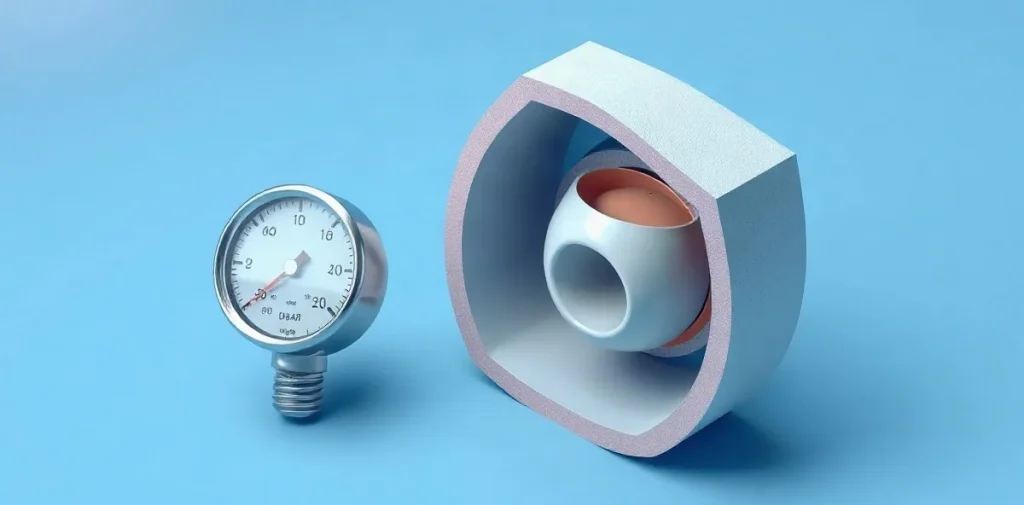
Middle-ear barotrauma is pressure-related injury to the space behind the eardrum. In hyperbaric oxygen therapy, pressure rises and falls in a chamber; the middle ear must equalise with its surroundings. Understanding why equalisation fails matters to patients, clinicians and divers, who encounter related pressure changes underwater.
How does pressure affect the middle ear?
The middle ear is an air-filled cavity separated from the outer ear by the eardrum. The Eustachian tube connects it to the back of the nose and throat, allowing air to pass and pressure to equalise. When the pressure outside the eardrum changes, that connection must open at the right time.
During chamber compression or descent underwater, pressure increases around the body. If middle-ear pressure does not rise in step, the eardrum is pushed inward and the tissues may become painful or injured. During decompression or ascent, the pressure difference reverses; trapped gas must escape from the middle ear.
Equalisation depends on anatomy, timing and the ability to open the Eustachian tube. Congestion or inflammation can make this harder, but the response varies between people and from one occasion to another. Pressure-related ear symptoms are not all the same, so the affected structure and circumstances matter.
What questions do clinicians investigate?
Research into predictors asks which features might be associated with a greater chance of middle-ear barotrauma during hyperbaric oxygen therapy. The broader clinical question is how patient factors, ear function and the pressure exposure interact. “Predictor” describes a factor examined for an association; it does not by itself explain cause or guarantee an outcome for an individual.
Studies in this area can compare clinical histories and ear assessments with changes observed during chamber treatment. They may consider whether a person can equalise, whether symptoms occur during compression or decompression, and whether examination shows pressure injury. The choice and timing of assessments affect what a study can detect.
Clinicians also distinguish symptoms from signs. Pain or a sense of fullness can prompt assessment, while examination may identify changes to the eardrum. A sound approach considers the treatment conditions and the patient’s ear history together rather than treating one symptom as a complete measure of injury.
Why does chamber treatment raise a distinct question?
Hyperbaric oxygen therapy exposes a patient to increased pressure while oxygen is delivered in a chamber. The pressure change is central to treatment, so the middle ear has to accommodate repeated compression and decompression. This makes ear equalisation a practical clinical issue as well as a subject for physiological study.
Chamber treatment and diving share the basic physics of pressure acting on air spaces, but they are not interchangeable exposures. Divers change depth in water, while a hyperbaric patient undergoes a prescribed chamber session. The timing, setting and reasons for the exposure differ; conclusions about one situation should not automatically be transferred to the other.
For hyperbaric clinicians, the issue connects treatment delivery with a common pressure-sensitive structure. For diving physicians, it illuminates a mechanism relevant to descent and ascent. In both settings, the key concern is whether air can move through the Eustachian tube as surrounding pressure changes.
What can divers take from this research area?
A diver’s middle ear must equalise during descent, and difficulty doing so can turn a routine pressure change into an injury. Chamber research helps frame the underlying physiology, but a diver’s risk depends on the dive, the person and the circumstances at the time. Ear symptoms should not be dismissed simply because a previous dive was uneventful.
- Pressure gradient: the difference between pressure in the middle ear and pressure outside the eardrum.
- Equalisation: movement of air through the Eustachian tube to reduce that difference.
- Barotrauma: tissue injury caused by a pressure imbalance.
- Predictor: a characteristic studied for its relationship to an outcome, not a certain forecast.
These concepts also help separate equalisation difficulty from other causes of ear discomfort. If symptoms persist, recur or are accompanied by hearing changes or dizziness, a diving-medicine physician should assess the situation before further exposure to pressure.
What does this work contribute to wider diving medicine?
Middle-ear barotrauma sits where physiology, clinical assessment and pressure-exposure practice meet. Research asks not only how pressure affects the ear, but which observable features may help identify people who need closer assessment. That question links hyperbaric medicine with the wider study of pressure-related injury in divers.
The useful boundary is clear: shared pressure physiology makes comparisons informative, while different exposure conditions limit direct transfer. For an individual decision about chamber treatment or diving, clinical evaluation matters more than a generalised prediction; persistent ear problems warrant discussion with a physician experienced in diving or hyperbaric medicine.
Frequently asked questions
What is middle-ear barotrauma?
Why can equalising be difficult?
Is chamber pressure exposure the same as diving?
An original research-library explainer written by the Rubicon editors. It is not a summary of a specific publication.
Related reading on Rubicon
- First Aid Essentials for Diving Ear Barotrauma
- The Physiology Behind Oxygen Toxicity in Deep Dives
- Understanding Oxygen Toxicity Risks and Prevention in Diving
- Oxygen Partial Pressure: Key to Dive Safety and Performance
- Middle-Ear Barotrauma and Hyperbaric Oxygen
- Hyperbaric Oxygen Therapy for Lyme Disease
- More on Dive Medicine
- Browse the Research Library