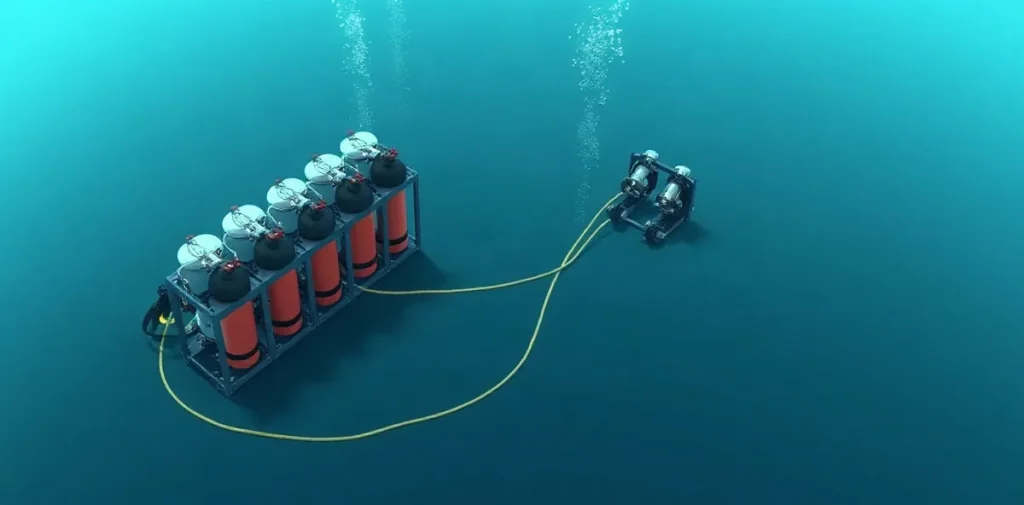
The research area linking technical and recreational diving examines how methods developed for demanding dives are adopted in recreational settings, and what changes when they are. Its central concern is not equipment alone: training, gas planning, decompression, human factors and operational safeguards all affect whether a technique remains appropriate as the dive and diver change.
What distinguishes technical diving from recreational diving?
Technical diving generally involves exposures or environments that exceed the limits of ordinary recreational profiles. It may include planned decompression, overhead environments, multiple gas mixtures or greater depth. These features increase the demands on planning and execution; they do not by themselves make a dive safe or suitable for a particular diver.
Recreational diving usually aims to keep the ascent direct and the dive within established training and equipment limits. The boundary between the two is not simply a depth line. It depends on the dive plan, environment, gases, decompression obligations and the diver’s preparation.
When technical methods enter recreational practice, the useful question is whether the whole system transfers: the training, procedures, equipment configuration and support around the dive. Borrowing one visible element without its associated discipline can create new failure points rather than reduce risk.
What questions does this research area ask?
Studies of the transition examine how divers learn and apply unfamiliar procedures, how equipment choices affect task load, and how teams manage changing conditions underwater. They may also consider how agencies define training boundaries and how divers interpret those boundaries in practice.
Decompression is a recurring concern. A decompression obligation means a diver must make planned stops during ascent to manage inert-gas elimination; it changes the consequences of delay, gas loss or a missed stop. Research therefore considers not only physiological models, but also whether divers can carry out the plan reliably under real operating conditions.
- Exposure: depth, duration, ascent profile and the surrounding environment.
- Gas planning: breathing-gas selection, reserves and contingencies for equipment problems.
- Human factors: workload, communication, attention and decision-making under stress.
- Training transfer: whether a skill learned in one setting works in another.
- Risk controls: team procedures, equipment redundancy and limits on the planned dive.
How do researchers study the transition?
The questions call for more than one method. Physiological and decompression research can examine how pressure exposure and breathing gases affect the body, while equipment testing assesses performance and failure modes. Training and human-factors studies look at task execution, judgement and communication.
Field observation and incident analysis can reveal where planned procedures meet the practical conditions of diving. Each method answers a different question: a laboratory measure cannot by itself establish how a team will respond underwater, while an incident account cannot isolate every physiological mechanism.
For a meaningful comparison, researchers need to distinguish the dive itself from the surrounding system. A technique may work under controlled conditions yet become difficult to apply when visibility, current, workload or team coordination changes. That is why operational context matters alongside depth and gas choice.
Why does the issue matter to divers and clinicians?
For divers, the move between styles can alter the risk profile even when the equipment looks familiar. More complex gas plans and decompression procedures require additional preparation, reliable execution and contingencies. A diver’s comfort with a tool is not a substitute for training in the full procedure.
Diving physicians and hyperbaric clinicians may need to assess an exposure that includes unusual gases, prolonged or staged ascent, or an overhead environment. Clear information about the planned profile and what actually happened helps clinical assessment. Symptoms after diving warrant prompt medical evaluation; suspected decompression illness or another serious diving emergency requires urgent care.
Scientific divers face a related tension: research objectives can require specialized profiles, while the work must remain manageable for the team. A sound plan accounts for the task, diver capability, equipment and emergency response together. Personal medical fitness and suitability for a particular exposure should be discussed with a diving-medicine physician.
What should you consider before adopting a technical method?
Start with the demands of the dive, not the appeal of a technique or device. Consider whether the method changes decompression obligations, gas requirements, team roles or emergency options. Training should match the actual exposure, and the plan should include a way to respond if a key assumption fails.
These questions belong to the wider effort to connect diving physiology with equipment design, education and operational safety. The practical test is whether the entire approach—not just one procedure—fits the dive and the people carrying it out.
Frequently asked questions
Is technical diving defined only by depth?
Why can a technical procedure be risky in recreational diving?
Who should advise on medical fitness for complex diving?
An original research-library explainer written by the Rubicon editors. It is not a summary of a specific publication.