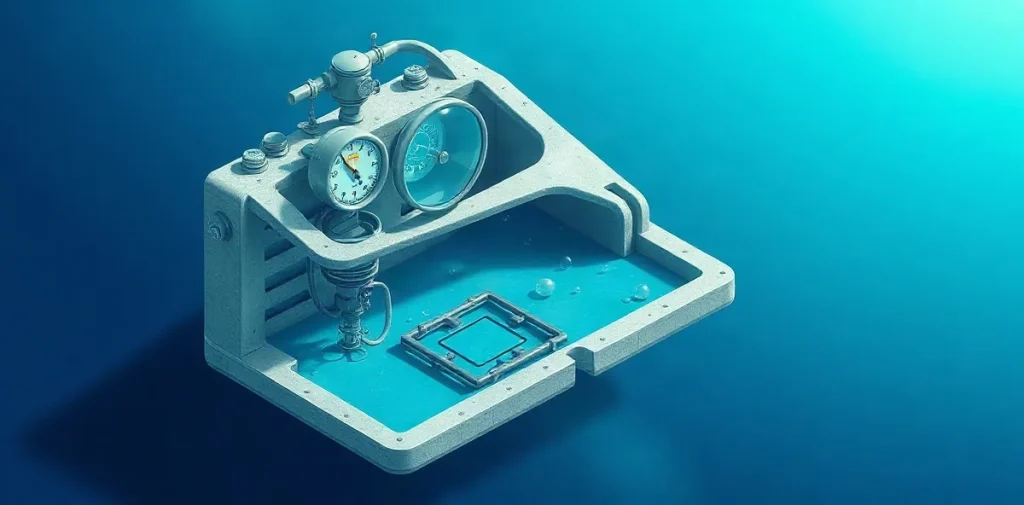
High-pressure living research examines how people function when they spend extended periods in pressurised environments, including underwater and enclosed habitats. It matters to divers because pressure changes affect physiology, while prolonged exposure raises questions beyond those encountered during a single dive: how the body adapts, what risks accumulate, and how work and health can be monitored.
What does “high-pressure living” mean?
Pressure increases with depth, raising the pressure of the gases a diver breathes. In a pressurised habitat, people may remain at a pressure above the surface level for a sustained period, rather than repeatedly returning to normal atmospheric pressure. This changes the exposure problem: researchers must consider both the pressure itself and the length of time spent breathing gases under pressure.
Human physiology responds to the partial pressures of gases in the body. Nitrogen can have narcotic effects at elevated partial pressures, while oxygen toxicity depends on oxygen pressure and exposure duration. Inert gas also dissolves into tissues under pressure and leaves them during decompression, so the sequence and duration of exposure matter.
Which physiological questions matter over time?
Studies of prolonged pressurised exposure can examine breathing, circulation, nervous-system function, sleep, and the ability to carry out demanding tasks. These are connected: a change in ventilation affects gas exchange, while fatigue or impaired concentration can affect operational safety. The relevant question is not simply whether a person can tolerate pressure, but how physiological and cognitive function behave across an exposure.
Decompression is central to the wider research area. When pressure falls, dissolved inert gas must be eliminated without bubbles forming or growing in ways that cause injury. A long stay at pressure presents a different exposure history from a brief dive, and the decompression plan must account for the pressure, breathing gas, exposure duration, and the individual’s condition.
How do researchers study life under pressure?
Research may combine controlled chamber exposures with physiological monitoring and observation of task performance. A chamber allows pressure and breathing conditions to be controlled while researchers track how people respond over time. The measurements chosen depend on the question: gas exchange, cardiovascular responses, neurological effects, symptoms, and performance may all be relevant.
Animal studies and work with different breathing atmospheres can help investigate mechanisms, but they do not automatically predict human responses. Results must be interpreted in light of species, exposure conditions, and the limits of the experimental setting. For human diving practice, controlled observations are most useful when their conditions resemble the pressure, duration, and gas mixture of the situation being considered.
- Pressure and duration: both shape the exposure and its physiological consequences.
- Breathing gas: oxygen and inert-gas partial pressures influence toxicity, narcosis, and gas loading.
- Decompression: pressure reduction must allow inert gas to leave the body safely.
- Human function: symptoms, cognition, sleep, and task performance help describe how exposure affects a person.
Why does this research matter to divers and clinicians?
Commercial, scientific, and military diving can involve extended work at pressure, and some operations use pressurised habitats or saturation techniques. Understanding prolonged exposure helps inform decisions about breathing environments, work schedules, monitoring, and decompression. It also helps clinicians assess symptoms in the context of a diver’s full pressure and gas-exposure history.
The research connects with several established areas of diving medicine: decompression physiology, oxygen toxicity, inert-gas narcosis, and the medical effects of breathing gases. These problems overlap, but they are not interchangeable. A symptom during exposure may have more than one possible cause, so evaluation depends on the person’s circumstances and the details of the dive or pressurised operation.
What should you keep in mind about applying the findings?
Pressure exposure is not a single variable. Depth or chamber pressure, breathing gas, time under pressure, workload, and the decompression profile all shape the conditions being studied. A conclusion from one set of conditions should not be transferred casually to a different dive or habitat.
High-pressure living research provides a framework for asking how sustained exposure affects the body and how those effects can be managed. It does not replace individual medical assessment. If you have symptoms after a dive or during a pressurised operation, consult a diving-medicine physician.
Frequently asked questions
How is prolonged high-pressure exposure different from an ordinary dive?
Why does breathing gas matter under pressure?
Who should assess a health concern after pressure exposure?
An original research-library explainer written by the Rubicon editors. It is not a summary of a specific publication.
Related reading on Rubicon
- The Science of Diving SSI: Education and Physiology Insights
- Diving Physics: Gas Laws, Pressure Effects, and Safety
- Diving Science: Physiology and Tech Behind Safe Dives
- Impact of Microgravity on Dive Physiology and Safety
- High Pressure Nervous Syndrome: Research Summary
- High-Mountain Medicine and Diving Physiology
- More on Diving Science
- Browse the Research Library