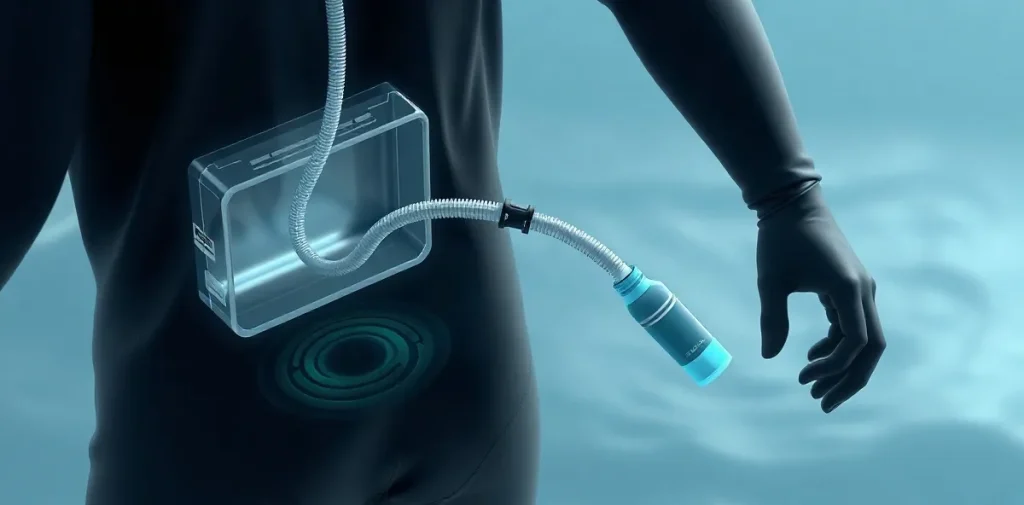
Research on external urinary catheters in diving examines how a device used to manage urine interacts with infection risk and pressure changes. The subject matters because a diver’s equipment, body and exposure to pressure operate together: a device that is useful on the surface may create practical or medical concerns underwater.
What is a P-valve, and why study it underwater?
A P-valve is an external urinary catheter system used by some divers to drain urine into a collection arrangement, often as part of a drysuit. Its purpose is practical: it can reduce the need to end a dive to urinate. The system also introduces interfaces between skin, tubing, valves and the surrounding suit environment.
Those interfaces raise questions that do not arise in quite the same way during ordinary use on land. Researchers and clinicians consider fit, drainage, leakage, skin condition, hygiene and how the system behaves when a diver changes depth. The device is one part of a larger human-factors problem: keeping essential life-support equipment functional while managing bodily needs.
How can infection risk enter the picture?
Any catheter system can irritate or injure skin, and contamination can increase the risk of infection. With an external device, relevant considerations include cleanliness during application, contact time, moisture, pressure from an ill-fitting sheath and whether urine drains freely. Infection may involve the urinary tract or the skin around the device; the mechanisms and symptoms are not interchangeable.
In diving, discomfort or infection can affect a diver’s ability to concentrate, operate equipment and complete a planned exposure. Symptoms such as pain, fever, urinary difficulty or inflamed skin deserve medical attention rather than being treated as a routine inconvenience. A diving-medicine physician can assess fitness to dive in light of the condition, treatment and planned exposure.
What does barotrauma mean in this context?
Barotrauma is tissue injury caused by pressure differences between a body space and its surroundings. Divers most often encounter it in familiar contexts such as the ears, sinuses, lungs and mask. A urinary catheter system adds a different question: whether pressure changes can affect a device, trapped gas, drainage or the tissues in contact with it.
The answer depends on the system’s design and how it is used. A flexible, open drainage pathway does not behave like a sealed gas space, while a kink, blockage or closed component can change how pressure is transmitted. For that reason, research in this area has to distinguish the physiology of pressure exposure from the mechanical behaviour of the particular equipment.
What questions and methods matter to researchers?
Work on this subject can combine clinical observation with equipment assessment. Researchers may ask whether a system remains secure, drains reliably and avoids harmful skin effects during use, while also examining how pressure changes and dive conditions affect its function. The exact design of a study determines which of those questions it can answer.
- Device performance: Does the catheter remain attached, and does urine pass through the system without obstruction?
- Skin and infection: Are there signs of irritation, tissue damage or infection associated with use?
- Pressure exposure: Could depth changes, gas trapping or a blocked pathway alter device function or tissue loading?
- Practical use: Can the diver manage the system without compromising comfort, hygiene or other tasks?
These lines of inquiry sit within the wider study of diving medicine, where equipment performance and human physiology are considered together. They also connect with broader catheter research, but underwater use brings pressure variation, exposure duration and the constraints of a dive suit into the clinical picture.
What should divers and clinicians consider?
For a diver, the relevant issues include the reason for using the device, the health of the skin, reliable drainage and the ability to manage the system before and after a dive. Equipment compatibility and correct fitting matter; so do hygiene and a plan for what to do if the system leaks, becomes blocked or causes pain.
Clinicians assessing a diver need to consider the underlying urinary or medical condition, any active infection, treatment effects and the demands of the planned dive. A device question cannot be separated from the diver’s health or the equipment configuration. Decisions about an individual’s fitness to dive should be made with a clinician familiar with diving medicine.
Frequently asked questions
Is a P-valve the same as an indwelling urinary catheter?
Does a P-valve itself cause barotrauma?
Can someone dive with a urinary infection?
An original research-library explainer written by the Rubicon editors. It is not a summary of a specific publication.