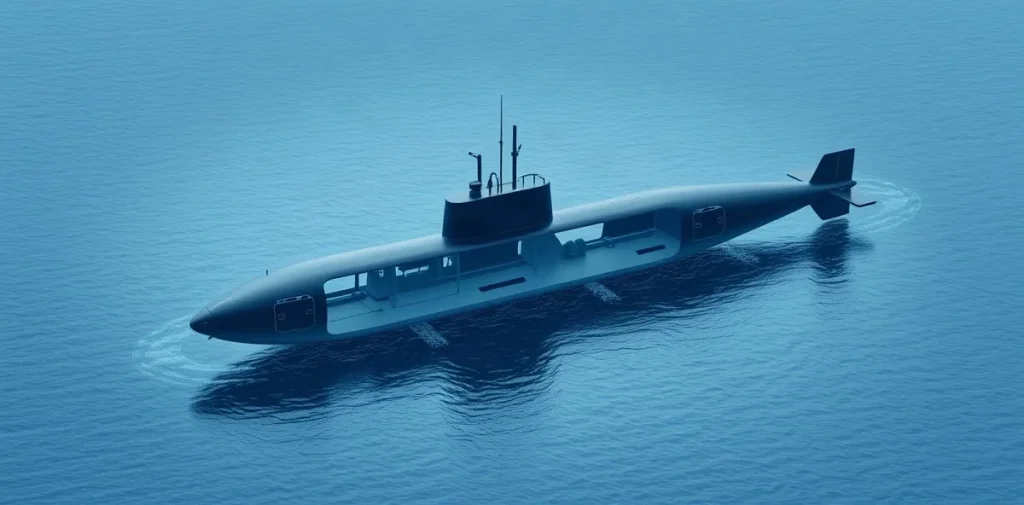
Submarine medicine studies how people function and stay healthy in the enclosed, pressurised environment of a submarine, and how medical support works when access to care is limited. Its concerns overlap with diving and hyperbaric medicine: pressure, gas, environmental control and human performance all shape risk and operational decisions.
What makes a submarine a distinct medical environment?
A submarine is not simply a vessel beneath the water. Its crew lives and works in a confined atmosphere, where ventilation, temperature, humidity and contaminants require control, while the surrounding water constrains access to outside help. Medical planning must account for both the atmosphere inside the vessel and the difficulty of evacuation.
Pressure effects depend on the vessel’s design and operating conditions. In a pressure-resistant submarine, the crew’s living space is maintained separately from the ambient water pressure; this differs from a diver breathing under elevated pressure. The distinction matters: submarine medicine and diving medicine share some physiological concerns, but their exposures and clinical problems are not interchangeable.
Which human factors does the research examine?
Research in this area asks how the operating environment affects health, alertness and the ability to carry out demanding tasks. Sleep disruption, fatigue, stress, limited privacy and prolonged confinement can influence performance. These are operational concerns as well as health concerns, because a crew depends on coordinated work and reliable decisions.
Environmental monitoring and medical surveillance can help identify hazards before they become acute problems. The relevant questions include how to detect changes in air quality, how to recognise illness in a setting with limited diagnostic resources, and how to maintain care when normal clinical support is distant. Research may address the systems and procedures around these questions, not only the physiology of an individual crew member.
- Atmosphere: ventilation and the control of gases, heat, humidity and contaminants.
- Human performance: fatigue, sleep, stress and the demands of sustained operations.
- Medical readiness: assessment, treatment capability and communication when outside care is difficult to reach.
- Emergency planning: decisions about stabilisation, evacuation and transfer to a suitable treatment facility.
How does this work connect to decompression and hyperbaric medicine?
The connection is strongest where submarine operations involve diving, escape or rescue, or require medical support for personnel exposed to pressure. Decompression science asks how inert gas enters and leaves body tissues as pressure changes. The same broad principles inform the assessment of pressure-related illness, but the exposure profile and treatment decision depend on the actual operation.
Decompression tables and recompression treatment tables address different tasks. Decompression tables guide planned pressure reduction after an exposure; recompression treatment tables are used in clinical care for selected pressure-related conditions. Submarine medical research sits alongside this work by considering the operational setting, the available resources and how an affected person can reach appropriate care.
That relationship makes coordination important. A medical plan must fit the exposure, the person’s condition, the vessel’s capabilities and the route to treatment. A pressure-related emergency calls for assessment by clinicians trained in diving or hyperbaric medicine.
Why does a small specialist command matter?
Submarine medical support is a specialised function within a larger operational system. Its value lies not in size alone, but in whether medical knowledge, environmental expertise and operational planning can be brought together when conditions are restrictive. Research on command structure and presence therefore concerns how expertise is organised and made available to the submarine force.
The broader field combines physiology with engineering, occupational health and emergency planning. Its questions are practical: which hazards need monitoring, what care can be delivered onboard, and what must be arranged before an incident occurs? The answers depend on the mission and platform, so procedures need to match the conditions rather than assume one universal submarine environment.
Frequently asked questions
Is submarine medicine the same as diving medicine?
Why is air quality a medical concern aboard a submarine?
Who should assess a suspected pressure-related illness?
An original research-library explainer written by the Rubicon editors. It is not a summary of a specific publication.