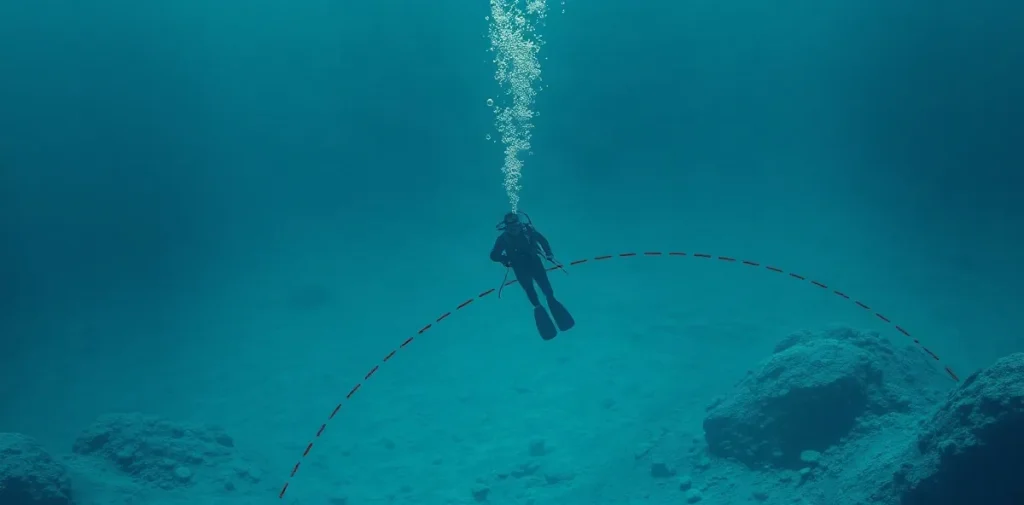
The importance of deep safety stops: rethinking ascent patterns from decompression dives is a 1997 journal article by Pyle RL, published in SPUMS Journal 27(2), reprinted from Deep Tech. It addresses how ascent patterns and deep safety stops relate to decompression diving—a subject that connects dive planning with the body’s changing response to pressure.
What is a deep safety stop in decompression diving?
A decompression dive requires a diver to manage the return to the surface so that pressure reduction occurs in a controlled way. A deep safety stop is a pause made during ascent at a depth deeper than the shallower stops commonly associated with staged decompression. The title frames the article around whether ascent patterns deserve reconsideration, rather than treating the stop as an isolated procedure.
At depth, elevated ambient pressure increases the amount of inert gas that can dissolve in body tissues. During ascent, pressure falls and that gas moves back toward the lungs for elimination. The speed and pattern of ascent influence this process, but the response is not identical across all tissues: some exchange gas relatively quickly, while others do so more slowly.
Why does ascent pattern matter to decompression?
Decompression sickness is associated with bubbles forming or growing as dissolved gas comes out of solution during pressure reduction. Bubble formation is not a simple switch triggered by reaching one depth. It is affected by the dive’s pressure history, gas loading, ascent, and individual physiological variation.
Stops shape the pressure changes experienced on the way to the surface. A pause at one depth may alter the balance between gas leaving tissues and bubbles changing within the body; the consequences can depend on the full profile, not on a single stop considered alone. This makes the design of ascent schedules a technical and physiological question, as well as a practical one for divers.
What concepts help explain the debate?
Several related ideas are useful when considering deep stops and staged ascents:
- Inert-gas uptake and elimination: gases such as nitrogen move between breathing gas, blood, and tissues as pressure and exposure change.
- Tissue compartments: decompression models represent different rates of gas exchange; these are useful abstractions, not literal containers in the body.
- Supersaturation: tissues can remain temporarily loaded with gas beyond the level expected at the new ambient pressure.
- Bubble dynamics: bubbles may form, grow, or shrink as pressure changes, and their behaviour is not captured fully by a single tissue-loading measure.
- Ascent schedule: depth, speed, pauses, breathing gas, and the preceding dive profile work together rather than independently.
These concepts explain why a stop that appears intuitively helpful cannot be judged by depth alone. Decompression planning must consider both gas gradients and the possibility of bubble activity, while recognising that models simplify complex biology.
Why is this question important beyond technical diving?
Ascent strategy matters to recreational and scientific divers whenever a dive involves substantial inert-gas loading or required decompression. It also matters to diving physicians and hyperbaric clinicians because understanding the profile helps place symptoms and exposure history in context when assessing a possible decompression illness.
The broader field of decompression research compares theoretical models, physiological observations, and operational experience. Questions about deep pauses sit within continuing efforts to improve decompression schedules and understand why divers with seemingly similar exposures can have different outcomes. A journal article focused on rethinking ascent patterns belongs to that wider conversation about how best to manage pressure reduction.
How should divers apply the subject safely?
A discussion of stop depth is not a substitute for a validated decompression procedure. Divers should follow training, established planning methods, and the requirements of their equipment and breathing-gas configuration; changing an ascent schedule on the basis of a general concept can create additional risk.
After diving, concerning symptoms warrant prompt assessment by an appropriate diving-medicine physician or emergency service. This page is general education, not individual medical advice. A diving-medicine physician should be consulted for questions about personal fitness to dive, decompression illness, or return to diving after treatment.
Frequently asked questions
Is a deep safety stop the same as a decompression stop?
Why can’t one stop depth suit every dive?
Who should seek advice about decompression concerns?
Citation details
- Title: The importance of deep safety stops: rethinking ascent patterns from decompression dives
- Authors: Pyle RL
- Year: 1997
- Published in: SPUMS Journal 27(2) (reprinted from Deep Tech)
- Record type: Journal article
- Repository record: Rubicon Research Repository, handle 123456789/6066
This page is an original summary written by the Rubicon editors from the publication’s bibliographic record. It does not reproduce the paper, its abstract or its data; consult the publication itself for its methods and findings.