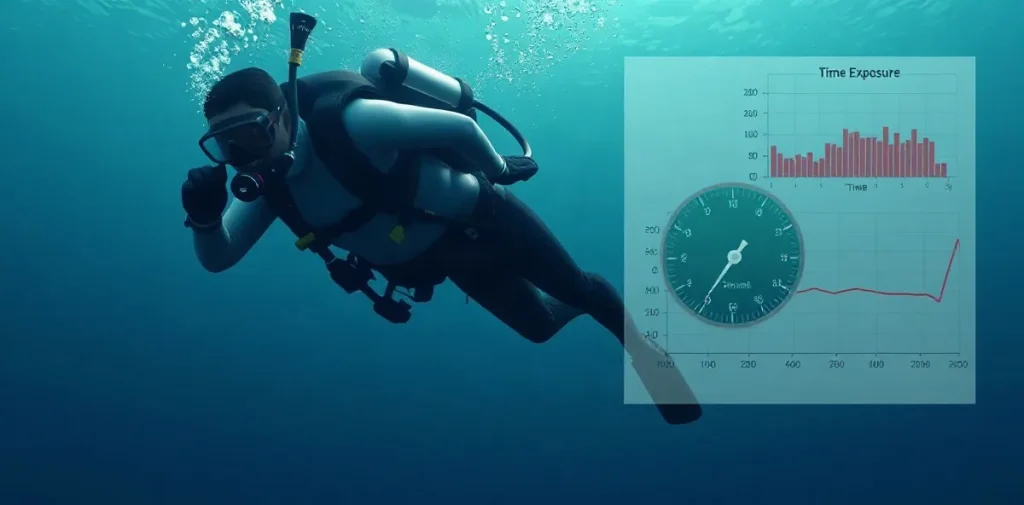
Oxygen toxicity limits during diving are defined primarily by the partial pressure of oxygen (PO2) and the duration of exposure, not simply by the oxygen percentage in the breathing gas. Safe exposure thresholds typically consider a maximum PO2 of 1.4 atmospheres absolute (ATA) for working dives and 1.6 ATA for short decompression stops, as established by standards such as NOAA’s Diving Manual (2026).
What is oxygen partial pressure and why does it matter for toxicity?
Oxygen partial pressure (PO2) is the pressure exerted by oxygen in a breathing gas mixture, measured in atmospheres absolute (ATA). It determines the amount of oxygen dissolved in body tissues during a dive and is the key factor influencing oxygen toxicity risk.
Understanding PO2 calculation
- PO2 = Fraction of oxygen (FO2) × ambient pressure (ATA)
- Example: Breathing air (21% O2) at 30 meters depth (~4 ATA) results in PO2 of 0.21 × 4 = 0.84 ATA
Oxygen toxicity occurs when PO2 exceeds safe thresholds, causing harmful effects such as central nervous system (CNS) toxicity or pulmonary oxygen toxicity (POT). The NOAA Diving Manual (2026) sets a maximum working PO2 of 1.4 ATA to avoid CNS toxicity during routine dives, with a short-term ceiling of 1.6 ATA allowed for decompression stops.
How long can divers safely be exposed to elevated oxygen levels?
Safe exposure time depends inversely on PO2 levels: higher PO2 shortens permissible exposure. NOAA’s Oxygen Exposure Limits Table provides limits for CNS toxicity ranging from hours at 1.4 ATA down to minutes near 1.6 ATA.
Exposure time guidelines
- At 1.4 ATA PO2: maximum recommended exposure is about 150 minutes
- At 1.6 ATA PO2: maximum exposure reduces to approximately 45 minutes
- Below 1.3 ATA PO2: exposure can extend for many hours with minimal risk
| PO2 (ATA) | Max Exposure Time (min) |
|---|---|
| 1.3 | 180 |
| 1.4 | 150 |
| 1.5 | 90 |
| 1.6 | 45 |
These limits are designed to prevent CNS oxygen toxicity symptoms such as convulsions underwater, which can be fatal. Pulmonary oxygen toxicity risk increases with longer exposures, typically over several hours at moderate PO2 levels.
Are oxygen percentages alone sufficient to determine safety?
Oxygen percentage in breathing gas does not directly indicate toxicity risk; the ambient pressure at depth must be considered to calculate PO2. For example, 100% oxygen at 6 meters depth (~1.6 ATA) reaches the CNS toxicity ceiling, while 40% oxygen at 20 meters (~3 ATA) produces a PO2 of 1.2 ATA, which is generally safer.
Misconceptions about oxygen percentages
- Higher FO2 always means higher toxicity risk is false without considering depth
- Diving on Nitrox with FO2 below 40% is typically safe within recreational depths due to lower PO2
- Breathing air (21% oxygen) at depths over 60 meters leads to PO2 above 1.4 ATA, increasing toxicity risk
Thus, practical dive planning focuses on controlling PO2 exposure rather than oxygen fraction alone, following recognized standards like NOAA and DAN guidelines.
How do dive computers and planning tools handle oxygen toxicity limits?
Modern dive computers and planning software integrate oxygen toxicity calculations using PO2 and exposure time, alerting divers when limits approach. Models such as the Shearwater Petrel 2 and Suunto D5 include NOAA-compatible oxygen toxicity tracking.
Features of leading dive computers
- Real-time PO2 monitoring and alarms
- Tracking cumulative CNS oxygen exposure (oxygen toxicity units)
- Support for multiple gas mixes including Nitrox and Trimix
- Customizable PO2 setpoints for personal or agency limits
| Model | PO2 Alarm | CNS Tracking | Gas Mix Support |
|---|---|---|---|
| Shearwater Petrel 2 | Yes (customizable) | Yes | Nitrox, Trimix |
| Suunto D5 | Yes (fixed at 1.6 ATA) | Yes | Nitrox only |
| Garmin Descent Mk2i | Yes (customizable) | Yes | Nitrox, Trimix |
Dive planners use NOAA and DAN oxygen exposure tables or algorithms to calculate safe limits, emphasizing PO2 and exposure time over oxygen fraction alone.
What are the recognized standards and guidelines for oxygen toxicity limits?
Several authoritative organizations provide guidelines defining oxygen toxicity limits in diving. NOAA’s Diving Manual (2026 edition) is a primary reference, specifying a maximum working PO2 of 1.4 ATA and a short-term limit of 1.6 ATA. The Divers Alert Network (DAN) also publishes oxygen exposure limits consistent with NOAA.
Key standards and their thresholds
- NOAA Diving Manual (2026): 1.4 ATA max working PO2, 1.6 ATA short-term ceiling
- Divers Alert Network Oxygen Exposure Guidelines: align with NOAA, include CNS and pulmonary toxicity metrics
- US Navy Diving Manual: similar PO2 limits, with additional oxygen exposure tables for prolonged exposures
Compliance with these standards ensures diver safety by minimizing CNS and pulmonary oxygen toxicity risk during dives involving elevated oxygen partial pressures.
- 1.4 ATA maximum recommended PO2 for working dives
- 1.6 ATA short-term maximum PO2 for decompression stops
- 150 minutes max exposure at 1.4 ATA PO2
- 45 minutes max exposure at 1.6 ATA PO2
- NOAA Diving Manual 2026 primary reference for oxygen toxicity limits
Frequently asked questions
Can breathing 100% oxygen at shallow depth be dangerous?
Is oxygen toxicity risk only about oxygen percentage?
How do dive computers alert about oxygen toxicity?
What symptoms indicate oxygen toxicity underwater?
Can pulmonary oxygen toxicity occur during typical recreational dives?
Key takeaways
- Oxygen toxicity is governed by partial pressure (PO2), not oxygen percentage alone.
- Safe PO2 limits are 1.4 ATA for working dives and 1.6 ATA for short decompression stops.
- Exposure time limits decrease sharply as PO2 approaches 1.6 ATA.
- Dive computers integrating NOAA/DAN standards help manage oxygen toxicity risk.
- Authoritative guidelines include the NOAA Diving Manual 2026 and DAN oxygen exposure tables.
In conclusion, understanding oxygen toxicity requires focusing on partial pressure and exposure time rather than simply oxygen percentage. Using established standards like those from NOAA and DAN, divers can plan safe dives that minimize the risk of CNS and pulmonary oxygen toxicity. Modern dive technology further enhances safety by providing real-time monitoring and alarms, ensuring divers stay within proven oxygen exposure limits.