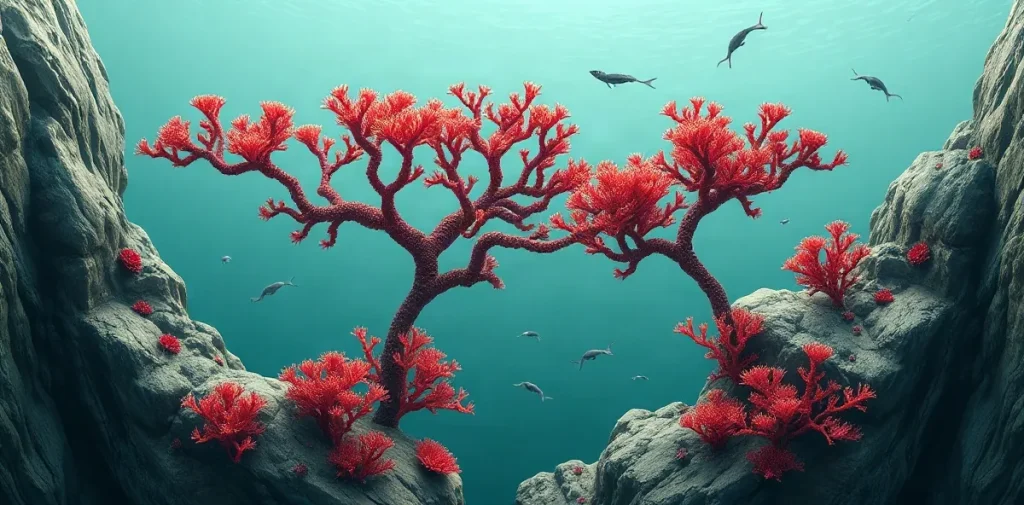
Red tree coral reproduction is the study of how these deep-water corals produce offspring, how young corals establish themselves, and how populations change over time in southeastern Alaskan fjords. These questions connect life history to conservation: a reef’s persistence depends not only on living colonies, but on whether new ones can replace those lost.
Why study reproduction in fjord corals?
Coral populations are shaped by the balance between recruitment—the arrival and establishment of young individuals—and losses through mortality or disturbance. Reproduction determines the supply of potential recruits; local conditions then influence whether larvae reach suitable habitat and survive.
Fjords are steep-sided, sheltered inlets with distinct physical and ecological conditions. Their underwater habitats can be difficult to access, and their depth, light and water movement differ from those of shallow reefs familiar to recreational divers. Understanding how coral populations renew themselves helps researchers assess their vulnerability and the timescales on which damaged areas might recover.
What does “population turnover” mean?
Population turnover describes the replacement of individuals over time as new corals enter a population and older or damaged colonies disappear. It is not simply a count of living colonies. Researchers need to understand the processes behind that count: reproductive output, dispersal, settlement, growth and survival.
These processes can be separated in time and space. A coral may release reproductive material, while the resulting larvae travel before settling; suitable settlement surfaces and local environmental conditions can then shape whether young corals persist. A snapshot of adult colonies therefore cannot, by itself, explain how the population is being replenished.
How do scientists investigate coral reproduction?
Studies of deep-water coral life histories combine observations of colonies with sampling and measurements suited to the organism’s depth and habitat. Researchers may examine reproductive structures and seasonal changes, document the size and condition of colonies, and look for young individuals on available surfaces. Repeated observations help distinguish a population’s continuing renewal from a single visible cohort.
Field methods have practical constraints. Deep fjord work can require specialized vessels, remotely operated equipment or carefully planned scientific diving, depending on depth and conditions. Each method offers a different view: direct observation can reveal habitat context, while collected samples can support closer examination of reproductive biology.
- Reproductive timing: when colonies develop or release reproductive material.
- Recruitment: whether young corals settle and become established.
- Habitat: which surfaces and local conditions support settlement and survival.
- Turnover: how recruitment and losses together shape the population through time.
Why does this matter to divers and conservation?
Red tree corals are part of the underwater environments that scientific divers and other researchers document. Knowing how they reproduce gives conservation work a life-history framework: protecting adult colonies is important, but so is maintaining the conditions that allow future generations to settle and grow.
For divers, this research also highlights why a site’s apparent abundance can be misleading. A dense stand may include old colonies but little recent recruitment, or a small population may be changing in ways that a single visit cannot reveal. Careful observation and repeat monitoring are more informative than treating one encounter as a measure of long-term condition.
Deep-water coral work also sits at the boundary of ecology and diving practice. Scientific divers must plan around depth, exposure, access and the need to avoid damaging fragile habitat; work beyond practical diving limits calls for appropriate remote methods. The biological question does not remove the need to match the method to the site and the team’s training.
What should a monitoring programme track?
A useful programme records more than coral presence. It links colony condition and size structure to evidence of recruitment, habitat characteristics and signs of disturbance, with observations repeated in a way that allows change to be assessed. Consistent methods matter because differences in sampling can look like ecological change.
Interpretation also depends on scale. Local observations may describe one site, while conservation decisions often concern a broader fjord system. Researchers therefore need to consider how reproductive timing, larval movement and habitat availability connect sites, and whether a local pattern represents a wider population process.
Frequently asked questions
What is coral recruitment?
Why is population turnover important?
Can recreational divers assess coral population health?
An original research-library explainer written by the Rubicon editors. It is not a summary of a specific publication.