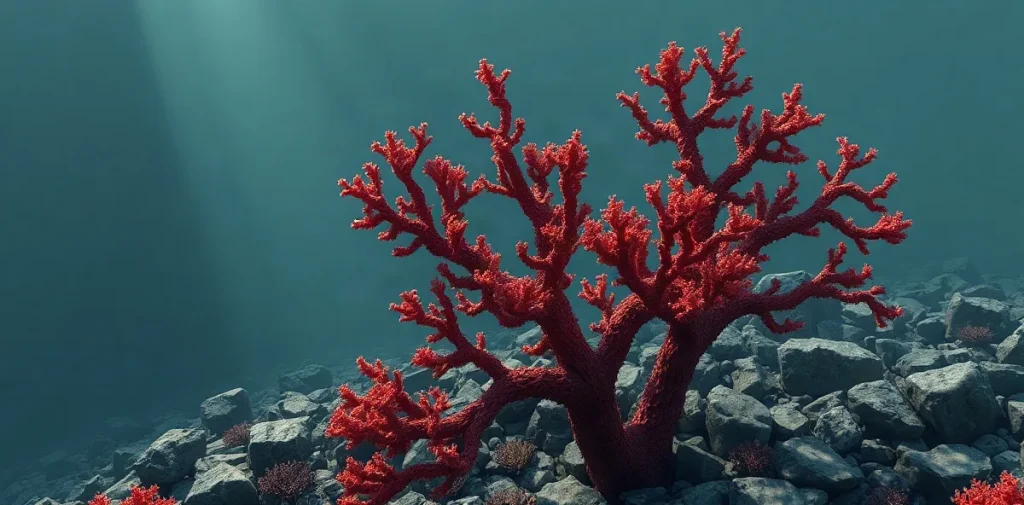
Reproduction of red tree corals in the southeastern Alaskan fjords: implications for conservation and population turnover is a 2011 symposium proceedings paper by Waller RG and colleagues. It addresses coral reproduction in a cold-water fjord environment and the link between reproductive biology, the persistence of local populations and conservation—questions relevant to scientific diving and underwater ecology.
What does coral reproduction have to do with population turnover?
A coral population is shaped not only by the survival of existing colonies but also by reproduction, the arrival of new individuals and the loss of older ones. Population turnover describes these changes through time. Studying reproduction helps frame how a population may be replenished and how its structure could change.
For red tree corals in southeastern Alaskan fjords, the setting matters: fjords are underwater habitats with local environmental conditions that can influence where organisms live and how populations are distributed. The title connects reproductive biology with conservation, making the central concern broader than the life cycle of an individual coral.
Why is a cold-water fjord setting important?
Corals are often associated in popular accounts with tropical reefs, but corals also inhabit cold, deep-water environments. Their biology and habitat can be less familiar to divers, even though these organisms form part of complex marine communities. A fjord setting places the question within a distinctive coastal environment rather than a shallow tropical reef.
Reproduction is a key part of understanding how a species persists in its habitat. In ecological studies, researchers may examine reproductive condition, life stages, distribution and the conditions that support recruitment—the addition of young organisms to a population. These concepts help explain why reproductive ecology is relevant to assessing vulnerability and informing conservation.
What should scientific divers keep in mind?
Scientific diving can provide access to underwater organisms and habitats that are difficult to study from the surface alone. Work in cold-water fjords also brings practical demands: exposure protection, careful dive planning, reliable observation methods and attention to the effects of sampling or contact on the study environment. The specific approach depends on the research question and conditions at the site.
Observations underwater are only one part of ecological research. Researchers must connect what they see with biological processes that may occur across seasons, life stages or areas that a dive cannot cover. That is why studies of reproduction and population change benefit from clear methods and careful interpretation alongside field observations.
- Reproductive biology: how organisms produce offspring and pass through life stages.
- Recruitment: the entry of young individuals into a population.
- Population turnover: change in population composition as individuals are added and lost.
- Conservation: applying ecological understanding to the persistence of species and habitats.
How does this topic fit into diving science?
Diving science includes more than human physiology, equipment and decompression. It also encompasses the use of diving to investigate underwater environments and the organisms living in them. This paper appeared in the proceedings of the American Academy of Underwater Sciences 30th Symposium, placing its subject within a scientific-diving forum.
Research on reproduction and population turnover complements studies of habitat, distribution and environmental change. Together, these lines of inquiry help build a biological picture of marine ecosystems. For divers and clinicians, the connection is also practical: scientific diving has distinct occupational demands, while ecological findings can inform how underwater sites are understood and cared for.
Why does the subject matter to conservation?
Conservation depends on knowing how populations persist, not simply where a species occurs. Reproductive processes can help identify the biological stages and habitat relationships that matter for population renewal. This provides a framework for asking how disturbance or environmental change might affect a species over time.
The paper’s subject is therefore relevant to marine conservation as well as underwater research. It brings together organismal biology, population ecology and the study of a cold-water habitat, illustrating how field science can address questions that are important well beyond a single dive site.
Frequently asked questions
What is the publication about?
What does population turnover mean?
Why is the paper relevant to diving science?
Citation details
- Title: Reproduction of red tree corals in the southeastern Alaskan fjords: implications for conservation and population turnover
- Authors: Waller RG; Stone RP; Mondragon J; Clark CE
- Year: 2011
- Published in: In: Pollock NW, Ed. Diving for Science 2011. Proceedings of the American Academy of Underwater Sciences 30th Symposium. Dauphin Island, AL: AAUS; 2011
- Record type: Symposium proceedings paper
- Repository record: Rubicon Research Repository, handle 123456789/10134
This page is an original summary written by the Rubicon editors from the publication’s bibliographic record. It does not reproduce the paper, its abstract or its data; consult the publication itself for its methods and findings.