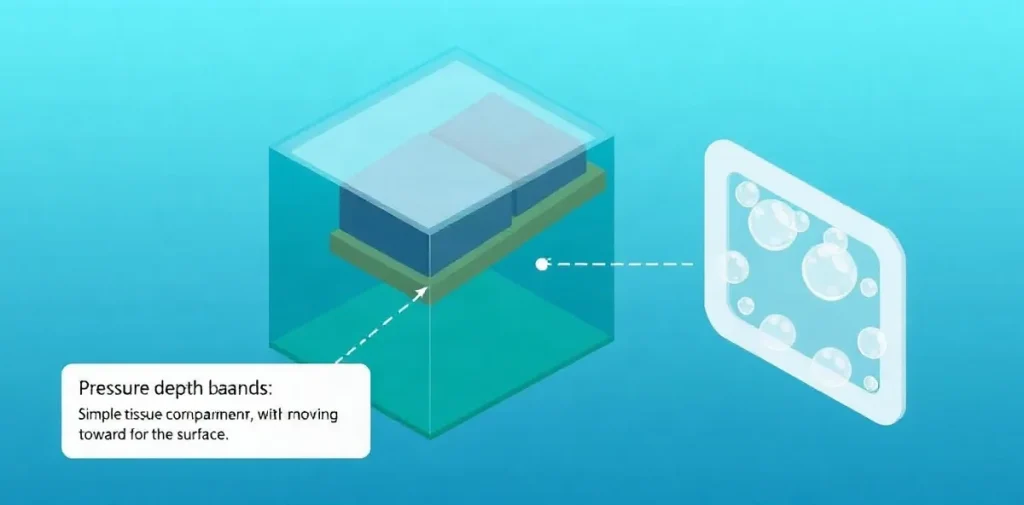
Tissue gas exchange models describe how inert gas moves between blood and body tissues during a dive and subsequent ascent. Decompression computations use those representations to estimate changing gas loads and evaluate ascent schedules—a central problem in diving science because pressure changes can allow bubbles to form and cause decompression illness.
What do tissue gas exchange models represent?
As pressure increases during descent, more inert gas dissolves in the body. During a dive, gas moves between the lungs, circulation and tissues; the rate differs across tissues because blood supply and gas solubility vary.
On ascent, falling pressure reverses the gradient. Inert gas leaves tissues and is carried to the lungs for elimination. A model simplifies this continuous, distributed process into compartments or other mathematical representations, each standing in for tissue with particular gas-exchange behaviour.
These are not literal maps of individual organs. They are tools for estimating how a range of tissues may respond to a specified pressure history, including the time spent at depth and the pace of ascent.
How do computations turn gas exchange into a schedule?
A decompression computation takes a dive profile as input and estimates how tissue gas loads change over time. The calculation can then identify ascent constraints, such as pauses at particular depths, intended to limit the pressure reduction while gas is still leaving the body.
Different models can represent uptake and elimination differently, so they may produce different schedules from the same profile. A computed schedule is therefore not a direct measurement of gas in every tissue; it is an output shaped by assumptions about physiology and the way the model handles pressure changes.
- Inert-gas loading: gas entering tissues under increased ambient pressure.
- Off-gassing: gas moving from tissues back into circulation and being eliminated through the lungs.
- Compartments: mathematical groupings used to represent different rates of tissue gas exchange.
- Ascent profile: the sequence of pressure changes and pauses used to return to the surface.
Why does the model matter to divers?
Decompression illness can occur when pressure falls and dissolved gas forms bubbles or otherwise disrupts normal function. Decompression models help translate complex gas exchange into practical limits on ascent, but no computation can remove all uncertainty about how an individual body responds.
For divers, the practical implication is that a schedule depends on the model and the profile it is applied to. Changes in depth, time, ascent, repetitive exposure or other conditions can alter the calculation; a schedule should not be treated as a universal guarantee against injury.
Diving physicians and hyperbaric clinicians encounter the consequences when decompression illness is suspected or treated. Models provide a framework for understanding exposure and decompression, while clinical assessment must account for the diver’s symptoms and circumstances.
What are the limits of a mathematical model?
A model has to simplify biology. Real tissues differ, circulation changes, and gas exchange does not necessarily follow a single uniform pattern. The choice of compartments and assumptions influences what a computation can represent and where its predictions may be uncertain.
Models also address only the processes they include. A calculated schedule is not a diagnosis, and a computer output cannot determine whether a diver is fit to dive or whether symptoms are due to decompression illness. Those questions require appropriate medical evaluation.
Research in this area therefore concerns both the mathematics and its physiological meaning: which processes are represented, how assumptions affect predicted gas loads, and how a schedule should be interpreted in real diving practice.
How does this work fit into diving science?
Decompression research sits at the intersection of physiology, mathematics and operational diving. It shares questions with broader studies of pressure exposure and gas exchange, while focusing on how those processes can inform safe ascent after underwater work.
The area matters beyond recreational diving. Scientific divers, commercial divers and people receiving hyperbaric treatment all operate in settings where pressure changes affect gas exchange, although the relevant exposures and protocols differ. The model is one part of a larger safety system that includes planning, monitoring and clinical judgement.
When symptoms follow a dive, seek prompt assessment from a diving-medicine physician or emergency medical service; suspected decompression illness should not be managed by adjusting a future schedule.
Frequently asked questions
What is a decompression model?
Why can different models give different schedules?
Does following a computed schedule rule out decompression illness?
An original research-library explainer written by the Rubicon editors. It is not a summary of a specific publication.
Related reading on Rubicon
- Microbubbles in Decompression Stress and Tissue Health
- Gas Absorption and Elimination in Decompression
- Why Dive Computers Show Different No-Decompression Limits
- Safety Dive: Safety Stops vs Decompression Stops
- Decompression Stress Index and Tissue Bubble Dynamics
- Probabilistic Decompression Models: Research Summary
- More on Diving Science
- Browse the Research Library