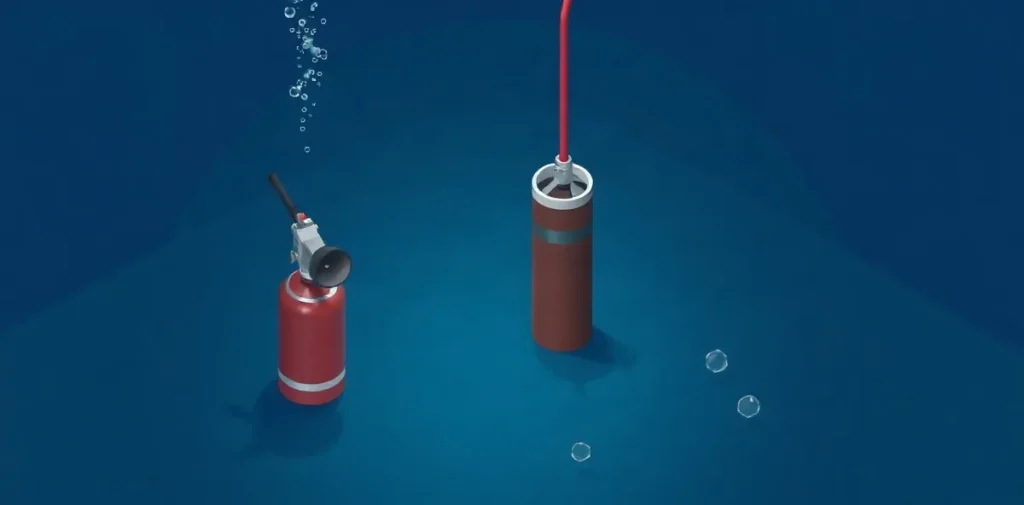
Research on decompression after trimix and heliox bounce dives asks how breathing-gas composition affects the time and profile needed to return safely to the surface. The question matters because helium and nitrogen behave differently in the body, while divers must manage decompression as a practical exposure with real physiological consequences.
What changes when a dive uses trimix or heliox?
Trimix combines helium, nitrogen and oxygen; heliox combines helium and oxygen. In both, oxygen supports metabolism, while helium and nitrogen act as inert gases: they do not fuel the body, but they dissolve in tissues under pressure and leave them during decompression.
At depth, increased ambient pressure raises the partial pressures of gases in the breathing mixture. Inert gas moves from the lungs into blood and tissues. During ascent, pressure falls and the direction reverses, but gas elimination takes time and varies among tissues.
Replacing some nitrogen with helium changes the gas mixture’s physical properties and the way inert gases move through the body. The comparison is not simply “one gas is faster”: decompression depends on the dive profile, exposure, breathing mixture and the model or procedure used to manage ascent.
What does “bounce dive” mean in this research area?
A bounce dive is a dive to depth followed by a return to the surface, rather than a prolonged saturation exposure. Its decompression problem is shaped by the pressure-time history: how deep the diver goes, how long the exposure lasts and how the ascent is staged.
Research comparing bounce dives examines whether changing the inert-gas mixture alters decompression requirements under defined exposure conditions. A meaningful comparison must account for the profiles being compared, as well as the method used to describe or assess decompression. Results from one type of exposure do not automatically transfer to saturation diving or recreational profiles.
The work belongs to a wider effort to understand decompression across different gases and exposure patterns. Related research considers decompression after air, nitrox, heliox and trimix saturation exposures—another setting, with a different pressure history and operational problem.
How do researchers study decompression efficiency?
“Efficiency” needs a defined meaning before two decompression approaches can be compared. It might refer to the time spent decompressing or to another operational measure, but a shorter schedule alone does not establish that a procedure is safer or more suitable.
Studies of this kind can compare planned gas mixtures and decompression profiles under controlled conditions, then assess relevant physiological or operational outcomes. The essential questions include whether the exposures are comparable, how decompression is represented, and what outcome counts as an acceptable trade-off. The title and venue identify the research area; they do not, by themselves, establish an individual dive procedure.
- Gas composition: the proportions of helium, nitrogen and oxygen being breathed.
- Exposure profile: the depth and duration that determine pressure history.
- Decompression schedule: the staged ascent or other procedure used to manage gas elimination.
- Safety outcome: whether the comparison accounts for decompression illness risk as well as time or operational demands.
These distinctions matter when interpreting any comparison: the gas mixture is only one part of the exposure, and “more efficient” is meaningful only when the endpoint is clear.
Why should divers and clinicians care?
Decompression illness can occur when inert gas comes out of solution and forms bubbles in or around tissues during or after ascent. Risk depends on more than a single gas choice; exposure, ascent and individual factors all matter. Decompression planning therefore aims to manage competing constraints rather than treat a gas mixture as a guarantee.
For technical and scientific divers, gas selection affects planning and operational choices. For diving physicians and hyperbaric clinicians, understanding how gases and exposure profiles interact helps frame decompression illness and evaluate the context of a dive. Research on these questions informs the broader evidence base, but it does not replace training, approved procedures or individual medical assessment.
If you are considering a dive involving complex gas mixtures or demanding decompression, follow the applicable operational procedures and consult a diving-medicine physician about personal medical concerns.
Frequently asked questions
What is the difference between trimix and heliox?
Does helium eliminate decompression risk?
Can findings from bounce dives be applied to saturation diving?
An original research-library explainer written by the Rubicon editors. It is not a summary of a specific publication.
Related reading on Rubicon
- Safety Dive: Safety Stops vs Decompression Stops
- Decompression Sickness: Causes and Risk Reduction
- How Decompression Sickness Develops: Physiological
- How Hydration Affects Decompression Stress and Diver Health
- Misclassification of Decompression Illness: Research Summary
- Constrictive Postures and Decompression Sickness
- More on Diving Science
- Browse the Research Library