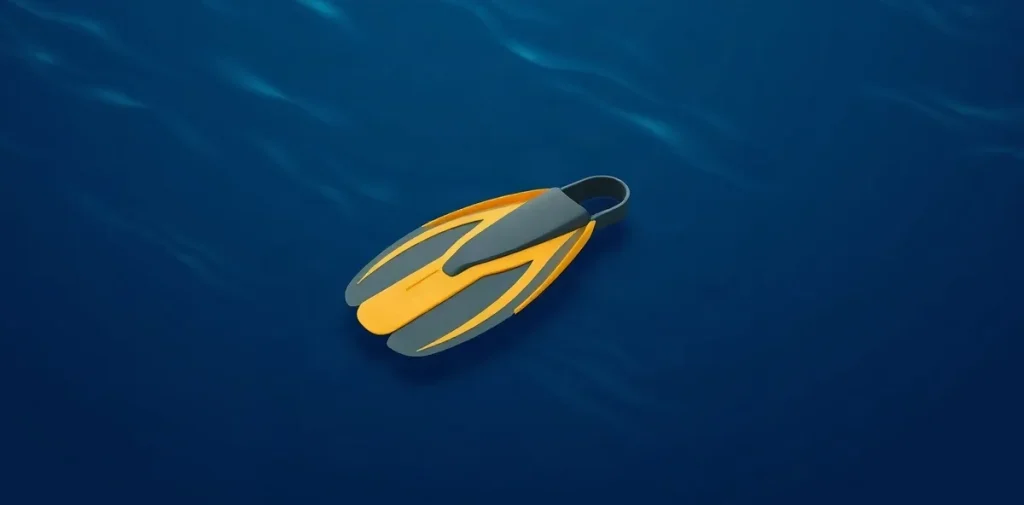
Evaluation of fins used in underwater swimming is a 2003 journal article by Pendergast and colleagues in Undersea Hyperbaric Medicine 30(1). Its subject is the assessment of swimming fins: equipment that converts leg movement into thrust and can shape a diver’s effort, mobility and ability to work underwater.
Why evaluate fins as part of underwater swimming?
A fin increases the area moved against the water, helping a swimmer generate propulsion with the legs. But a fin is not simply a larger paddle: its shape, stiffness and flexibility affect how it bends and moves water during each kick.
For divers, propulsion is part of the overall workload. A fin that changes the force needed for a kick may affect how comfortably a person swims, how long a task takes and how much physical effort it demands. Those considerations matter in recreational diving, scientific work and other underwater tasks.
Fin evaluation therefore belongs to a broader question in diving science: how does equipment interact with human movement in a dense fluid? The answer depends not only on the equipment but also on the swimmer, technique and conditions of use.
What does fin performance involve?
Swimming performance reflects the relationship between thrust, speed and energy expenditure. A fin can help produce forward motion, but the leg muscles must supply the work that moves it. More thrust is not automatically more efficient if producing it requires substantially greater effort.
Fin stiffness is one relevant mechanical property. A blade must flex during the kick, and that flex changes the way it loads the swimmer’s legs and pushes against the water. Blade geometry and material also influence how a fin responds, so assessing one feature in isolation may not capture how the equipment performs as a whole.
- Propulsion: how effectively leg movement produces forward thrust.
- Mechanical demand: the force and muscular work required to move the fin.
- Swimming economy: the relationship between effort and movement through the water.
- Fit and technique: how the fin works with an individual swimmer’s foot, kick and experience.
How can equipment affect a diver’s workload?
Underwater, the diver must overcome water resistance while coordinating breathing, buoyancy and movement. Swimming against a current or carrying out a task can add to that demand. Fin choice is one part of the system, alongside physical condition, exposure protection, carried equipment and the task itself.
Greater muscular effort has practical implications because exercise increases the body’s demand for oxygen and can contribute to fatigue. In diving, workload also matters for breathing-gas use and thermal comfort. These relationships make fin mechanics relevant to physiology without making any single equipment feature a measure of a diver’s overall safety.
Response varies between people. Leg strength, joint mobility, kick style and experience can all influence how a particular fin feels and performs. The same equipment may suit one swimmer’s movement and feel demanding or awkward to another.
How does fin evaluation fit into diving research?
Diving research often examines people and equipment together: the equipment changes the task, while the diver’s physiology and technique shape the response. Fin assessment is one example of this human–equipment interaction. It connects equipment design with swimming mechanics and the physical demands of underwater activity.
Comparisons of fins can involve more than observing speed. Researchers may consider movement, propulsion, muscular demand or physiological responses, depending on the question and the testing conditions. Any comparison needs a clear account of the task and the population being studied, since a result under one set of conditions need not apply to every diver.
The subject is also relevant to clinicians who consider exercise tolerance or fatigue in divers. Equipment can be one contributor to workload, but it does not replace individual medical assessment. Divers with health concerns about exercise underwater should discuss them with a diving-medicine physician.
What should divers consider when choosing fins?
Think about the swimming you actually do: short manoeuvres, sustained travel, current, or work that requires carrying equipment. Comfort and control matter alongside propulsion. A fin that is difficult to use with your normal kick may not be a practical choice, even if its design appears powerful.
Try equipment in conditions that resemble its intended use where possible, and pay attention to fit, leg fatigue and control. Avoid treating a single performance measure as a universal ranking. Training, technique and the demands of the dive remain part of the equation.
Frequently asked questions
Why do fins affect swimming effort?
Does a faster fin necessarily require less effort?
Can fin choice address a medical concern about diving?
Citation details
- Title: Evaluation of fins used in underwater swimming
- Authors: Pendergast, DR; Mollendorf, J; Logue, C; Samimy, S
- Year: 2003
- Published in: Undersea Hyperbaric Medicine 30(1)
- Identifiers: PMID 12841609
- Record type: Journal article
- Repository record: Rubicon Research Repository, handle 123456789/3936
This page is an original summary written by the Rubicon editors from the publication’s bibliographic record. It does not reproduce the paper, its abstract or its data; consult the publication itself for its methods and findings.