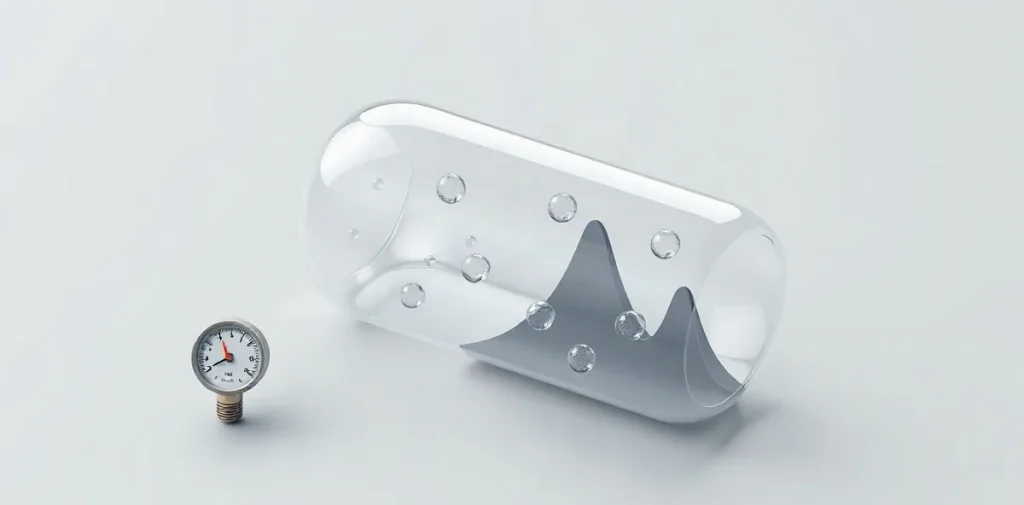
Research on bubble evolution asks how gas bubbles form, change and persist during and after a dive, and whether their behaviour helps explain decompression sickness risk. The question connects pressure physics with human physiology: decompression sickness is not simply a matter of bubbles being present, but of how gas and tissue responses interact over time.
Why does bubble behaviour matter after a dive?
As ambient pressure falls during ascent, inert gas absorbed under pressure can leave tissues and enter the circulation. If local conditions favour it, gas may form bubbles in tissues or blood. These bubbles can be clinically silent, or they may contribute to symptoms through effects on circulation, vessel lining and inflammatory responses.
Decompression sickness is variable: divers following similar profiles may not have the same outcome, and symptoms can differ in timing and severity. Bubble measurements therefore offer researchers one way to investigate a biological process between the dive profile and illness, rather than treating depth and time as a complete explanation.
What does “time course” mean in bubble research?
The time course is the pattern of change in bubbles over time: when they appear, how their number or size changes, and how long they remain detectable. A single observation can miss this dynamic. Researchers may therefore compare measurements taken at different points after exposure or during decompression.
Bubble evolution is not identical to decompression sickness. Bubbles detected in venous blood are commonly called venous gas emboli; their presence does not by itself diagnose the illness. Researchers examine whether bubble patterns, considered alongside exposure and other physiological responses, help clarify risk and the mechanisms that produce symptoms.
How do researchers study bubbles and decompression?
Studies in this area bring together controlled pressure exposure, decompression profiles and measurements made during or after a dive. Doppler ultrasound can detect moving gas bubbles in the circulation; echocardiography can help observe bubbles passing through the heart. Such methods measure a physiological signal, not every bubble in the body or the full clinical picture.
Researchers can compare bubble observations with the timing of exposure and any clinical signs, while accounting for differences in profiles and individuals. The central challenge is interpretation: a measured bubble signal may be associated with decompression stress without directly establishing whether a diver will become ill.
- Bubble formation: gas comes out of solution as pressure decreases.
- Venous gas emboli: bubbles travelling in venous blood, often assessed with ultrasound.
- Decompression sickness: a clinical disorder that requires assessment of symptoms and exposure, not bubble detection alone.
- Time course: changes in bubble signals across decompression and the period after it.
How does this fit into decompression research?
Decompression research has long addressed how pressure exposure, inert-gas uptake and elimination, and ascent affect the body. Decompression models help plan exposures, but no model makes the individual response perfectly predictable. Bubble studies add observations of a possible mechanism to the broader effort to understand why risk varies.
This work also sits alongside research into dive profiles, physiological responses to pressure and the clinical recognition of decompression illness. For scientific divers and clinicians, the useful question is not simply whether bubbles occur, but how measurements relate to exposure, symptoms and other signs—and where that relationship remains uncertain.
What can divers and clinicians take from the research?
Bubble monitoring is a research tool, not a personal clearance test. A low or absent measured signal cannot rule out decompression sickness, and a detected signal does not establish that illness is present. Dive planning and clinical decisions must account for the full exposure and the diver’s condition.
If symptoms occur after diving, prompt assessment by a diving-medicine physician is important; bubble measurements should not delay care. For research interpretation, check what was measured, when it was measured, and whether the study relates those observations to clinical outcomes.
Frequently asked questions
Do bubbles always cause decompression sickness?
Why measure bubbles at more than one time point?
Can an ultrasound bubble check tell me whether I am safe to dive?
An original research-library explainer written by the Rubicon editors. It is not a summary of a specific publication.
Related reading on Rubicon
- Decompression Sickness: Causes and Risk Reduction
- How Decompression Sickness Develops: Physiological
- Microbubbles’ Role in Decompression Stress and Risk
- Managing Suspected Decompression Sickness on a Dive Boat
- Bubble Evolution and Decompression Sickness Risk
- Decompression Sickness: Bubbles, Risk and Treatment
- More on Diving Science
- Browse the Research Library