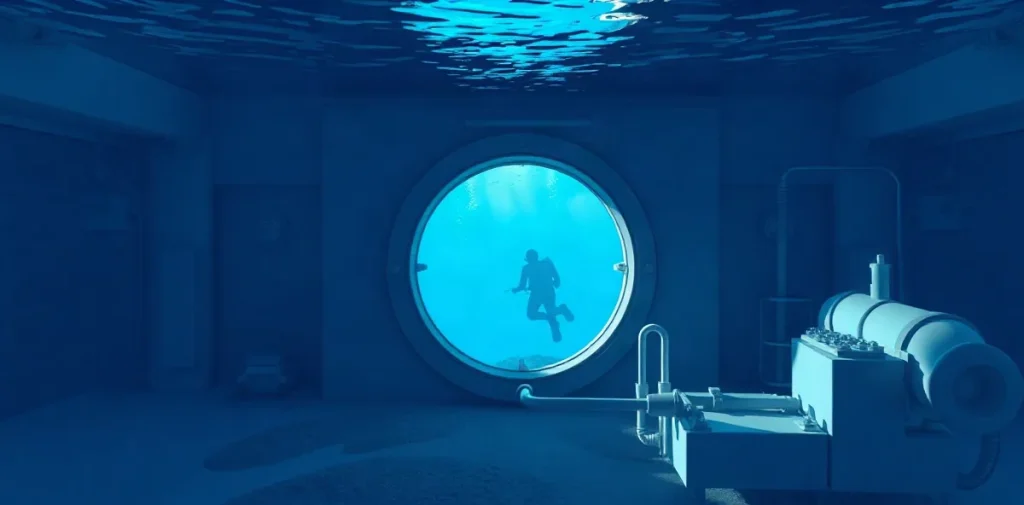
Aquarius undersea laboratory: The next generation is a 1996 symposium proceedings paper by Shepard AN and colleagues about the development and role of an undersea research laboratory. Its subject connects underwater habitat technology with the conditions of human work at depth, a concern for scientific divers, diving physicians and others studying prolonged underwater operations.
What does an undersea laboratory make possible?
An underwater laboratory provides a working environment in which people can live and conduct research beneath the surface. Unlike a sequence of separate short dives, habitat-based operations can support sustained activity underwater and change how researchers plan access, work periods, equipment use and return to the surface.
The title’s phrase “the next generation” points to the continuing challenge of developing such facilities. A habitat must function as both a scientific workspace and a life-support environment: its design has to account for the surrounding water, the needs of its occupants and the practical demands of carrying out research.
Why does saturation matter to divers?
In saturation diving, the body’s tissues take up inert gas under pressure over time. Once a diver has reached saturation at a given pressure, adding more time at that pressure does not keep increasing the decompression obligation in the same way as extending a nonsaturation exposure; returning to the surface still requires a carefully managed decompression process.
This approach can make repeated underwater work more practical than returning to the surface after each excursion. It also makes pressure management central to the operation. The habitat environment, transitions between habitat and water, and the eventual return to surface pressure all need to be considered as parts of one connected system.
Which physiological and medical issues are relevant?
Life and work under pressure expose divers to a combination of physiological demands. Gas composition and pressure affect breathing, while immersion, exertion, temperature and the duration of exposure can influence comfort and physical performance. The work itself may also involve tasks that require attention, coordination and reliable communication.
Decompression is a core concern because dissolved inert gas must be eliminated in a controlled manner as pressure falls. Divers and clinicians also consider the possibility of decompression illness and other problems associated with underwater work. These general principles help explain why habitat operations belong within diving medicine as well as engineering and marine research.
- Pressure and breathing: how the operating environment shapes gas exposure and respiratory demands.
- Immersion and workload: how underwater activity combines physical effort with environmental stress.
- Decompression: how a planned return to surface pressure is integrated into an operation.
- Life support and monitoring: how a habitat sustains occupants and supports safe, organised work.
- Human factors: how communication, task design and the working environment affect underwater operations.
How do engineering and diving medicine intersect?
An undersea laboratory is not simply a room placed underwater. Its continued operation depends on systems that maintain a suitable environment and allow people to enter, work and leave under controlled conditions. Equipment reliability, maintenance and emergency planning therefore sit alongside scientific objectives.
Engineering decisions can shape physiological exposure: pressure, breathing conditions and the organisation of underwater work are linked to the facility’s design and procedures. Conversely, knowledge of human limits informs what equipment and operational arrangements must support. This two-way relationship is a recurring theme in research on habitats, saturation diving and other forms of prolonged underwater work.
Where does this subject fit in diving research?
Undersea laboratories bring together questions that are often studied separately: how people respond to pressure, how decompression is managed, and how technology can sustain scientific activity underwater. Their study also sits within the broader history of efforts to extend the duration and capability of human work below the surface.
The paper appeared in the 1996 proceedings Diving for Science…1996, “Methods and Techniques of Underwater Research”, edited by MA Lang and CC Baldwin. Its proceedings setting places the subject in a practical scientific context, where methods, equipment and the conditions needed to conduct underwater research are central concerns.
Frequently asked questions
What is an undersea laboratory?
What is saturation diving?
Who may find this subject relevant?
Citation details
- Title: Aquarius undersea laboratory: The next generation
- Authors: Shepard AN; Dinsmore DA; Miller SL; Cooper CB; Wicklund RI
- Year: 1996
- Published in: In: MA Lang, CC Baldwin (Eds.) the Diving for Science…1996, "Methods and Techniques of Underwater Research"
- Record type: Symposium proceedings paper
- Repository record: Rubicon Research Repository, handle 123456789/4703
This page is an original summary written by the Rubicon editors from the publication’s bibliographic record. It does not reproduce the paper, its abstract or its data; consult the publication itself for its methods and findings.