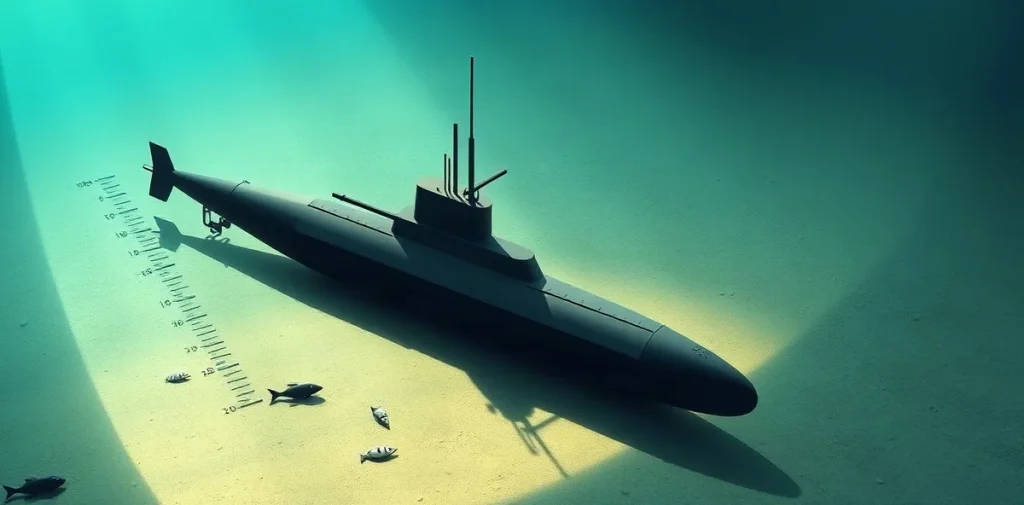
Underwater Archaeology and the Confederate Submarine H.L. Hunley is a 2005 publication by Neyland on the underwater archaeological subject signalled by its title. Presented in Diving For Science 2005, it brings the study of a historic submarine into a field where careful documentation, preservation and the conditions of scientific diving are closely linked.
What does underwater archaeology ask of a dive?
Underwater archaeology investigates human-made objects and places in their submerged setting. A submarine is not simply an artefact to retrieve: its position, orientation, surrounding material and relationship to the site can all contribute to understanding and preserving it.
That work requires observation that is both systematic and repeatable. Divers may need to record features, make measurements and work with tools while controlling their position and avoiding disturbance. The site’s scientific value depends on recording context, not just collecting objects.
Why does the H.L. Hunley matter to diving science?
The title joins a specific subject—the Confederate submarine H.L. Hunley—to underwater archaeology. That combination raises questions familiar across scientific diving: how to examine a submerged historical object, document it in place and carry out useful work without compromising the site or the diver.
Underwater archaeology also sits at the intersection of several disciplines. Historical interpretation depends on physical evidence; conservation concerns the condition of that evidence; and diving science considers how people can work underwater in a controlled, observable way. The demands of a particular site shape how those concerns are balanced.
Which diving and preservation factors matter?
Scientific tasks underwater compete with the limits of time, visibility, movement and attention. Buoyancy control helps a diver hold position without contacting the site; clear task planning reduces avoidable handling and supports consistent observations. Equipment and procedures must suit the work, the environment and the diver’s training.
- Site context: record where features lie in relation to the submarine and to one another.
- Documentation: use observations and measurements that can be checked and interpreted later.
- Conservation: limit disturbance and consider how exposure or handling could affect submerged materials.
- Diver workload: account for task demands, environmental conditions and the need to monitor the dive.
These considerations are connected. A difficult task can increase workload and reduce the attention available for both site recording and dive monitoring. Planning should therefore treat archaeological objectives and safe execution as parts of the same operation.
How does this subject connect with dive medicine?
Underwater archaeology is not itself a medical specialty, but its fieldwork can involve the physiological demands of diving. Pressure, breathing-gas use, exertion, thermal conditions and the duration and pattern of a dive all matter to a diver’s exposure. The specific risks depend on the operation and conditions rather than on the archaeological label.
For diving physicians and hyperbaric clinicians, the broader relevance lies in understanding how work changes a dive. Concentration on a task, equipment use and repeated underwater activity can affect workload and the practical management of exposure. Individual fitness or medical concerns require assessment by a diving-medicine physician, not a general account of archaeological diving.
What should readers take from the publication’s setting?
The publication appears in the proceedings of the American Academy of Underwater Sciences symposium Diving For Science 2005, held March 10–12, 2005, at the University of Connecticut at Avery Point in Groton, Connecticut. That venue places the subject within scientific diving: underwater work in which research questions, field methods and diver safety must be considered together.
For readers, the durable point is methodological. A historic submarine creates a demanding setting for observing and preserving underwater evidence, while scientific diving supplies the practical framework for conducting that work. How those aims are managed depends on the site, the task and the conditions of the dive.
Frequently asked questions
What is underwater archaeology?
Why is context important at a submarine site?
What makes scientific diving different from a recreational dive?
Citation details
- Title: Underwater Archaeology and the Confederate Submarine H.L. Hunley
- Authors: Neyland, RS
- Year: 2005
- Published in: In: Godfrey, JM; Shumway, SE. Diving For Science 2005. Proceedings of the American Academy of Underwater Sciences Symposium on March 10-12, 2005 at the University of Connecticut at Avery Point, Groton, Connecticut
- Record type: Journal article
- Repository record: Rubicon Research Repository, handle 123456789/9012
This page is an original summary written by the Rubicon editors from the publication’s bibliographic record. It does not reproduce the paper, its abstract or its data; consult the publication itself for its methods and findings.
Related reading on Rubicon
- The Diving Reflex: What Happens Underwater
- Why Divers Get Cold Faster Underwater
- Diving Safety: Key Insights into Underwater Exploration
- Diving: Exploring Underwater Activities, Science, and Safety
- Underwater Archaeology and the H.L. Hunley
- CSS Georgia: Blackwater Underwater Archaeology
- More on Diving Science
- Browse the Research Library