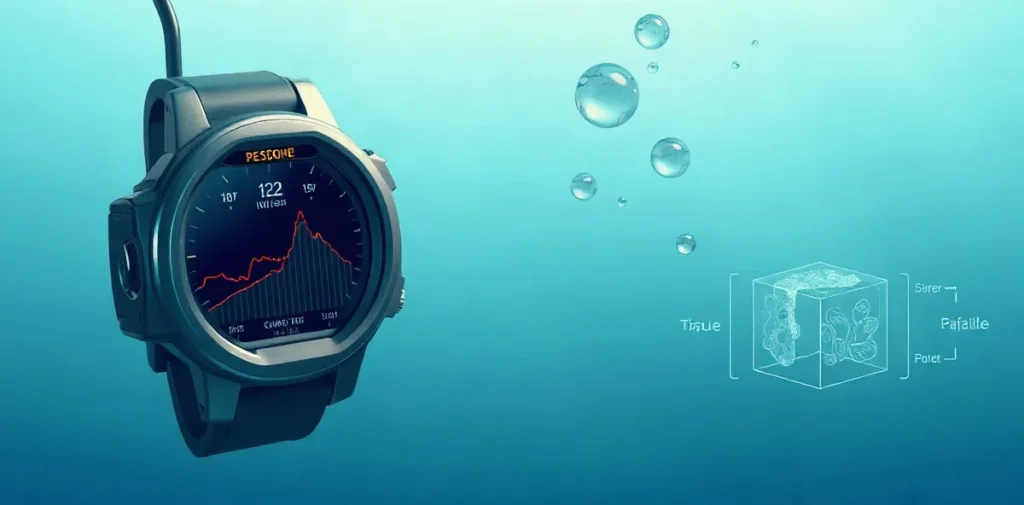
Albert A. Bühlmann is closely associated with mathematical models used to plan decompression after diving. These models estimate how inert gas enters and leaves body tissues under pressure, helping divers and clinicians reason about decompression obligations and the risks of changing pressure too quickly.
What does a decompression model describe?
As a diver descends, increased pressure raises the partial pressure of nitrogen or another breathing-gas inert component. The gas dissolves into blood and tissues; during ascent, ambient pressure falls and the dissolved gas must return to the lungs for removal.
Different tissues exchange gas at different rates. A decompression model represents this process with theoretical tissue compartments, each assigned a characteristic rate of gas uptake and elimination. These compartments are a useful calculation framework, not literal anatomical structures.
The model’s central task is to estimate when ascent can proceed and where pauses may be needed. It turns a changing pressure-and-time exposure into a schedule, while simplifying a complex biological process.
Why does pressure change matter to divers?
If pressure falls faster than inert gas can be safely eliminated, supersaturation can develop. Gas bubbles may form or grow in tissues and circulation, contributing to decompression illness. The relationship between exposure, ascent and individual response is not identical for every diver.
Decompression planning therefore matters to recreational, technical and scientific divers, as well as to diving physicians and hyperbaric clinicians assessing a possible injury. A schedule is a risk-management tool, not a guarantee against illness, and symptoms after diving need medical assessment.
How are Bühlmann-style models used?
Decompression algorithms use tissue-compartment calculations alongside limits on tolerated supersaturation. Bühlmann’s work is part of the wider development of these mathematical approaches, which are used in dive computers and planning methods. The underlying concepts help explain why profiles with similar maximum depths can still carry different decompression demands.
Actual computer settings and procedures depend on the model and its configuration. Gradient factors, for example, modify the allowable relationship between ambient pressure and calculated tissue gas pressure; they do not turn the model into a measurement of a diver’s actual tissue state.
- Inert-gas loading: gas uptake during exposure to elevated pressure.
- Compartments: mathematical representations of tissues with different gas-exchange rates.
- Supersaturation: a condition in which tissue gas pressure exceeds the surrounding pressure.
- Ascent schedule: a planned sequence of ascent and, when required, decompression stops.
What are the limits of decompression calculations?
A model simplifies physiology. It cannot directly measure bubble formation, account perfectly for every tissue, or capture all differences in workload, temperature, hydration, health and dive history. Those factors can affect a diver’s response, while the exact effect is not always predictable for an individual.
Computers also depend on correct settings, gas choices and profile information. You should understand the algorithm and conservatism settings used by your device, and follow training appropriate to the planned exposure rather than treating a displayed schedule as a complete safety assessment.
How does this work fit into diving medicine?
Decompression modelling sits at the intersection of physics, physiology and clinical medicine. It helps organise knowledge about pressure exposure, but diagnosis and treatment of decompression illness require clinical judgement. Hyperbaric oxygen is used in the medical management of some diving injuries; decisions about care belong with qualified medical professionals.
For divers, the practical questions remain specific: which decompression model is in use, what assumptions does it make, and does the planned profile match your training and equipment? A diving-medicine physician should assess concerning symptoms after a dive.
Frequently asked questions
Is a tissue compartment an actual body part?
Does following a decompression schedule eliminate risk?
What should I do about symptoms after diving?
An original research-library explainer written by the Rubicon editors. It is not a summary of a specific publication.
Related reading on Rubicon
- Why Dive Computers Show Different No-Decompression Limits
- Safety Dive: Safety Stops vs Decompression Stops
- Decompression Sickness: Causes and Risk Reduction
- How Decompression Sickness Develops: Physiological
- Misclassification of Decompression Illness: Research Summary
- Constrictive Postures and Decompression Sickness
- More on Diving Science
- Browse the Research Library