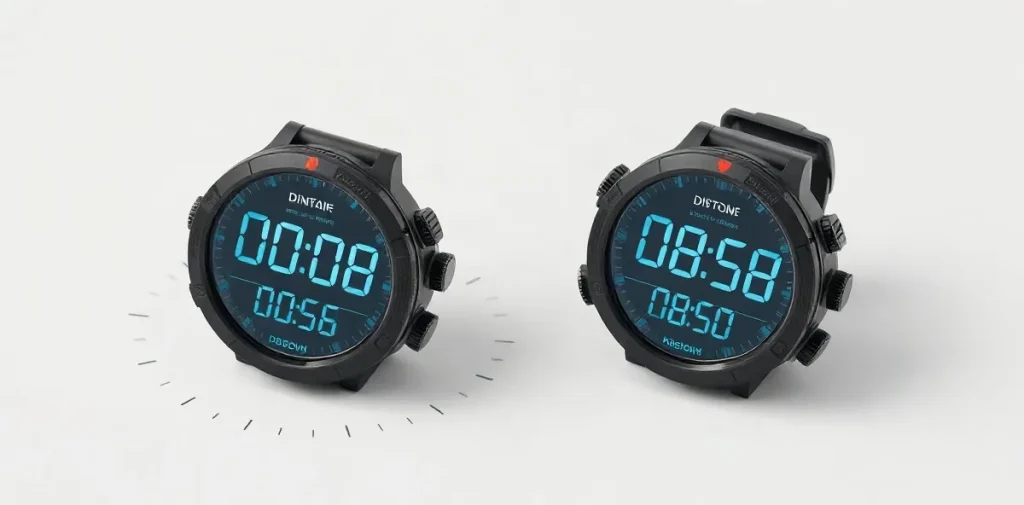
Dive computers show different no-decompression limits because they may use different decompression models, settings and assumptions about a diver’s exposure. The displayed time is therefore a model-based estimate, not a universal limit that every computer calculates identically.
Even on the same dive, those differences can matter: one computer may reach its limit sooner than another. Understanding why no-decompression limits vary helps divers interpret their displays and avoid treating the most generous reading as a guarantee of safety.
| Factor | How it can affect the display |
|---|---|
| Algorithm | Different models can calculate different limits. |
| Conservatism setting | Different safety margins can change the displayed NDL. |
| Recorded depth | Small depth differences can affect the calculation. |
| Recent dive history | Residual modeled gas can shorten a repetitive-dive limit. |
| Breathing-gas setting | Different configured gases can produce different calculations. |
- 2 Computers can display different NDLs even when divers swim together.
- 0 The countdown value divers should not deliberately target as a planned margin.
- 1 Current depth is one factor the computer uses as its NDL changes during a dive.
What does a dive computer’s no-decompression limit mean?
A dive computer’s no-decompression limit (NDL) is its calculated remaining time at the current depth before its model calls for mandatory decompression stops during ascent. It is a live reading, not a fixed time allowance for the whole dive: as depth or dive time changes, the displayed limit changes too.
The NDL is an output of a mathematical decompression model, not a guarantee that decompression sickness cannot occur. Two divers swimming together can see different limits if their computers use different algorithms or conservatism settings, record slightly different depths, or account for different recent dive histories or breathing gases.
How to use the displayed limit
Treat the NDL as a boundary, not a target. Leave a reasonable margin rather than deliberately letting the countdown reach zero; during a team dive, divers should follow their own computers and plan around the more conservative limit.
Why can two computers show different NDLs side by side?
Two dive computers can show different no-decompression limits (NDLs) side by side because their algorithms, safety settings, depth readings and stored dive histories may differ, even when their divers are at the same depth. An NDL is a model-based calculation, not a shared countdown or a guarantee against decompression sickness.
What can change the displayed limit
- Algorithm: Different computers can use different decompression models, so the same depth and dive profile may produce different NDLs.
- Conservatism: A more conservative setting applies a larger safety margin and can display a shorter limit than a less conservative setting.
- Recorded depth: Computers may register slightly different depths. Because NDL changes with depth, even a small reading difference can affect the calculation.
- Recent dives: Each computer tracks its own diver’s previous exposure. After a repetitive dive, modeled residual gas loading can shorten the next NDL compared with starting that dive without a recent history.
When diving together, each diver should monitor their own computer and plan around the more conservative limit. Do not treat the longer display as permission to stay down until its timer reaches zero; leave a reasonable margin because the NDL is a model, not a promise of safety.
How do previous dives and ascent history change the limit?
A repetitive dive can produce a shorter no-decompression limit (NDL) than a first dive at a similar depth because the computer carries forward its modelled residual gas from earlier dives. The depth alone is not enough to explain the display: the computer’s recorded dive history, including the preceding dive and its ascent, also affects the calculation.
Why two computers may show different limits
Two computers can differ if one tracked the earlier dive and ascent while the other was not worn or was not used to record them. The second computer may therefore calculate from a different history, even when both divers are now at the same depth. Each device also recalculates during the dive, so its displayed NDL can change as the diver moves deeper or shallower.
- Computer used throughout: carries forward its own modelled residual gas and ascent history.
- Computer not used for the preceding dive: may not include that dive’s history in its current calculation.
When comparing displays, check both the current depth and each computer’s recorded history; matching depths do not mean matching NDLs. A computer’s NDL is a model-based limit, not a guarantee against decompression sickness, so divers should follow their own computer and retain a margin rather than deliberately letting the timer reach zero.
What should a dive team do when computer limits disagree?
When dive computers disagree on no-decompression limits, each diver should follow their own computer, and the team should plan around the shorter displayed limit. A buddy’s longer NDL does not extend the other diver’s limit: the two devices may calculate differently because of their settings, dive histories, recorded depths or breathing-gas selections.
Before descent, compare the computers’ gas settings with the breathing gases each diver will actually use. A mismatch between a computer’s selected gas and the diver’s real gas can change its calculation, so confirm the settings individually rather than assuming both devices are configured alike.
Agree on the response before descent
Make the more conservative displayed NDL the team’s planning constraint, then decide what happens if one computer reaches its limit first. The diver whose computer shows the shorter limit should not stay deeper or longer to match the buddy’s display; the team should follow its agreed plan and retain a margin rather than deliberately letting either timer reach zero. An NDL is a model-based limit, not a guarantee against decompression sickness.
When is an NDL comparison misleading or insufficient?
An NDL comparison is misleading when it treats a longer displayed time as proof that a computer is more accurate or a diver is safer. Two computers may calculate limits with different decompression algorithms and conservatism settings; even divers swimming together can have different recorded depths or recent dive histories. On a repetitive dive, the remaining load from an earlier dive affects the next limit, so displays are not directly comparable unless those inputs match.
What the display cannot tell you
An NDL is a model-based limit, not a guarantee against decompression sickness, and reaching zero is not a sensible target. A computer cannot settle a disagreement about the team’s plan, either: divers need to agree on a conservative limit before the dive and follow their own instruments underwater.
- Different dive histories: Compare limits only with the divers’ preceding dives and recorded depths in view; a repetitive dive does not start from zero.
- Different computers or settings: A longer NDL may reflect an algorithm or conservatism setting, not greater accuracy or safety.
- Team planning: Agree on the more conservative limit for the team, while each diver continues to monitor their own computer.
FAQ
Why is my NDL shorter on a repetitive dive?
What this piece draws on
- scubadiver.gr — “What Is a No-Decompression Limit in Scuba Diving?”
- Koh Chang — “No-Decompression Limits (NDL) Explained – Tables vs. Dive Computers”
- dan.org — “A Critical Look at No-Decompression Limits – Divers Alert Network”
- emperordivers.com — “Dive Computers: How They Work and Why You Need One – Emperor Divers”
- scubanetwork.com — “Using Dive Computers – Scuba Network”
