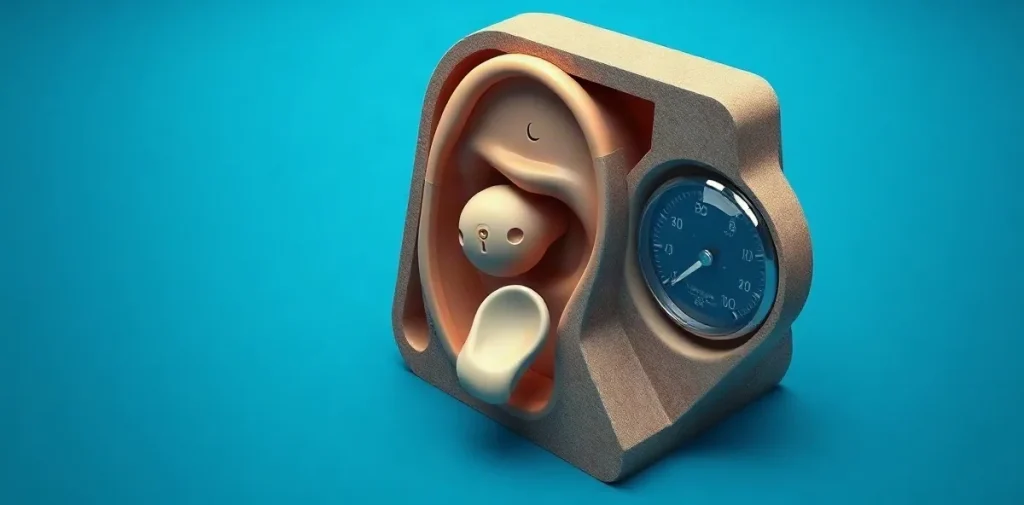
Ear squeeze is pressure-related injury to the ear during diving, most often when a diver cannot equalise pressure in the middle ear as surrounding water pressure rises. Prevention centres on understanding ear anatomy, pressure changes and equalisation, because pain or injury can interrupt a dive and may threaten hearing or balance.
What happens to the ear as a diver descends?
Water pressure increases with depth. The middle ear is an air-filled space behind the eardrum, connected to the back of the nose and throat by the Eustachian tubes. During descent, air must pass through these tubes into the middle ear to keep its pressure close to the surrounding pressure.
If the tubes do not open adequately, pressure outside the eardrum exceeds pressure inside. The eardrum is pulled inward, which can cause discomfort and, if the pressure difference persists, tissue injury. The term “squeeze” describes this pressure imbalance rather than a single diagnosis or a uniform degree of damage.
Equalisation is therefore a repeated task during descent, not a one-time action at the surface. A diver who waits until pain begins may find the tubes harder to open; continuing down despite difficulty can worsen the imbalance.
Why can equalisation fail?
The Eustachian tubes open intermittently, and their function can be affected by congestion, inflammation, anatomy and the way a diver descends. A cold or nasal allergy may narrow the passage or make it less responsive. Equalisation may also be difficult when a diver is anxious, descending too quickly or using a head position that makes the manoeuvre less effective.
Common equalisation techniques use gentle changes in throat, jaw or nasal pressure to move air into the middle ear. Forceful attempts are not a safe substitute for a blocked tube: they can injure the ear or transmit pressure to the inner ear. If pressure does not clear, stopping the descent and ascending slightly can reduce the pressure difference while the diver reassesses.
- Pressure balance: the middle ear needs air replenishment as ambient pressure rises.
- Timing: equalisation should begin early and continue during descent.
- Patency: congestion or inflammation can interfere with Eustachian tube opening.
- Force: painful or forceful manoeuvres can cause harm rather than solve the problem.
What does prevention involve?
Prevention combines preparation with decisions made underwater. Divers can check that their ears feel clear before entering the water, descend in a controlled manner, and equalise early and often. If one ear lags, pausing or ascending slightly is preferable to pushing through pain; the dive should be abandoned if equalisation remains unsuccessful.
Medication is not a universal solution. Some decongestants can wear off during a dive, and their effects or risks depend on the individual and the drug. Divers with recurring difficulty, recent ear disease or questions about medication should consult a diving-medicine physician before diving rather than treating symptoms as a routine equipment problem.
After a dive, persistent pain, hearing change, ringing, dizziness or fluid from the ear warrants medical assessment. These symptoms can have different causes, and inner-ear injury requires particular care. Avoid further pressure exposure until a clinician has assessed a significant or unresolved problem.
How is ear squeeze studied and assessed?
Research in this area asks how pressure exposure, ear function and equalisation behaviour interact. Investigators may examine the anatomy and function of the Eustachian tube, the pressure changes experienced during descent, symptoms, and clinical signs such as eardrum changes. The exact methods depend on the question, from clinical assessment to controlled pressure exposure.
Clinical assessment distinguishes middle-ear barotrauma from other causes of ear pain, hearing loss or vertigo. The history matters: when symptoms began, whether they occurred during descent or ascent, and whether one or both ears were affected. Examination of the eardrum and, when appropriate, hearing or balance assessment help guide care.
This work belongs to the broader study of barotrauma: injury caused by pressure differences in air-containing spaces. It connects practical dive procedures with otology, respiratory physiology and occupational dive medicine, where preventing injury helps divers remain fit for safe work.
When should a diver seek medical advice?
Repeated difficulty equalising, pain that persists after surfacing, sudden hearing loss, pronounced ringing or vertigo should not be managed by repeatedly attempting to clear the ear. A diving-medicine physician or an ear specialist can assess the cause and advise when it is safe to return to diving.
Assessment is especially important when symptoms affect balance or hearing, because inner-ear problems may need urgent attention. Until the problem is understood and resolved, avoid diving and other activities that expose the ear to substantial pressure changes.
Frequently asked questions
What is ear squeeze?
Should I keep descending if equalisation hurts?
When should I seek medical care after a dive?
An original research-library explainer written by the Rubicon editors. It is not a summary of a specific publication.
Related reading on Rubicon
- Understanding Oxygen Toxicity Risks and Prevention in Diving
- First Aid Essentials for Diving Ear Barotrauma
- The Diving Reflex: What Happens Underwater
- Thesis Research in Diving and Hyperbaric Medicine
- HPNS Suppression in Deep Human Dives: Research Summary
- More on Dive Medicine
- Browse the Research Library