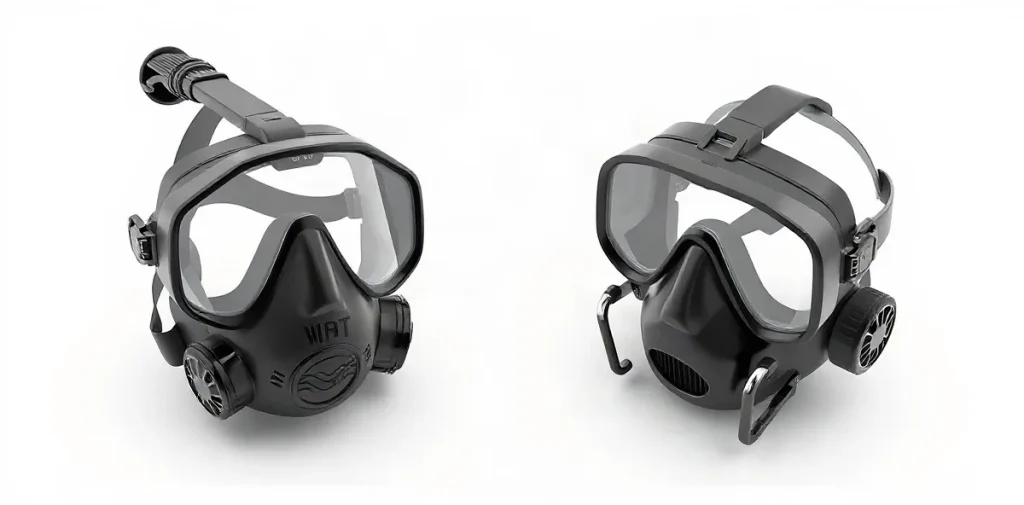
Full-face masks and traditional dive masks each have distinct advantages and disadvantages in recreational diving. Full-face masks provide enhanced safety and communication options but at higher cost and complexity, while traditional masks offer simplicity, affordability, and ease of use. Choosing the right mask depends on factors like diving environment, budget, and personal preference.
What are the main usability differences between full-face and traditional dive masks?
Full-face masks integrate the breathing apparatus within the mask, allowing divers to breathe through nose and mouth simultaneously. This enhances comfort and convenience, especially on longer or cold-water dives. Traditional masks cover only the eyes and nose, requiring a separate mouthpiece for breathing.
Key usability factors
- Breathing method: Full-face masks allow natural breathing; traditional masks require mouthpiece use.
- Field of vision: Full-face masks often have a wider panoramic view.
- Integration: Full-face masks may include communication systems; traditional masks do not.
For example, the Ocean Reef Aria full-face mask, popular in 2026, offers a 180-degree field of vision and built-in comms. In contrast, the Cressi F1 traditional mask costs around $70 and provides a reliable, simple fit with a narrower field of view.
How do safety features compare between the two mask types?
Full-face masks improve safety by providing continuous air supply to the nose and mouth, reducing risks of water inhalation if the mouthpiece is dislodged. They often incorporate redundant air supply valves and quick-release systems.
Safety features in detail
- Water intrusion prevention: Full-face masks seal completely, reducing water ingress risk.
- Emergency options: Many full-face masks include emergency purge valves.
- Communication: Integrated comms improve diver coordination and emergency response.
However, full-face masks require careful training to manage potential CO2 buildup, while traditional masks allow easy clearing of water through the mouthpiece. The cost of full-face masks ranges from $400 to over $1,000, with training recommended to ensure safe use.
Why might comfort and fit influence a diver’s mask choice?
Comfort depends on mask fit, breathing ease, and how the mask handles temperature variations. Full-face masks distribute pressure evenly over the face and avoid jaw fatigue since no mouthpiece is required.
Comfort considerations
- Pressure distribution: Full-face masks reduce jaw strain.
- Seal quality: Silicone skirts in both types affect comfort and leak prevention.
- Temperature comfort: Full-face masks help warm inspired air in cold water.
The Ocean Reef Aria weighs about 1.2 kg, heavier than typical traditional masks like the Scubapro Spectra, which weighs around 0.2 kg. Some divers find full-face masks bulkier, while others appreciate the ergonomic benefits for extended dives.
How do costs and maintenance compare between full-face and traditional masks?
Traditional masks generally cost between $40 and $150, while full-face masks range from $400 to over $1,000 depending on features like communications and integrated regulators.
Cost and upkeep factors
- Initial purchase price: Full-face masks are significantly more expensive.
- Maintenance: Full-face masks require regular servicing of seals, valves, and communication systems.
- Replacement parts availability: Traditional masks have widely available parts at low cost.
Maintenance of full-face masks must follow manufacturer guidelines strictly to avoid safety risks. Traditional masks are straightforward to clean and maintain, making them accessible for beginners.
| Feature | Full-Face Mask (e.g., Ocean Reef Aria) | Traditional Mask (e.g., Cressi F1) |
|---|---|---|
| Price Range | $400–$1,000 | $40–$150 |
| Weight | 1.2 kg | 0.2 kg |
| Breathing Method | Integrated nose and mouth breathing | Mouthpiece breathing only |
| Field of View | Up to 180 degrees | Typically 90–110 degrees |
| Communication System | Often included | Not available |
| Maintenance Complexity | High | Low |
- 180° typical panoramic view in full-face masks
- $400–$1,000 price range for popular full-face masks
- $40–$150 price range for traditional masks
- 1.2 kg average weight of full-face masks
- 0.2 kg average weight of traditional masks
When should a recreational diver choose a full-face mask over a traditional mask?
Full-face masks are preferable in cold water, contaminated water, or situations requiring underwater communication, such as technical dives or guided tours. Their integrated systems offer safety and convenience but require training and higher budgets.
Conversely, traditional masks are ideal for beginners, warm water diving, and recreational use where simplicity and cost-efficiency are priorities.
Frequently asked questions
Can full-face masks be used with scuba regulators?
Are full-face masks heavier than traditional masks?
Do full-face masks require special training?
Which mask type is better for underwater communication?
Key takeaways
- Full-face masks offer integrated breathing, communication, and enhanced safety but cost $400–$1,000 and require training.
- Traditional masks are affordable ($40–$150), lightweight, and simple, best suited for beginner and recreational divers.
- Full-face masks provide wider fields of view and better protection against water ingress.
- Maintenance and complexity are higher for full-face masks, involving regular servicing of seals and electronics.
- Choice depends on diving conditions, budget, and personal comfort preferences.
In conclusion, neither mask type is universally superior for all recreational divers. Full-face masks excel in specialized conditions demanding communication and safety features, while traditional masks remain a practical and economical choice for most recreational divers. Understanding each type’s usability, safety, comfort, and cost factors helps divers make informed decisions tailored to their diving style and needs.