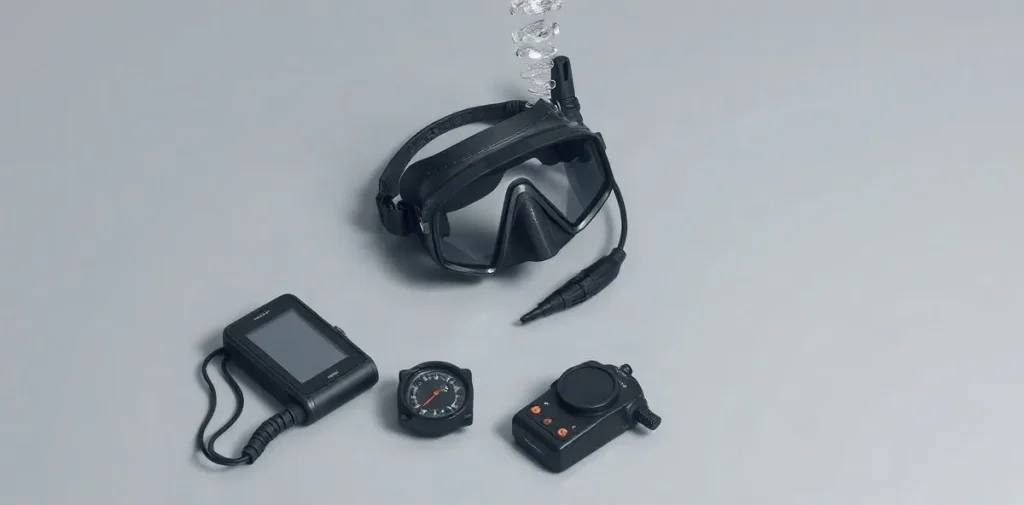
Human factors in diving examines how people interact with equipment, procedures, teams and the underwater environment. It matters because a diver’s actions depend not only on training or physiology, but also on attention, workload, communication and the conditions in which decisions must be made.
What does human factors research examine underwater?
The field studies the relationship between human abilities and the demands of a task. In diving, those demands include controlling buoyancy, monitoring breathing gas, navigating, communicating and responding to changing conditions, often while wearing equipment that limits movement and sensation.
Human factors is not a way to blame a diver after an incident. It asks how task design, procedures, equipment and team coordination can make errors more or less likely, and how people detect and recover from them.
Why can ordinary tasks become demanding?
Water changes the setting in which a person senses, moves and acts. A diver may have restricted vision, reduced dexterity, limited communication and a breathing system that requires deliberate monitoring. Cold, exertion, depth and task complexity can add demands, while anxiety or an unexpected problem can narrow attention.
Workload is the effort required to manage a task. When several demands compete, a diver may miss a cue, delay a response or focus on one instrument at the expense of another. The practical question is not whether people can make mistakes, but whether a system helps them notice problems early and respond safely.
- Attention: what the diver notices, misses or prioritises.
- Workload: the demands placed on working memory and action.
- Situation awareness: understanding what is happening and what may happen next.
- Communication: how a team shares information when speech is constrained.
- Human–equipment fit: whether controls, displays and procedures support reliable use underwater.
How do researchers study human performance?
Research may use controlled tasks, simulations, equipment trials, observation of real operations or analysis of incidents. Each method answers different questions: a controlled task can isolate a factor, while field observation captures the combined demands of an actual dive. Researchers must account for differences in experience, environment and task, rather than treating every diver or operation as interchangeable.
Measures can include task completion, response to a signal, communication accuracy, workload ratings and physiological responses. No single measure explains performance by itself. A slow response, for example, can reflect distraction, a difficult control, an unclear procedure or a deliberate choice to prioritise another safety task.
Good research also distinguishes individual performance from system design. A useful finding can point toward clearer displays, simpler procedures, better practice or improved team communication—not merely a demand that divers pay closer attention.
What does this mean for dive medicine and hyperbaric care?
Human factors connects with physiology because the body and the task influence one another. Fatigue, cold, exertion, stress and some medical conditions can affect attention or coordination; in turn, a demanding task can make it harder to recognise a physical problem or communicate it clearly.
For diving physicians and hyperbaric clinicians, the area is relevant to evaluating fitness for a particular kind of diving, understanding how symptoms may affect task performance, and designing procedures that support safe care. These questions depend on the individual and the operation. A diving-medicine physician should assess personal health concerns and fitness to dive.
How can human factors reduce operational risk?
Risk controls can address the environment, equipment, procedures and teamwork together. Training can rehearse decisions and communication, while equipment design can make important information easier to see and controls easier to use with gloves. Procedures can reduce unnecessary task switching and clarify who is responsible for a shared task.
Scientific divers, working divers and recreational divers face different tasks, but all benefit from planning that accounts for attention and coordination. Before a dive, consider which tasks may compete, how the team will communicate, and what happens if a key piece of equipment or information is unavailable.
Frequently asked questions
Is human factors just another term for diver error?
Can human factors be studied outside the water?
Does human factors research apply to recreational divers?
An original research-library explainer written by the Rubicon editors. It is not a summary of a specific publication.
Related reading on Rubicon
- Diving Safety: Training, Gear, Sites, Risk
- Understanding Hypoxia Risks in Recreational Diving
- Understanding Oxygen Toxicity Risks and Prevention in Diving
- The Diving Reflex: What Happens Underwater
- Human Factors in Diving: Research Summary
- Factors Affecting CNS Oxygen Toxicity in Humans
- More on Safety
- Browse the Research Library