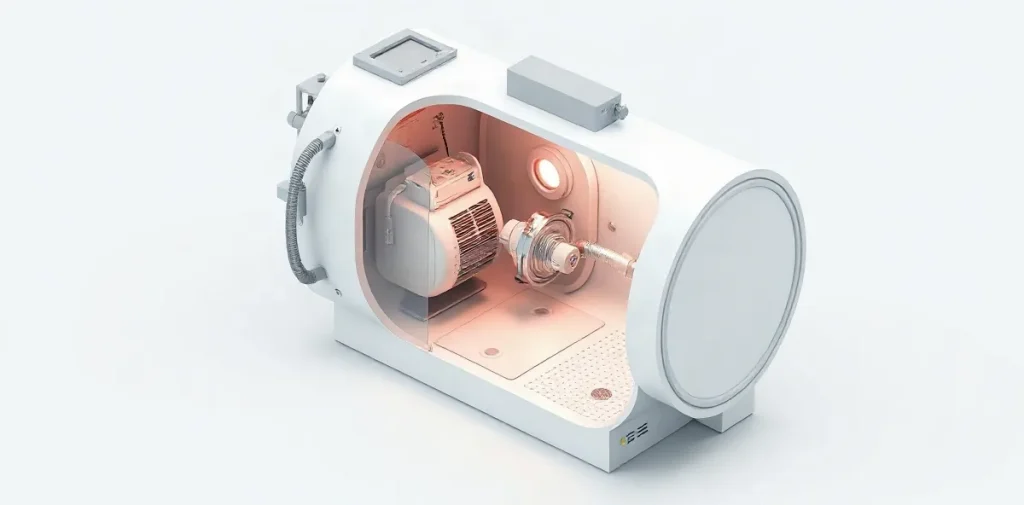
Ventilator performance in a monoplace hyperbaric chamber is a question of whether a breathing-support device can deliver and measure ventilation reliably while its surroundings are pressurised. The issue matters because chamber treatment can involve patients who cannot breathe adequately without assistance, and pressure changes affect both equipment behaviour and clinical monitoring.
Why does a ventilator behave differently under pressure?
A monoplace chamber accommodates one patient and is pressurised as a whole. A ventilator used inside it therefore operates in a pressurised environment, rather than supplying a patient through a barrier from outside. The chamber’s pressure and the gas conditions around the device become part of the equipment’s operating environment.
Ventilation moves gas into and out of the lungs. Clinicians assess it through measures such as tidal volume, the amount of gas moved in a breath, and respiratory rate, the number of breaths each minute. Pressure can affect gas density and the relationships between pressure, volume and flow, so a device’s displayed values and delivered breaths need interpretation in context.
That is distinct from oxygenation, the transfer of oxygen into blood. Hyperbaric oxygen treatment raises the pressure of the oxygen environment, but a ventilator’s task is to support breathing. The two processes interact in care, yet neither substitutes for the other.
What does performance testing examine?
Equipment studies in this area ask whether a ventilator continues to function as intended when exposed to chamber pressure and whether its measurements remain useful to clinicians. Testing can examine gas delivery, pressure control, alarms, circuit behaviour and the agreement between a device’s settings or readings and its actual output. The precise methods depend on the device and the question being tested.
A useful assessment considers more than whether the ventilator switches on. A breathing circuit may change how gas flows; connections must remain secure; and alarms must be audible or otherwise detectable in the clinical setting. Monitoring also needs to distinguish a true change in the patient’s breathing from an effect of the pressurised environment.
- Delivered ventilation: whether breath size and timing remain appropriate to the selected settings.
- Pressure and flow: how the chamber environment affects gas movement and the interpretation of measurements.
- Alarms and monitoring: whether problems can be recognised promptly during treatment.
- Practical integration: whether the device, circuit and patient can be managed within the chamber’s constraints.
Why is this relevant to divers?
Hyperbaric medicine and diving share the central problem of caring for people in environments where pressure changes the conditions of breathing. A diver with serious illness or injury may need transfer to a chamber for treatment, and some patients need ventilatory support during that care. Equipment compatibility is therefore part of treatment planning, not a detail that can be assumed.
For diving physicians, the wider lesson is that a chamber intervention must be considered as a system: patient, ventilator, breathing circuit, chamber and monitoring. A device that performs acceptably at surface pressure cannot automatically be presumed to perform identically in a pressurised chamber. Clinicians need equipment procedures that reflect the treatment environment and the patient’s condition.
The same reasoning matters in scientific diving and other operational settings. Diving medicine may involve urgent decisions about stabilisation and transfer, while hyperbaric clinicians must maintain safe respiratory support throughout treatment. The relevant equipment question is not simply whether a ventilator is available, but whether its operation can be assessed under the conditions in which it will be used.
How does this fit into hyperbaric research?
Hyperbaric research spans the effects of elevated pressure and oxygen on physiology, clinical uses of hyperbaric oxygen, and the technologies needed to deliver treatment safely. Ventilator assessment belongs to this applied, equipment-focused strand. It connects respiratory physiology with engineering and bedside practice.
It also sits alongside research into the varied conditions treated in hyperbaric medicine, including carbon monoxide poisoning, infection and acute blood-loss anaemia. These clinical problems differ, but each can raise questions about oxygen delivery, patient stability and the practical demands of treatment. Respiratory support is one part of that broader care environment.
Historically, the move from describing pressure effects to delivering complex treatment has made equipment validation increasingly important. A device must be evaluated for its intended environment, and clinicians must understand which readings remain meaningful there. For an individual patient, decisions about ventilatory support belong with the treating team and a diving-medicine or hyperbaric physician.
Frequently asked questions
What is a monoplace hyperbaric chamber?
Why assess a ventilator under pressure?
Does hyperbaric oxygen replace ventilatory support?
An original research-library explainer written by the Rubicon editors. It is not a summary of a specific publication.