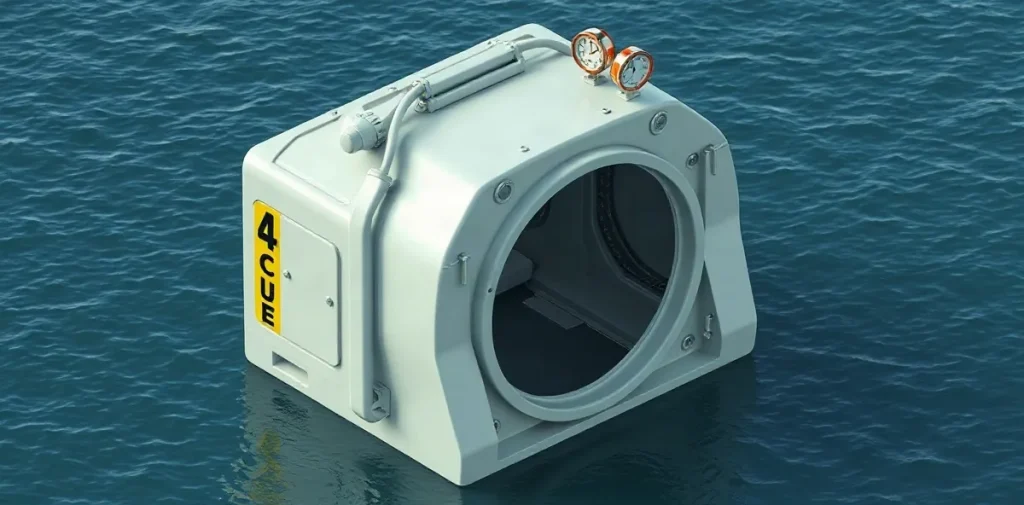
Pressurized submarine rescue is the medical and engineering problem of bringing trapped submariners to safety while keeping them at elevated pressure. It matters because a rapid return to surface pressure can cause decompression illness, while a pressurized transfer must also control breathing gas, temperature, equipment and clinical care.
Why keep a rescue chamber pressurized?
A person living in a disabled submarine may breathe at a pressure above that at the surface. In that environment, inert gas from the breathing mixture enters body tissues. If pressure falls too quickly, gas can form bubbles, producing decompression illness that may affect joints, the nervous system, lungs or circulation.
Keeping the rescued occupants under pressure during transfer can avoid an abrupt pressure reduction. The approach shifts the challenge: instead of bringing people immediately to surface conditions, the rescue system must maintain a controlled atmosphere until a suitable decompression can be carried out.
This is not simply a matter of matching two pressure readings. The rescue team must account for the condition of the submarine, the transfer route, the chamber atmosphere and the people inside it. Each factor can constrain how the operation proceeds.
What must be controlled during transfer?
A pressurized rescue system has to connect the casualty environment to a receiving chamber without exposing occupants to an unsafe pressure change. Seals, hatches, gas supplies, monitoring and communication all matter, alongside the physical fit between the rescue vehicle and the submarine escape point.
The atmosphere also needs attention. Oxygen is essential, but its partial pressure—the pressure contributed by oxygen in a gas mixture—must be controlled. Carbon dioxide produced by breathing must be removed, and the breathing mixture must remain suitable for the pressure and duration involved.
- Pressure continuity: avoid an uncontrolled fall in ambient pressure during transfer.
- Breathing gas: manage oxygen delivery and carbon dioxide removal in a confined space.
- Environmental control: consider heat, humidity and the capacity of life-support systems.
- Medical observation: monitor occupants for illness or injury during rescue and decompression.
- Operational compatibility: coordinate the rescue vehicle, submarine interface and receiving chamber.
These are linked requirements rather than separate checkboxes. A problem with power, gas supply or a seal can become a medical problem if it changes the pressure or atmosphere.
How does decompression shape the medical plan?
Once occupants are in a chamber, pressure can be reduced in a planned sequence. Decompression allows inert gas to leave the body gradually through the lungs instead of forming harmful bubbles during a rapid ascent to surface pressure. The appropriate schedule depends on the pressure exposure and the individual circumstances.
Rescue medicine must also address problems that are not caused by decompression. People may have injuries, dehydration, exhaustion, cold stress or illness, and access to them can be limited by chamber conditions. A medical plan has to fit the available space, equipment, staffing and communication arrangements.
Symptoms that may indicate decompression illness require assessment by clinicians familiar with diving and hyperbaric medicine. A suspected pressure-related injury is not a reason to improvise a treatment schedule; the response depends on the person and the operational situation.
What does research in this area examine?
Research on pressurized rescue brings physiology together with system design and emergency planning. It asks how pressure exposure affects people, what environmental conditions a transfer system must sustain, and how rescue procedures can remain workable under demanding constraints.
Methods can include controlled studies of pressure and breathing atmospheres, evaluation of life-support equipment, and analysis of transfer and decompression procedures. Animal research has also formed part of the wider history of studying prolonged exposure to pressurized normal and synthetic atmospheres; such work addresses questions that cannot be answered by engineering tests alone.
The subject sits beside other strands of undersea medicine and safety: submarine casualty response, decompression research, breathing-gas physiology and human performance in confined environments. Each offers a different piece of the problem, from what happens in the body to what a rescue system must do reliably.
Why is this relevant beyond submarines?
The central lesson applies wherever people work under pressure: the environment, the equipment and the medical plan cannot be designed in isolation. Divers and hyperbaric clinicians encounter the same basic physiological concern when pressure changes faster than the body can safely accommodate.
Pressurized submarine rescue is a specialised operation, not a routine diving procedure. Its principles are relevant to understanding decompression risk and life-support requirements, but an individual emergency calls for trained rescue teams and medical oversight. For a specific exposure or symptom, consult a diving-medicine physician.
Frequently asked questions
Why not bring rescued submariners straight to the surface?
Is pressurized rescue the same as decompression treatment?
What makes a rescue chamber medically demanding?
An original research-library explainer written by the Rubicon editors. It is not a summary of a specific publication.
Related reading on Rubicon
- The Science of Diving SSI: Education and Physiology Insights
- Diving Science: Physiology and Tech Behind Safe Dives
- Impact of Microgravity on Dive Physiology and Safety
- The Physiology Behind Oxygen Toxicity in Deep Dives
- Decompression Risk in Pressurized Submarine Rescue
- Hyperbaric Stretchers in Submarine Escape and Rescue
- More on Dive Medicine
- Browse the Research Library