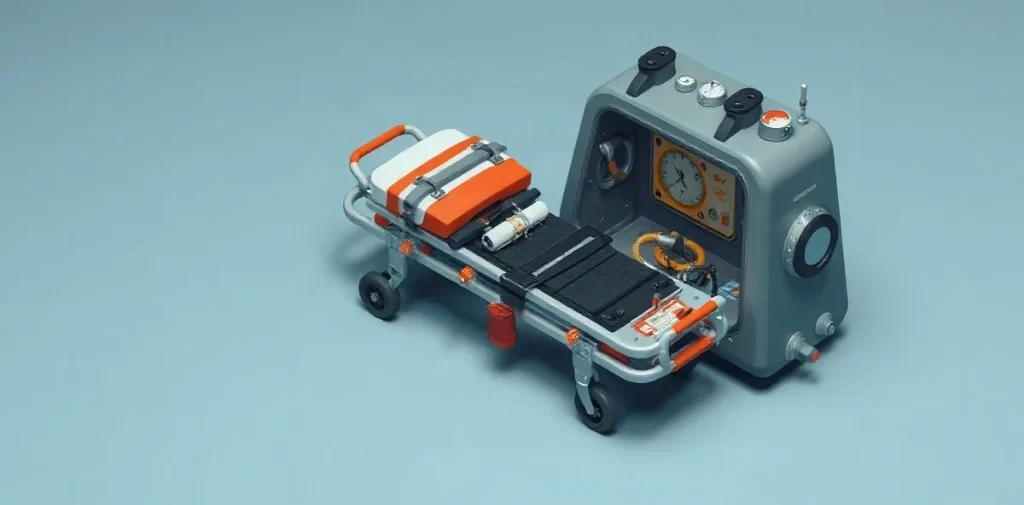
An emergency evacuation hyperbaric stretcher is a sealed, pressurised enclosure intended to protect a person during transfer from a submarine escape or rescue operation. Its purpose sits at the junction of life support, pressure management and evacuation logistics: a casualty may need medical care while remaining under pressure and moving between underwater and surface environments.
Why does evacuation under pressure matter?
After a submarine escape or rescue, a diver may face a changing pressure environment as well as injury, cold, exhaustion or breathing problems. A rapid change in ambient pressure can contribute to decompression illness when inert gas dissolved in tissues forms bubbles during ascent. The risk depends on the pressure exposure and the individual’s circumstances, so safe transfer cannot be treated as a simple transport problem.
A hyperbaric enclosure can maintain pressure around the casualty during movement, providing time and continuity while a route to further treatment is arranged. It does not remove the need for assessment or definitive care. Its practical value depends on whether the system can be connected to the rescue chain, operated reliably and matched to the pressure and medical needs of the person inside.
What does the stretcher need to do?
The central engineering challenge is to combine a pressure boundary with access, monitoring and movement. The enclosure must contain gas at the intended pressure, while allowing the team to observe the casualty and manage essential life-support needs. Connections, seals, valves and controls must function as a system; a pressure-rated shell alone is not enough.
Research and evaluation in this area examine questions such as:
- Pressure control: Can internal pressure be maintained and adjusted during transfer?
- Breathing gas: How will the occupant receive an appropriate gas supply, and how will exhaled carbon dioxide be managed?
- Monitoring and access: Can rescuers assess the casualty and reach necessary controls without compromising the enclosure?
- Handling: Can the stretcher be secured and moved through the relevant rescue and transfer stages?
- Failure response: What happens if a supply, seal or control system does not work as intended?
These questions link equipment testing to operational procedures. A device that works under controlled conditions must still be usable by a team coordinating an evacuation, where space, time and access may be constrained.
How are these systems evaluated?
Evaluation can include engineering checks of pressure integrity, gas delivery, carbon-dioxide removal, monitoring and control functions. Human-factors assessment matters too: operators need to connect, check and manage the system correctly, while the occupant’s condition must remain observable during movement. Tests can explore how equipment behaves across the stages of a transfer rather than treating the stretcher as an isolated chamber.
Operational compatibility is another part of the research question. Rescue systems, transfer arrangements and receiving hyperbaric facilities must work together, including compatible connections and clear procedures for handover. The relevant pressure profile and the time spent at each stage shape what the equipment must support; these details cannot be reduced to one universal operating sequence.
What physiology and medicine shape the problem?
At depth, increased ambient pressure raises the partial pressures of gases a diver breathes. Inert gas uptake into tissues and subsequent decompression are central concerns, while oxygen and carbon dioxide require careful management in any confined breathing environment. The medical team must consider both pressure-related illness and ordinary clinical needs, such as maintaining ventilation and observing a deteriorating casualty.
Hyperbaric transfer is therefore part of a wider system of care, not a substitute for it. Clinicians need to assess the person, the pressure exposure and the available treatment pathway. The appropriate approach can differ with the casualty’s condition and the conditions of escape, rescue and transfer; decisions about an individual require a diving-medicine physician.
Why does this research matter beyond submarines?
Submarine escape and rescue bring together problems familiar across diving medicine: pressure exposure, gas management, casualty handling and access to hyperbaric treatment. Studying an emergency stretcher makes the interfaces visible. The enclosure, breathing supply, monitoring equipment, transport method and receiving facility all have to function as one chain.
For divers and clinicians, the broader lesson is that emergency equipment is only as useful as its integration into a practiced response. A design must be assessed not just for whether it can hold pressure, but for how it supports the casualty and the team during transfer. Training, equipment checks and a clear handover to medical care remain practical parts of the safety problem.
Frequently asked questions
What is an emergency hyperbaric stretcher?
Does a hyperbaric stretcher treat decompression illness?
Why are gas management and monitoring important?
An original research-library explainer written by the Rubicon editors. It is not a summary of a specific publication.