Decompression risk in pressurized submarine rescue concerns how changes in pressure affect people brought from a disabled submarine to the surface while remaining in a pressurized environment. The problem links rescue engineering with decompression medicine: pressure can reduce some hazards of ascent, but the full exposure history still shapes medical risk.
Why does pressure matter during a submarine rescue?
At depth, the pressure of breathing gas increases the amount of inert gas that dissolves in body tissues. During ascent, pressure falls and that gas leaves the body; if the change is too rapid for the tissues and circulation to accommodate, bubbles can form and cause decompression sickness (DCS).
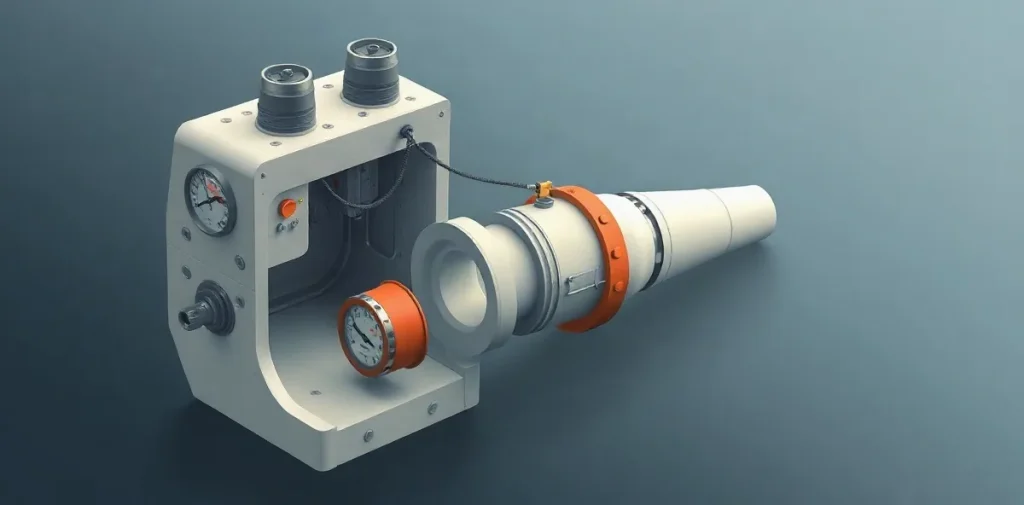
A pressurized rescue system aims to avoid an abrupt transition from the submarine’s ambient pressure to surface pressure. The rescue vehicle, transfer arrangements and receiving chamber must work as a connected pressure pathway. The medical question is not simply whether the rescued crew reaches the surface, but how the pressure changes and the time spent at each pressure affect their decompression exposure.
What does a DCS risk assessment examine?
Risk assessment brings together the pressure history, duration of exposure, breathing gas and the planned ascent or transfer profile. These factors help describe how much inert gas may have entered the body and how quickly pressure will fall. Individual susceptibility and health can also affect clinical assessment; a calculated risk is not a diagnosis for any one person.
In this field, models can represent gas uptake and elimination in different theoretical tissue compartments. Their outputs depend on assumptions about exposure and physiology, so model estimates are tools for comparing scenarios rather than guarantees that a particular person will or will not develop DCS.
- Pressure profile: the pressures encountered and the rate and sequence of transitions.
- Exposure time: how long the person remains at each pressure.
- Breathing gas: the gas composition affects inert-gas loading and oxygen exposure.
- Clinical observation: symptoms and examination remain essential alongside any model or plan.
How is rescue different from a planned dive?
A planned dive usually has a defined profile and a decompression procedure designed before entry. A submarine rescue begins with an emergency and may involve people whose pressure exposure, workload or health varies. Rescue planners must also account for the operation’s physical constraints: a pressure-controlled transfer has to remain feasible while equipment and personnel move the crew.
The pressure pathway can include transfer between the disabled submarine, a rescue vehicle and a surface chamber. Any change in pressure, interruption or delay matters to the overall exposure. Planning therefore connects decompression procedures with engineering limits, crew condition and the practical sequence of rescue operations.
Why does the problem matter beyond submarine rescue?
The same physiology underlies decompression planning across diving. Recreational, occupational and scientific divers all face pressure changes, while hyperbaric clinicians manage people whose treatment also involves pressure. Rescue research brings those shared questions into an unusually constrained setting, where the exposure may be prolonged and the person cannot simply end the dive on schedule.
It also illustrates a broader principle in diving medicine: a decompression model supports decisions, but does not replace observation or clinical judgment. For a diver with possible DCS symptoms, prompt assessment by a diving-medicine physician or hyperbaric clinician is important; the appropriate response depends on the individual and the circumstances.
What should readers keep in mind?
Pressure-managed rescue is not equivalent to eliminating decompression risk. It changes the conditions under which gas enters and leaves the body, and those conditions must be considered over the entire pressure history. A sound assessment distinguishes a modeled probability from a clinical outcome.
For clinicians and rescue planners, the practical task is to integrate pressure records, transfer procedures and medical monitoring. For divers, the subject is a reminder that decompression risk depends on the exposure as a whole, not on depth alone.
Frequently asked questions
What is decompression sickness?
Does a pressurized rescue remove DCS risk?
Can a decompression model predict an individual outcome?
An original research-library explainer written by the Rubicon editors. It is not a summary of a specific publication.
Related reading on Rubicon
- Decompression Sickness: Causes and Risk Reduction
- Microbubbles’ Role in Decompression Stress and Risk
- Safety Dive: Safety Stops vs Decompression Stops
- Diving Safety: Training, Gear, Sites, Risk
- Decompression Sickness: Bubbles, Risk and Treatment
- Temperature, Decompression and DCS Risk
- More on Dive Medicine
- Browse the Research Library