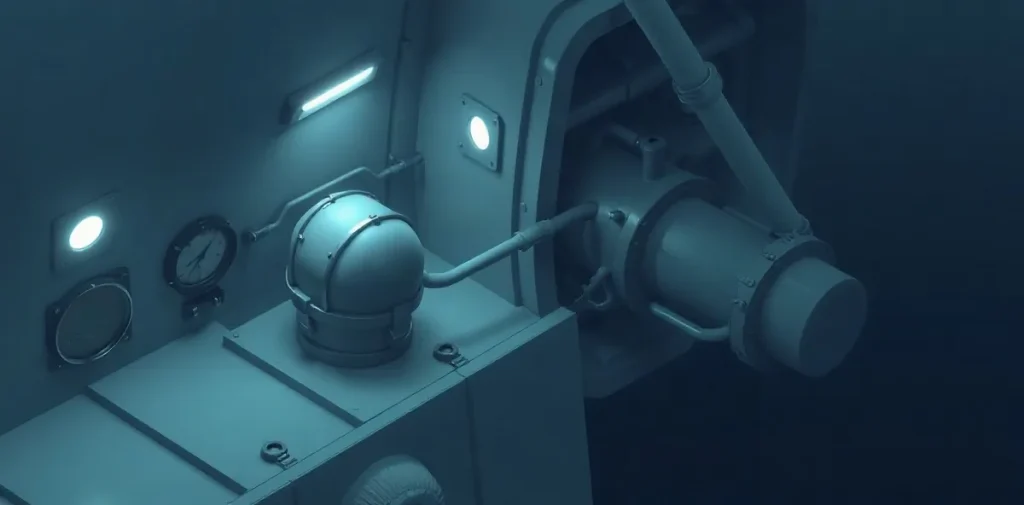
Pressurized Submarine Rescue is a 1984 publication by Eckenhoff in the Naval Submarine Medical Research Laboratory Technical Report NSMRL-1021. It addresses the medical and technical problem of rescuing people from a disabled submarine while preserving pressure conditions—a problem that connects submarine escape, diving physiology and hyperbaric care.
Why rescue under pressure is different
A submarine may be disabled at a depth where surrounding water pressure is far above the pressure inside the vessel. If the crew’s environment has been pressurized, moving them into ordinary atmospheric conditions too quickly can create a serious decompression hazard. Rescue planning must therefore account for the pressure the crew has experienced, not only the depth of the submarine.
Pressurized rescue is not simply a matter of transferring people between vessels. The rescue system must maintain a compatible pressure environment during transfer, while supporting breathing and monitoring the crew. The central challenge is to connect survival in the submarine with a controlled transition to a place where further treatment is possible.
What does pressure change in the body?
As ambient pressure rises, gases in the body and breathing environment behave differently. When a person breathes gas at elevated pressure, more inert gas can dissolve in body tissues. If pressure then falls too quickly, that gas may form bubbles, causing decompression sickness. The risk depends on the pressure exposure and its duration, among other factors.
Decompression is the managed reduction of pressure after exposure. In a rescue, the route from the submarine to a receiving chamber or other safe environment matters: a transfer that interrupts pressure control can turn an evacuation into a medical emergency. The basic physiological issue is familiar from diving, but the confined setting and urgency of submarine rescue add operational demands.
Which systems and decisions have to work together?
A pressurized rescue depends on more than a pressure vessel. The transfer interface, pressure control, breathing-gas supply and communication must function as parts of one system. Conditions inside the rescue equipment also need to support the crew while the transfer proceeds.
- Pressure compatibility: the receiving system must accommodate the pressure environment required for transfer.
- Breathing gas: gas composition and delivery must support breathing under the conditions of the rescue.
- Life support: the system must manage the enclosed environment during occupancy and movement.
- Medical monitoring: crew condition and possible decompression illness affect the next steps in care.
- Transfer and communication: coordination matters when the crew, rescue equipment and receiving facility must operate together.
These considerations are interdependent. For example, a change in pressure affects both decompression planning and the operation of the transfer system, so technical decisions cannot be separated cleanly from medical ones.
How does the subject fit into diving medicine?
Submarine rescue sits at the boundary between occupational diving, hyperbaric medicine and emergency engineering. It shares with saturation diving the problem of managing people who have spent time under elevated pressure, and with decompression medicine the need to control pressure reduction. It also raises practical questions that are specific to a rescue: how to move a group, preserve a breathable environment and arrange onward care under difficult conditions.
For diving physicians and hyperbaric clinicians, the subject highlights why a pressure history is essential when assessing someone after an underwater emergency. Symptoms, exposure conditions and the timing of pressure changes all matter. A diving-medicine physician should guide individual assessment and treatment; general descriptions of decompression physiology are not a substitute for clinical care.
What should readers take from the publication’s subject?
The title and technical-report setting place the work within applied research on submarine rescue, where medical safety depends on equipment and operating procedures as well as physiology. Readers interested in diving medicine can use the subject to understand how decompression concerns extend beyond recreational diving into complex rescue systems.
The key question is how to preserve a survivable pressure environment through evacuation and hand over safely to further care. That question remains relevant wherever people work or become stranded under pressure, and it requires coordination between engineering and medicine.
Frequently asked questions
What is pressurized submarine rescue?
Why can a rapid pressure change be dangerous?
Who may find this publication relevant?
Citation details
- Title: Pressurized Submarine Rescue
- Authors: Eckenhoff, RG
- Year: 1984
- Published in: Naval Submarine Medical Research Laboratory Technical Report NSMRL-1021
- Record type: Journal article
- Repository record: Rubicon Research Repository, handle 123456789/8416
This page is an original summary written by the Rubicon editors from the publication’s bibliographic record. It does not reproduce the paper, its abstract or its data; consult the publication itself for its methods and findings.