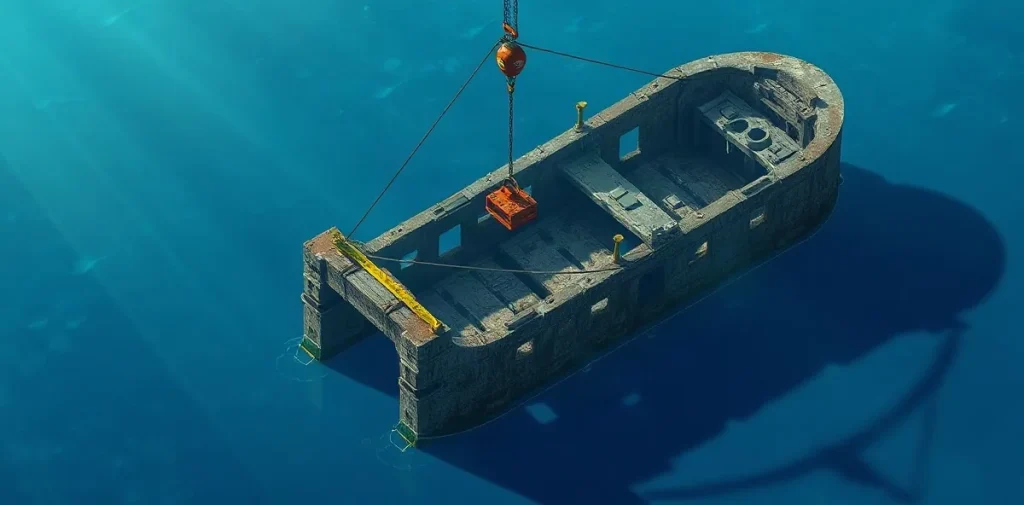
Scientific work on submerged wrecks combines underwater archaeology, salvage engineering and the practical science of diving. It asks how structures can be examined or recovered in an environment that limits visibility, movement and working time, while exposing divers to pressure, cold, entanglement and unstable debris.
What makes wreck salvage a research problem?
A wreck is both a physical structure and a record of past activity. Researchers may need to map its layout, assess damage, identify materials or plan how an object can be moved without harming the site or endangering a team. Salvage adds a demanding engineering question: what can be lifted, secured or dismantled underwater, and by what sequence?
Unlike work on land, underwater access changes with depth, currents, visibility and available breathing gas. A plan must account for the diver’s ability to reach the work area, perform precise tasks and return safely. The object’s condition matters too: corrosion, sediment and structural failure can make a seemingly solid wreck unpredictable.
This subject belongs to the wider study of scientific diving, where research tasks must be matched to training, equipment and exposure limits. It is not simply a matter of putting a diver beside an object; the method determines what can be observed and how safely the work can proceed.
How do teams investigate a wreck underwater?
Investigation often begins with documentation rather than removal. Divers can record position, dimensions, visible damage and the relationship between objects, while drawings, photographs and measurements help turn observations into a site plan. The choice of method depends on visibility, access and whether handling the wreck could disturb it.
Salvage planning then treats the site as a work area with hazards and constraints. Loads must be understood before lifting; attachments, lifting gear and the structure itself can fail or shift. Sediment disturbed during work can reduce visibility, complicate communication and make navigation harder.
- Site condition: assess instability, sharp edges, loose material and possible entanglement.
- Task design: break complex work into steps that divers can complete and monitor underwater.
- Exposure planning: account for depth, time, breathing-gas supply, decompression and the route back to the surface.
- Documentation: record observations in a form that can be checked and interpreted after the dive.
These considerations connect field observation with engineering judgement. A recovery operation needs more than a lifting plan: it needs a realistic account of how the underwater environment affects the people carrying it out.
Why does the work matter to diver physiology?
Pressure changes the demands of breathing and the way inert gas is taken up and released by the body. When a diver works at depth and later ascends, decompression becomes part of the task plan, not an afterthought. Repetitive dives, long work periods and limited exit options can make the overall exposure more complex.
Physical effort also matters. Handling tools, moving through confined spaces or controlling equipment can increase breathing demand, while cold and stress can affect performance. A diver focused on a difficult task may be less able to notice changing conditions or early symptoms of a problem.
For diving physicians and hyperbaric clinicians, salvage work raises familiar questions about exposure, fitness, decompression illness and post-dive assessment. A suspected diving-related illness requires prompt evaluation by qualified medical professionals; a diving-medicine physician should guide decisions about individual fitness and return to diving.
What safety problems are distinctive underwater?
Wrecks can create overhead or restricted environments, where a direct ascent may not be possible. Lines, nets and broken fittings can trap a diver, and silt can obscure both the exit and the team. A task that seems straightforward in clear water can become hazardous if visibility changes or a route is blocked.
Risk control depends on matching the operation to the site and the divers’ capabilities. Teams need clear roles, reliable communication, a plan for lost contact and a way to end the task if conditions deteriorate. Equipment selection and emergency arrangements must suit the actual work, rather than an abstract idea of a typical dive.
Salvage also raises a conservation question: removal can alter or damage the remaining site. Documentation before, during and after intervention helps distinguish what was present from what changed during the work, and supports responsible decisions about whether recovery is necessary.
How does wreck work fit into diving research?
Wreck investigation sits alongside research on scientific diving, underwater work capacity, equipment design and operational safety. Its methods can inform other settings where divers must carry out precise work under pressure, including remote field research and recovery operations. The common problem is how to obtain useful information without allowing the task to outrun the diver’s safe working capacity.
The engineering and physiological sides cannot be separated cleanly. A lift plan affects how long divers work; depth and access shape the available tools; and the need to preserve a site can constrain the simplest recovery method. That makes wreck salvage a useful case for examining how technical objectives, environmental conditions and human limits interact.
Frequently asked questions
Is wreck salvage the same as underwater archaeology?
Why can a small task become risky on a wreck?
What should divers do about symptoms after a salvage dive?
An original research-library explainer written by the Rubicon editors. It is not a summary of a specific publication.
Related reading on Rubicon
- Diving: Science, Practice, and Destinations
- Diving Science: Key Physiological and Environmental
- Diving: Exploring Underwater Activities, Science, and Safety
- The Science of Diving SSI: Education and Physiology Insights
- Rebreathers: Diving Science Research Summary
- Hydrogen Diving and Decompression Science
- More on Diving Science
- Browse the Research Library