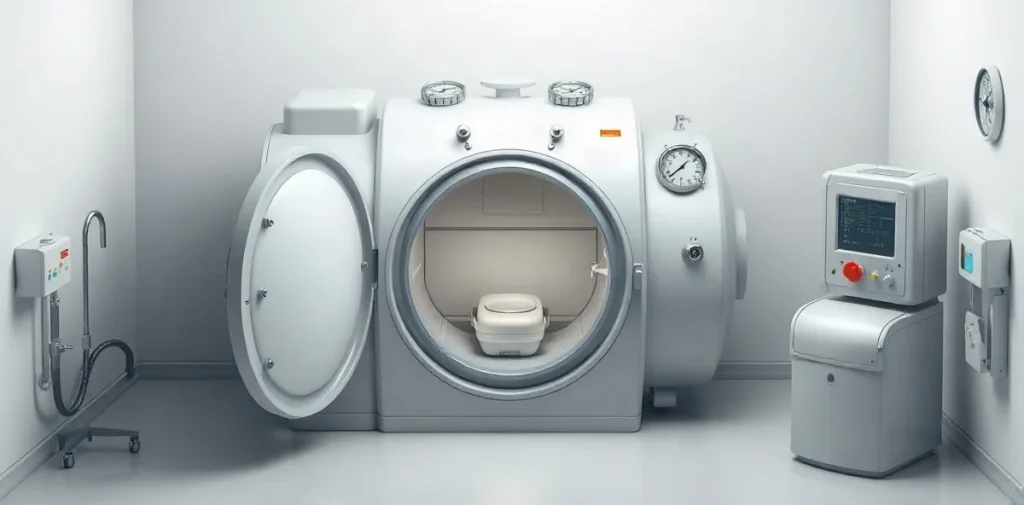
Utilization and Staffing of Monoplace Hyperbaric Facilities in the United States is a 1998 meeting abstract by Kob and colleagues in Undersea & Hyperbaric Medicine. Its subject is how monoplace hyperbaric facilities are used and staffed. That operational question matters because safe, effective treatment depends not only on chamber technology, but also on the people and systems that support it.
What is a monoplace hyperbaric facility?
A monoplace chamber is designed to accommodate one patient at a time. The chamber is pressurised, commonly with oxygen, so the patient breathes an elevated oxygen concentration under increased ambient pressure. This is distinct from a multiplace chamber, where several patients may be treated together and medical personnel may accompany them inside.
Hyperbaric oxygen therapy has established medical uses, including treatment of decompression illness and certain other conditions. The precise treatment protocol depends on the indication and clinical circumstances. A chamber’s configuration affects how care is delivered, how the patient is observed, and how clinical staff coordinate with chamber operators.
Why examine use and staffing together?
Facility utilization concerns how a chamber is incorporated into clinical service: the kinds of work it supports, its availability, and the demands placed on its operation. Staffing concerns the personnel needed to prepare and monitor treatment, manage the chamber, and respond to clinical or equipment issues. These are linked questions, since patterns of use shape operational workload and staffing arrangements.
In hyperbaric care, treatment takes place in a controlled pressure environment, and the patient may need ongoing observation while inside the chamber. Staff must understand the chamber’s procedures and communicate clearly across clinical and technical roles. Sound organisation helps align patient care with safe chamber operation rather than treating the equipment as a self-contained intervention.
- Utilization: how a facility’s chamber is used in its clinical setting.
- Staffing: the roles and coordination required to deliver and supervise treatment.
- Facility operations: the procedures, equipment readiness, and monitoring that support care.
- Clinical context: the indication and patient needs that shape a treatment plan.
What does the chamber environment require?
Pressure changes affect gas volumes and the way gases behave in the body. Hyperbaric treatment also involves exposure to elevated oxygen partial pressure, which is therapeutically useful but requires attention to treatment duration and clinical protocol. These basic physiological and technical considerations make trained supervision and reliable operating procedures essential.
Patient monitoring and communication must account for the chamber’s physical arrangement. Staff need to know how to observe the patient, maintain contact as appropriate, and act in response to a change in condition or a chamber concern. Facility planning also has to consider equipment checks, emergency procedures, and the safe handling of oxygen-rich environments.
How does this subject connect to diving medicine?
Hyperbaric medicine and diving medicine share a concern with pressure, gas exchange, and the consequences of breathing gases under altered ambient conditions. Decompression illness is one important point of contact: recompression treatment uses a pressure chamber to manage a condition arising from diving. A monoplace facility’s operational capacity is therefore relevant to the wider systems that support treatment, even though chamber type and clinical protocols vary.
Questions about staffing and service use sit alongside research into decompression physiology, treatment protocols, chamber safety, and access to care. They help frame how clinical knowledge is translated into a working service. For divers, diving physicians, and scientific divers, this operational perspective adds context to the medical response that may be needed after a pressure-related injury.
What should readers take from the topic?
The publication’s title places it at the intersection of hyperbaric equipment, clinical service delivery, and workforce organisation. Considering use and staffing together helps readers understand that treatment capability depends on more than chamber availability: it also rests on appropriate personnel, procedures, and coordination.
This is a general research-library overview, not individual medical advice. Divers with symptoms after a dive, or anyone considering hyperbaric treatment, should seek assessment from a diving-medicine or hyperbaric-medicine physician.
Frequently asked questions
What does “monoplace” mean?
Why is staffing important in hyperbaric treatment?
How is this relevant to divers?
Citation details
- Title: Utilization and Staffing of Monoplace Hyperbaric Facilities in the United States
- Authors: Kob, DG; Gesell, LB; Spadafora, MP; Liu, T
- Year: 1998
- Published in: Undersea & Hyperbaric Medicine 1998
- Record type: Meeting abstract
- Repository record: Rubicon Research Repository, handle 123456789/643
This page is an original summary written by the Rubicon editors from the publication’s bibliographic record. It does not reproduce the paper, its abstract or its data; consult the publication itself for its methods and findings.
Related reading on Rubicon
- How Hyperbaric Chambers Aid Recovery from Dive Injuries
- Thesis Research in Diving and Hyperbaric Medicine
- The Nursing Role in Hyperbaric Medicine
- More on Dive Medicine
- Browse the Research Library
