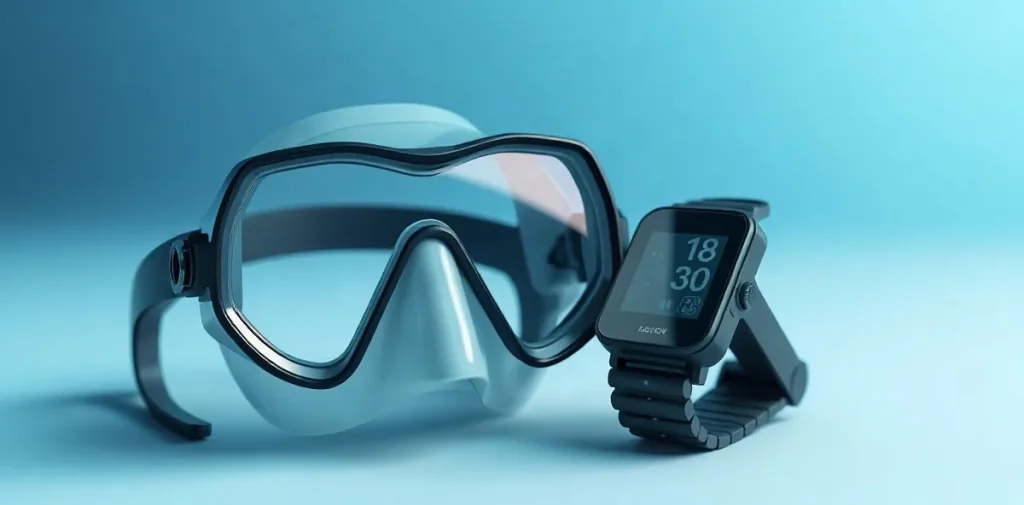
New thoughts on the correction of presbyopia for divers is a 2008 journal article by Bennett QM, published in Diving Hyperb Med 38(2). It addresses how divers can manage age-related difficulty focusing on nearby objects—a practical issue when reading gauges, computers and other equipment underwater.
What is presbyopia, and why does it matter underwater?
Presbyopia is the gradual loss of the eye’s ability to focus on close objects. It is associated with ageing and reflects reduced flexibility in the eye’s natural focusing system. A person may still see distant objects clearly while needing more help with near tasks.
Diving makes near vision operationally important. A diver may need to read a pressure gauge, check a dive computer or inspect a small marking while also maintaining awareness of the surrounding environment. Poorly legible displays can slow those checks or make them harder to complete accurately.
Underwater, the viewing conditions differ from those on land. A mask creates an air space in front of the eyes, and water alters how light behaves at the mask window. A correction that works for reading on land therefore needs to be considered in the context of the diver’s mask, task and equipment.
What does optical correction need to account for?
Near-vision correction aims to make close objects clear at a useful working distance. For diving, that distance may be the space between the diver’s eyes and a wrist-mounted computer or instrument. The required correction can depend on the wearer’s vision and on how the display is positioned and viewed.
Correction also has to function as part of a complete visual setup. The mask, lenses and display form a practical system: fit and viewing angle influence whether a diver can acquire information without excessive effort. The goal is not simply to make small print appear larger, but to support reliable access to essential visual information.
- Working distance: the separation between the eyes and the instruments the diver needs to read.
- Mask compatibility: whether the chosen optical arrangement works with the diver’s mask and field of view.
- Task demands: the size, contrast and location of displays or markings used during a dive.
- Visual comfort: whether the diver can shift attention between near instruments and the wider scene.
How does this fit into diving medicine?
Diving medicine considers vision because underwater tasks depend on seeing, interpreting and acting on information. A visual limitation can matter even when it does not prevent ordinary activities on land. Assessment needs to consider the demands of the planned diving, rather than treating a prescription as an isolated number.
Presbyopia is one part of a broader practical question: how can a diver maintain usable vision at the distances and under the conditions that diving requires? The same way of thinking applies to other optical needs, including distance correction and the interaction between corrective lenses and a mask.
For diving physicians, optometrists and divers, the subject sits at the intersection of eye care, equipment use and task performance. Decisions about correction are individual; a diving-medicine physician should be consulted when a vision concern could affect diving fitness or safe performance.
What should divers consider when choosing a correction?
Start with the tasks that require close vision. A diver who mainly checks a wrist computer may have different needs from someone who must read several instruments or inspect small details. Testing the actual equipment at its usual viewing distance can help clarify what needs to be legible.
Consider how the correction behaves when the diver looks away from a display and back to the surrounding scene. A solution that makes a gauge readable but interferes with other visual tasks may not suit the whole dive. Familiarity and clear access to instruments matter alongside sharpness at one distance.
Prescription details, lens options and suitability depend on the individual and the equipment. An eye-care professional can assess vision and correction; a diving-medicine physician can help relate those needs to the diver’s health and planned activity.
Frequently asked questions
What is presbyopia?
Why can presbyopia affect a diver’s work underwater?
Who can advise on vision correction for diving?
Citation details
- Title: New thoughts on the correction of presbyopia for divers
- Authors: Bennett QM
- Year: 2008
- Published in: Diving Hyperb Med 38(2)
- Identifiers: PMID 22692711
- Record type: Journal article
- Repository record: Rubicon Research Repository, handle 123456789/10206
This page is an original summary written by the Rubicon editors from the publication’s bibliographic record. It does not reproduce the paper, its abstract or its data; consult the publication itself for its methods and findings.
Related reading on Rubicon
- Why Divers Get Cold Faster Underwater
- Scuba Diving Equipment: Essential Gear for Every Diver
- Effects of Cold Water Immersion on Diver Metabolism
- How Hydrodynamics Boost Diver Efficiency and Safety
- PADI Diver Rescue Training: Research Summary
- Lobster Divers of La Mosquitia: Research Summary
- More on Dive Medicine
- Browse the Research Library