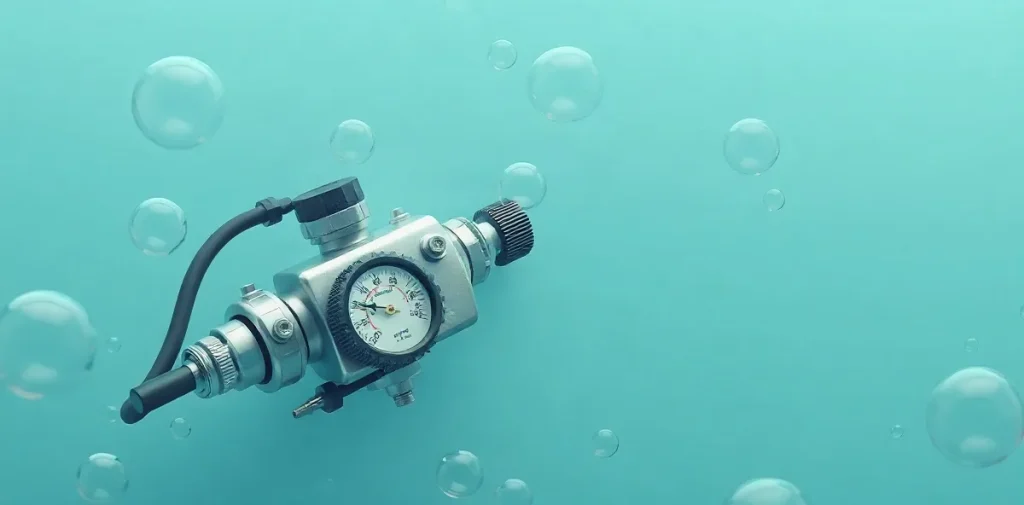
Operational oxygen physiology asks how breathing oxygen supports human work in demanding environments, including underwater and hyperbaric settings. For divers, the subject connects gas choice and exposure conditions with the body’s ability to sustain activity, while also defining hazards that must be managed during planning and clinical care.
What does operational oxygen physiology examine?
The field considers the interaction between oxygen supply, pressure, breathing gas and the body’s response during work. It is not simply a question of whether oxygen is present: exposure conditions affect how oxygen behaves, and physical effort changes how much oxygen the body uses.
Operational physiology applies basic respiratory and cardiovascular principles to real tasks. Researchers may examine how a breathing environment supports exertion, how the body responds to exposure, and what constraints arise when people must work in conditions that differ from ordinary life.
The practical setting matters. A diver carrying equipment, a scientific diver performing a task, and a patient receiving hyperbaric treatment face different demands, even though oxygen physiology is relevant to each.
Why does pressure change the oxygen question?
At depth, ambient pressure increases, changing the partial pressure of each gas in a breathing mixture. Oxygen’s partial pressure is the portion of total pressure contributed by oxygen; it helps describe the exposure the lungs receive more usefully than oxygen percentage alone.
This distinction matters because a gas mixture that is suitable in one setting may not be suitable at another pressure. Oxygen is essential for metabolism, but excessive exposure can cause oxygen toxicity. The risk depends on the exposure conditions, including pressure and duration, so operational planning must consider the whole profile rather than a gas label in isolation.
Pressure also affects the physical demands of breathing and work. A diver’s workload, equipment, environment and breathing gas interact; physiology cannot be assessed by treating oxygen concentration as the only relevant variable.
What questions guide research in this area?
Studies of operational oxygen physiology examine how people respond to defined breathing and pressure conditions, and how those responses relate to task performance and safety. The aim is to understand mechanisms and operational limits, not to treat oxygen as either uniformly beneficial or uniformly hazardous.
- Oxygen delivery: how the lungs and circulation make oxygen available to working tissues.
- Exposure: how pressure, breathing-gas composition and time shape oxygen dose.
- Workload: how exertion changes oxygen demand and the body’s response.
- Toxicity: how excessive oxygen exposure can affect the central nervous system and other tissues.
- Operational relevance: how physiological observations inform gas selection, task planning and risk controls.
Methods depend on the question. Researchers can compare responses under controlled breathing or pressure conditions, monitor physiological measures, or assess performance during a defined task. Interpretation requires attention to the conditions being tested: results from one exposure or workload do not automatically describe another.
How does this connect to diving medicine?
Oxygen physiology sits alongside several related areas of diving research. Central nervous system oxygen toxicity concerns effects on the brain and nervous system; decompression research examines inert-gas uptake and elimination; studies of fatigue consider how a dive and its workload may affect performance afterwards. These questions overlap in practice but are not interchangeable.
Hyperbaric medicine also uses oxygen in clinical settings, where treatment conditions and medical goals differ from underwater operations. Shared physiology does not make a clinical protocol a diving procedure, or vice versa. Clinicians and operational planners need to consider the exposure, purpose and individual circumstances separately.
For divers, the central value of this research is a clearer account of the trade-offs involved in breathing gas and exposure planning. Decisions should follow established procedures and the relevant operational context; questions about personal fitness or medical risk belong with a diving-medicine physician.
Frequently asked questions
Is oxygen always beneficial to a diver?
Why is oxygen partial pressure important underwater?
Does operational physiology apply to hyperbaric treatment?
An original research-library explainer written by the Rubicon editors. It is not a summary of a specific publication.
Related reading on Rubicon
- The Physiology Behind Oxygen Toxicity in Deep Dives
- The Science of Diving SSI: Education and Physiology Insights
- Diving Science: Physiology and Tech Behind Safe Dives
- Understanding Oxygen Toxicity Risks and Prevention in Diving
- CNS Oxygen Toxicity in Closed-Circuit Diving
- Closed-Circuit Oxygen Diving in the U.S. Navy
- More on Diving Science
- Browse the Research Library