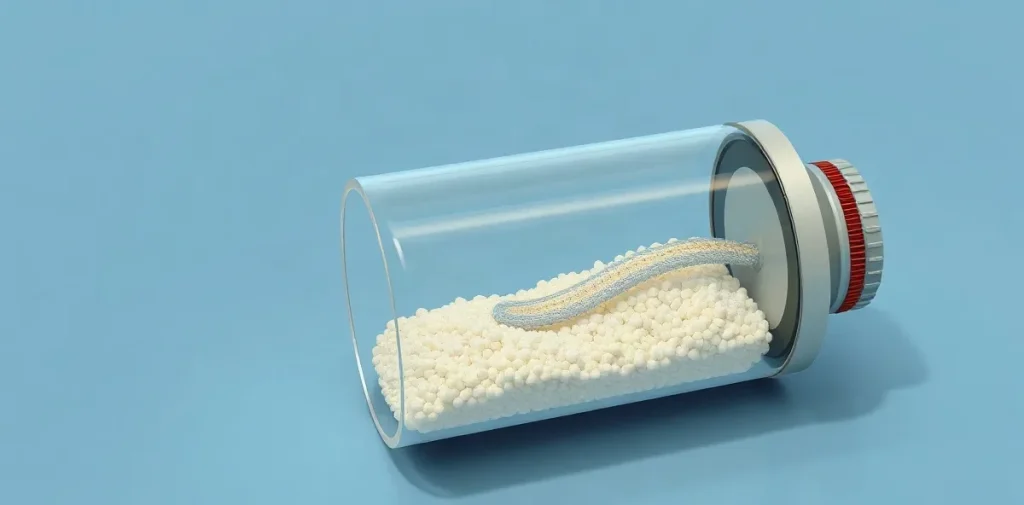
Soda lime safety research examines how the chemical absorbent used to remove exhaled carbon dioxide behaves in diving equipment, including its potential hazards during handling and use. The subject matters because a rebreather depends on effective carbon-dioxide removal, while the absorbent itself must be managed as a reactive material in a confined, life-support system.
Why does a rebreather need soda lime?
In a rebreather, exhaled gas passes through a canister containing an absorbent that removes carbon dioxide before the remaining gas is recirculated. Without that removal, carbon dioxide can accumulate in the breathing loop. The diver then risks hypercapnia, which can impair judgment, cause distress and become dangerous underwater.
Soda lime is a mixture designed to absorb carbon dioxide through chemical reactions. Its performance depends on conditions such as moisture, temperature, gas flow and the way the material is packed. A safety assessment therefore concerns more than the chemical in isolation: it also concerns how the absorbent behaves inside the equipment and how people handle it.
What does “chemical safety” cover?
Chemical safety asks whether a material can harm people or equipment through contact, inhalation, ingestion, heat generation or unwanted reactions. For a diving absorbent, those questions apply across storage, loading, operation and disposal. The distinction between a hazard and a risk is useful: a substance may have an intrinsic hazard, while the actual risk depends on exposure and controls.
Studies in this area can examine the composition and properties of an absorbent, its reactions under relevant conditions, and the routes by which a diver or technician might be exposed. They may also consider whether water or other contaminants change the material’s behaviour. The practical aim is to understand where safe handling and system design need particular attention.
How do researchers examine an absorbent?
Laboratory work can characterise a material’s chemical and physical properties, then test its behaviour under controlled conditions relevant to a breathing system. Equipment testing adds questions that a bench test cannot answer alone: how gas moves through a canister, whether packing is even, and whether operating conditions alter performance.
Common considerations include:
- Exposure: whether dust, liquid or reaction products can reach the skin, eyes or airways during handling.
- Operating conditions: how moisture, temperature, gas flow and duration affect absorption and heat.
- System performance: whether the canister maintains effective carbon-dioxide removal throughout use.
- Controls: how packaging, equipment design, procedures and training reduce avoidable exposure or misuse.
These lines of inquiry complement one another. A material can be chemically suitable yet present handling concerns; a canister can be well designed yet perform poorly if its contents are contaminated, incorrectly packed or used outside the intended conditions.
Why does this matter to divers and clinicians?
For divers, reliable carbon-dioxide removal is a core life-support function, and safe preparation helps protect both equipment performance and the person handling the absorbent. The concerns overlap: poor handling can expose people to a chemical hazard, while problems in the breathing loop can create a physiological hazard during a dive.
Diving physicians and hyperbaric clinicians may encounter symptoms associated with carbon-dioxide exposure or other diving emergencies, but chemical-safety research is not a substitute for clinical assessment. Symptoms underwater can have several causes, and decisions about fitness to dive or treatment require individual evaluation by a diving-medicine physician.
Where does the topic fit in diving research?
Research on soda lime sits at the intersection of equipment engineering, occupational hygiene and respiratory physiology. It belongs alongside broader work on rebreather function, breathing-gas quality, carbon-dioxide retention and human factors. Each field asks a different question, but safe operation depends on their interaction.
The broader lesson is that a life-support material should be evaluated in its working context, not only as a chemical product. If you handle an absorbent, follow the instructions for the specific equipment and product, use the stated protective measures, and check current safety documentation before use.
Frequently asked questions
What is soda lime used for in diving?
Is soda lime safety only a handling issue?
What should I do if I have a health concern after exposure?
An original research-library explainer written by the Rubicon editors. It is not a summary of a specific publication.
Related reading on Rubicon
- Scuba Diving Safety: Skills, Planning, and Hazards
- Diving Safety: Training, Gear, Sites, Risk
- Diving Safety: Key Insights into Underwater Exploration
- Diving: Exploring Underwater Activities, Science, and Safety
- CNS Oxygen Toxicity in Closed-Circuit Diving
- Closed-Circuit Oxygen Diving in the U.S. Navy
- More on Equipment
- Browse the Research Library