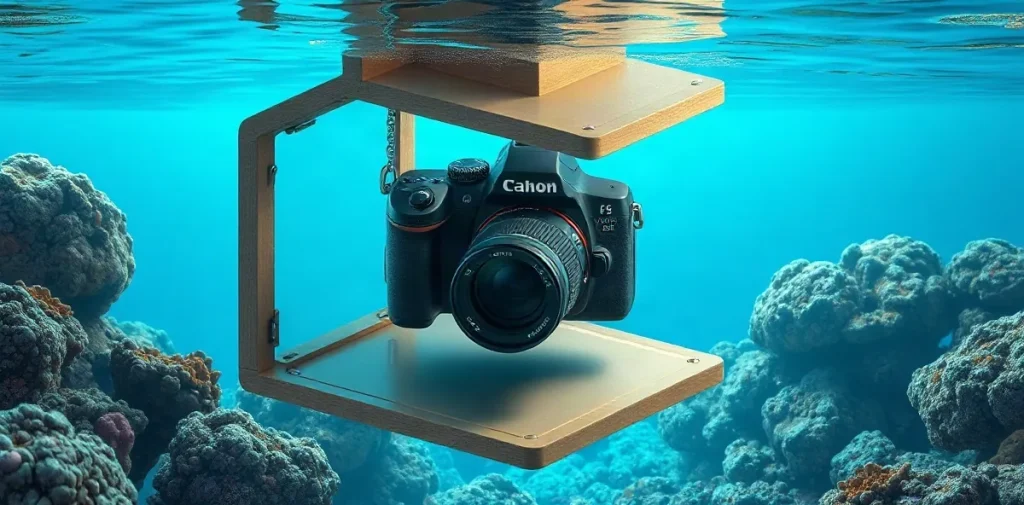
Underwater single-lens reflex (SLR) photography brings together camera automation and optics designed to work in water. Autofocus and automatic exposure help manage changing subjects and light, while water-contact optics address the image distortion created when a camera views the underwater scene through a flat port. These design questions matter both to divers documenting a dive and to scientists relying on usable images.
Why does water change the camera’s view?
Light bends when it crosses between materials with different optical properties. An underwater camera in a housing usually looks through a port: a flat pane or a curved dome separating the water from the air around the lens. A flat port changes the apparent size and position of objects and narrows the camera’s field of view.
A dome port can reduce some of the distortion associated with a flat port, but it brings its own optical requirements. The lens must be positioned and focused appropriately relative to the dome, and close-focus performance can become important. Water-contact optics take a different approach: optical elements are designed to operate in contact with water, avoiding the same air-filled gap at the front of a conventional housed lens.
These are not merely questions of image sharpness. The optical arrangement affects framing, focus, magnification and how reliably a diver can capture a subject in its actual environment.
What do autofocus and automatic exposure have to solve?
Autofocus must identify and track a subject through an optical system that differs from the camera’s ordinary above-water setup. Contrast, distance, movement, suspended particles and low light can all complicate focusing. A diver’s movement and the motion of the subject add another source of change.
Automatic exposure adjusts the camera’s response to the light reaching the sensor or film. Underwater brightness can vary sharply with depth, visibility, direction of light and distance from the subject. A camera’s metering system may also respond differently when a port and underwater optical path alter the scene.
- Focus accuracy: whether the camera can acquire and hold focus on the intended subject.
- Exposure control: whether automatic settings produce usable detail across changing light conditions.
- Optical performance: how the water-contact arrangement affects sharpness, field of view and distortion.
- Operational usability: whether controls and automation remain practical while the camera is housed and used underwater.
How are underwater camera systems evaluated?
Evaluation of an underwater camera is broader than checking whether it takes a photograph. A technical assessment can examine focus behaviour, exposure consistency and image quality across different subjects, distances and lighting conditions. It also needs to consider the complete imaging system: camera, lens, housing or optical interface, and the way they work together in water.
Comparisons are meaningful only when the conditions are clear. Subject distance, illumination, water clarity, camera settings and the optical configuration can all affect the image. A camera that performs well on a stationary, well-lit target may face a different challenge when photographing a moving animal or a scientific detail in dim water.
For divers, handling is part of performance. Access to controls, the time required to acquire focus and the ability to operate the camera without disrupting buoyancy or a task can determine whether a technically capable system is useful on a real dive.
Why does imaging matter beyond photography?
Underwater images support observation when a diver cannot remain at a site indefinitely or inspect every detail directly. Scientific divers may use photographs to document organisms, habitats, equipment or changes over time. For those purposes, consistent framing and focus can matter as much as an attractive image.
Imaging also links equipment research to practical diving constraints. A camera and housing add bulk and require attention underwater; taking photographs can compete with navigation, buoyancy control and other tasks. Better automation may reduce some operating demands, but it does not remove the need to plan the dive and manage the equipment safely.
Water-contact optics belong to a wider history of adapting photographic systems to underwater use. Their value depends on the intended subject and conditions, so divers should assess the whole system rather than treating autofocus, exposure automation or a particular port design as a guarantee of image quality.
Frequently asked questions
What are water-contact optics?
Why can underwater autofocus be difficult?
Are automatic exposure and autofocus enough for scientific images?
An original research-library explainer written by the Rubicon editors. It is not a summary of a specific publication.
Related reading on Rubicon
- The Diving Reflex: What Happens Underwater
- Why Divers Get Cold Faster Underwater
- Diving Safety: Key Insights into Underwater Exploration
- Diving: Exploring Underwater Activities, Science, and Safety
- Underwater SLR Camera with Water Contact Optics
- Hydrodynamic Drag in Underwater Swimming
- More on Equipment
- Browse the Research Library