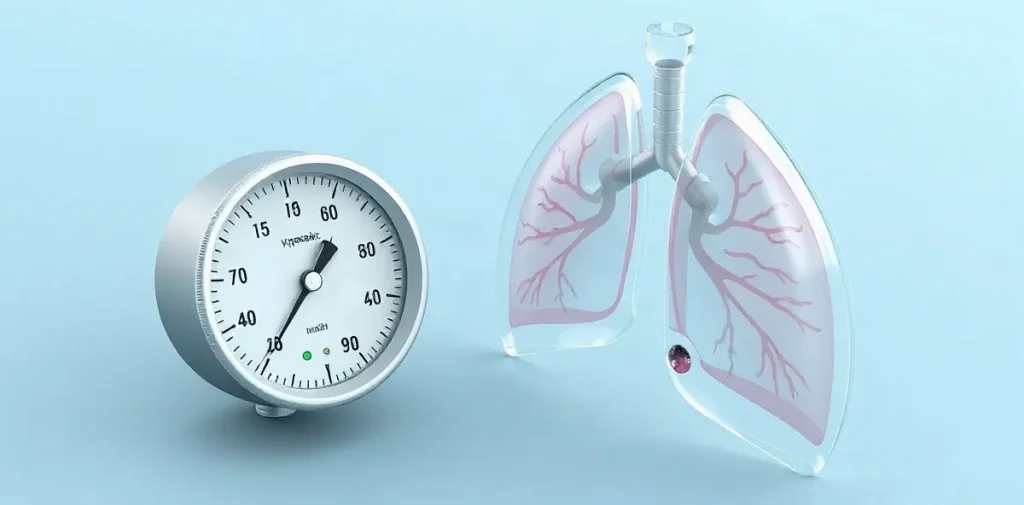
Pneumothorax is air in the space between the lung and chest wall; recompression therapy exposes a patient to increased ambient pressure to treat conditions such as cerebral arterial gas embolism. Their intersection matters because pressure changes affect trapped gas, making lung injury a critical consideration in hyperbaric treatment and diving medicine.
Why do pneumothorax and recompression raise a clinical question?
Cerebral arterial gas embolism occurs when gas enters the arterial circulation and obstructs blood flow, including blood flow to the brain. In diving, it can follow lung overexpansion injury during ascent, when expanding gas damages lung tissue and may enter blood vessels.
Recompression increases pressure and can reduce the volume of gas bubbles, while oxygen under pressure supports treatment of gas-related injury. A pneumothorax presents a separate concern: gas trapped outside the lung may change volume as pressure changes, and can impair breathing or exert dangerous pressure within the chest.
The clinical problem is therefore not simply whether recompression is useful. It is how to weigh urgent treatment of a gas embolism against the risks associated with an existing or suspected lung injury.
How does pressure affect gas in the chest?
As ambient pressure rises, a gas pocket tends to shrink; as pressure falls, it tends to expand. The rate and safety of those changes depend on the surrounding anatomy, the amount and location of gas, and whether gas can move through an opening or escape.
A pneumothorax can be small and stable, or it can progress to a tension pneumothorax, in which pressure builds in the chest and compromises breathing and circulation. Rapid changes in chest pressure can also affect the injured lung. These mechanisms make the pressure profile and the patient’s condition central to clinical assessment.
- Arterial gas embolism: gas in arterial vessels can obstruct blood flow and cause acute neurological symptoms.
- Pulmonary barotrauma: lung injury caused by pressure differences, including overexpansion during ascent.
- Pneumothorax: air between the lung and chest wall, with potential to enlarge as ambient pressure falls.
- Recompression: treatment in a pressurised chamber, followed by a controlled return to surface pressure.
What does research in this area examine?
Work on this problem sits at the intersection of diving injury, emergency medicine and hyperbaric treatment. It asks how clinicians identify lung injury in a patient who may also need time-sensitive recompression, and how treatment decisions account for both conditions.
Studies and clinical reports in this field may examine the sequence of symptoms, physical examination and imaging; the presence and extent of pleural air; and changes during compression and decompression. They also consider how clinical interventions, chamber access and monitoring shape risk management. The relevant evidence can include case descriptions and physiological reasoning as well as broader clinical research.
These questions connect to wider work on pulmonary barotrauma, decompression illness, gas embolism and chamber protocols. They are especially important because a symptom such as breathlessness can have more than one cause after a diving incident, while neurological signs may signal a separate emergency.
Why does the issue matter beyond the chamber?
For divers, the subject underscores why a suspected lung injury after ascent requires prompt medical assessment, rather than being treated as an isolated breathing complaint. For diving physicians and hyperbaric clinicians, it highlights the need to consider pulmonary and neurological injury together when deciding how to stabilise and treat a patient.
Scientific divers face the same underlying physiology as other divers, even when their work takes place in planned research operations. Dive planning, ascent practice and emergency readiness all help reduce the chance that a pressure-related lung injury will complicate an already urgent medical problem.
Suspected arterial gas embolism or pneumothorax is an emergency. Treatment decisions depend on the clinical picture and available facilities; a diving-medicine physician should guide assessment and care.
Frequently asked questions
What is a pneumothorax?
Why can recompression be complicated by a pneumothorax?
What should a diver do after suspected lung barotrauma?
An original research-library explainer written by the Rubicon editors. It is not a summary of a specific publication.